Friday, November 25, 2016

One War Unto The Next

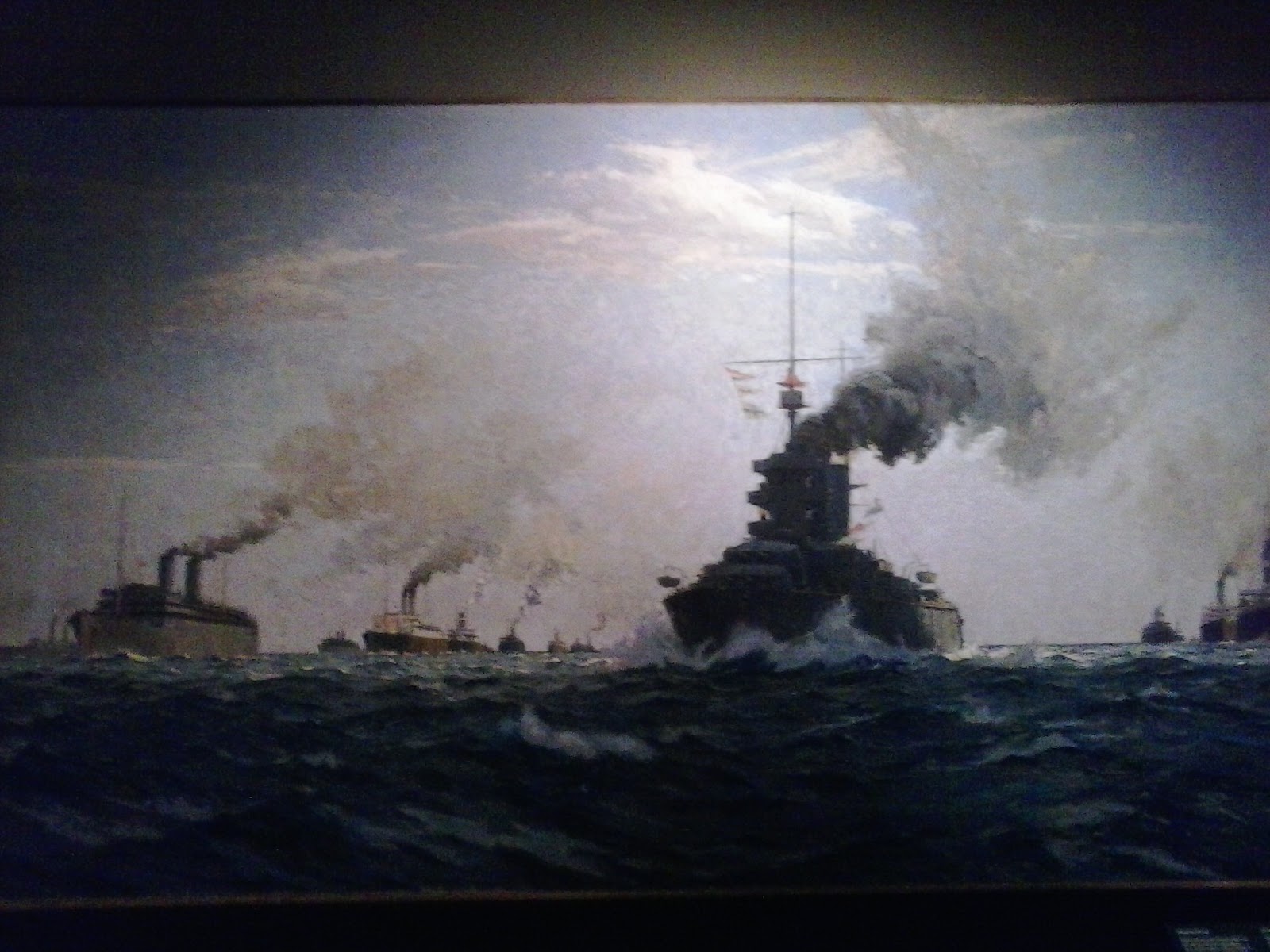
Carrying on with my series from the War Museum, this painting is of Halifax harbour during the war, with warships painted in the dazzle effect design. It accompanies displays and artifacts about the Halifax Explosion.


Theses are in the section that deals with the impact of the war at home. This clock was made by a clock company, Arthur Pequegnat Clock Company, which was founded in 1904 in Berlin, Ontario. As you can imagine during the war, there was a good deal of resentment about German names, and the town changed its name to what it's known as today, Kitchener, Ontario, now a city west of Toronto. The contents here also include a record player, children's books, and a display panel of newspaper headlines.


This combination of vehicle and war art caught my interest near the end of the World War One area. As you can imagine, it was a busy place that day, so you can't always get shots without people, though I think it's encouraging that the kid was absorbed in what he was seeing.


Moving on into the Second World War exhibit space, the first thing that meets your eye is this armoured Mercedes Benz limo. It was one of several owned by Hitler, and this first portion puts the world into context in the 1930s as to what the Axis powers were engaged in. As a military veteran and museum volunteer mentioned in a conversation in this area, the twenty years between the two wars wasn't really peace- it was just the calm between two storms.


Set in a display case is this device, one of the things that won the war. It's an Enigma device, which allowed the Allies to decode German communications.


Moving on, there's also a section here that also deals with the impact of the war at home, with multiple subjects. This wall of posters always catches my eye, as does the store window display, though I must wonder... how could anyone get by on that little bit of sugar? That's less than what I have in my tea in a given week!

Thursday, November 24, 2016

War Above And Below

As mentioned yesterday, the special exhibit going on in the War Museum at the moment deals with the skies over Europe during the First World War. New tactics and strategies for a brand new technology were literally being invented at the spur of the moment by young pilots. Their stories are presented in a series of panels that are rather like graphic novel or comic strip formats, which provides a different way of telling the story. There are also artifacts on hand, such as this Sopwith plane.


One of the panel displays tells the story of the German ace otherwise known as the Red Baron. The last time I was in here, I looked it over, but didn't photograph it. There's controversy as to who it is who actually killed him- Australian infantry on the ground or a Canadian pilot he was caught in a duel with. Even though he was on the other side, Von Richthofen was an extraordinary man.


This is a Royal Navy Ensign flag carried by a Canadian pilot, Henry Wiser, when he landed at an Ottoman aerodrome on the Gallipoli peninsula, the first officer from the British empire to do so after the armistice.


There was also a chance to try on period items to see how you'd look. While my oversized head was too big for a leather pilot's helmet, two different pairs of goggles did fit. Yes, I look thoroughly disreputable.


The main exhibit space of the museum starts off with the earliest recorded signs of human conflict between First Nations peoples, and moves forward in time through wars that Canadians have been involved with to the current day.

This stetson hat is a relic of the South African War that straddled the 19th and 20th centuries. A Canadian named George Roberts placed it on an ant hill to draw out a Boer sniper. There's a hole you can make out at the top that shows the skill of the shooter. The cannon is also from that war, a 12 pounder field gun used at the Battle of Lefliefontein.


This painting is one I've always liked, one of numerous examples spread throughout the Museum of war art. Norman Wilkinson painted this during the First World War, titled Canada's Response, depicting the convoys ferrying Canadian soldiers to the battlefields of Europe in 1914.


This is another work of art that some of you might remember, titled Canada's Golgotha, sculpted by artist Derwint Wood in 1918. It is based on an apocryphal rumour that during the Second Battle of Ypres, German soldiers had crucified a Canadian soldier on a barn door in Belgium.


The sculpture is part of a section dealing with propaganda, which also includes a panel on the murder of British nurse Edith Cavell (for whom a mountain in Canada is named), and a porthole and mementos related to the sinking of the Lusitania.


I finish today with this set. There are a series of such display cases in the First World War section dealing with the everyday life of a soldier- these are about good luck charms. Private John Steele's pocket bible and mirror saved his life when he was shot in the chest during the war. He gave them for luck to a brother-in-law, Private Wilbert Willan- who survived the war- but Steele himself died on the first day of the Battle Of Vimy Ridge, on April 9th, 1917.

Wednesday, November 23, 2016

At The War Museum

The present Canadian War Museum dates back to 2005, replacing an older one up beside the National Gallery after the collection had outgrown its confines. It has the shape and feel of a bunker or a battleship, depending on your point of view, and is ideally suited for its subject. It presents the story of Canadian military history as well as the context of global affairs. It rises up out of the ground on its west end, featuring grasses on its rooftop, and rises to a prominent spike on its east end, pointing towards Parliament Hill. I headed up onto the roof for the views- the pathway up there has the feel of a trench in its design, and features views of the grassy roof, as well as vantages of Parliament Hill to the east, and the nearby Ottawa River and Gatineau to the north.


As you can see, fall colours were still prominent along the riverside.


Typically on Remembrance Day in the large entry hall, one can find various displays. This year the emphasis was on the experience of black soldiers in the Canadian military down through time, including a series of panels on specific people, such as this man. I chatted with a couple of people who were manning the tables. One of them mentioned a black soldier who was part of the joint Canadian-American special operations force known as the Devil's Brigade. The other related the story of a man who was a decorated sergeant major whose family happened to live in the same town near where I grew up, as well as an officer who started out as a surgeon and wanted to be a military pilot- and did just that.


Memorial Hall is one of the two axis points of the entire museum, which is designed to be based around them. The room is stark and quiet, featuring a reflecting pool on one side and the tombstone of the Unknown Soldier on the other, topped with poppies on this occasion. The architects designed the building so that at eleven in the morning on November 11th, sunlight will be coming through an overhead window, illuminating the tombstone at that precise moment. I have no idea how they'd figure that out.


Emerging from the Memorial Hall and back into the entrance hall, I photographed this harpist playing. She might well have been the same musician playing last year in Regeneration Hall, and she was one of several musicians placed here and there in the museum that day.


The special exhibit going on at the museum is on the air war in Europe during the First World War. 


For those of us who are photographers, a relic from the past was in this exhibit. This Kodak camera was carried by a Canadian pilot back in the day. 

Tuesday, November 22, 2016

Memorial Vantages

After the ceremony at the War Memorial (and spending a few minutes getting warmed up), I headed west towards the Canadian War Museum as the clouds were breaking up. Along the way I stopped at the National Firefighters Memorial, where the names of over 1300 firefighters fallen in the line of duty are inscribed on the wall, overseen by a very large statue of a firefighter. I featured this year's national service here, here, and here if you happened to miss those posts.


I wanted a side view of the wall, to show the vegetation that grows on the north side of it. For good measure, the Library and Archives Canada headquarters and portions of the Parliament Buildings made it into this shot.


Across the street from the Memorial is another one that is under construction, standing between here and the museum, which you can see in the background. This is the National Holocaust Monument, presently a work in progress, a stylized but formidable memorial from the looks of the conceptual drawing. I'll be back here periodically to document the process of its construction.

Monday, November 21, 2016

Commemoration

I'm starting today with a series that I took on Remembrance Day earlier this month, featuring first the ceremony at the National War Memorial, which had military pipes and drums musicians lead out the veterans towards the Memorial. The service includes two minutes of silence at the eleventh hour, prayers in both official languages as well as a First Nations language, music, the firing of cannons, an official flypast, and the laying of wreaths at the Memorial. The crowds, as always, were large, showing support and appreciation for the veterans. Those surviving veterans of the Second World War are less in number each year.


After the service was finished, the veterans returned up Elgin Street and came around onto Wellington for the march past the Governor General, a formal salute that continues to carry on through time. They were followed by active members of all of the service branches, members of the Ceremonial Guard and the Highlanders, cadets of the Royal Military College in Kingston, and members of the Royal Canadian Mounted Police. There were even service dogs among the ranks of the veterans.