Thursday, August 26, 2021

Nefertari

 I left off yesterday with Queen Tuya, mother of Ramses II. This panel looks into more about her.


Here we have fragments including hieroglyphs. 


These are fragments of what might have been a sedan chair, thought to carry a statue of the deified queen Ahmose-Nefertari.


There was a space set inside with artifacts, a display space for items from the tomb of Nefertari, the favourite wife of Ramses.


Small artifacts were displayed in the walls: jewelry, jars, and figurines.


This included a replica of the capstone for her sarcophagus.

Wednesday, August 25, 2021

Ramses

 Carrying on, here we have the greatest of all the pharaohs, Ramses II, sitting between the god Amun and his wife Mut. 


This statue is thought to be Thutmose I.


This bust is of Isenofret, another of Ramses' wives.


Nefertari was the favourite wife of Ramses.


This model of her temple is here.


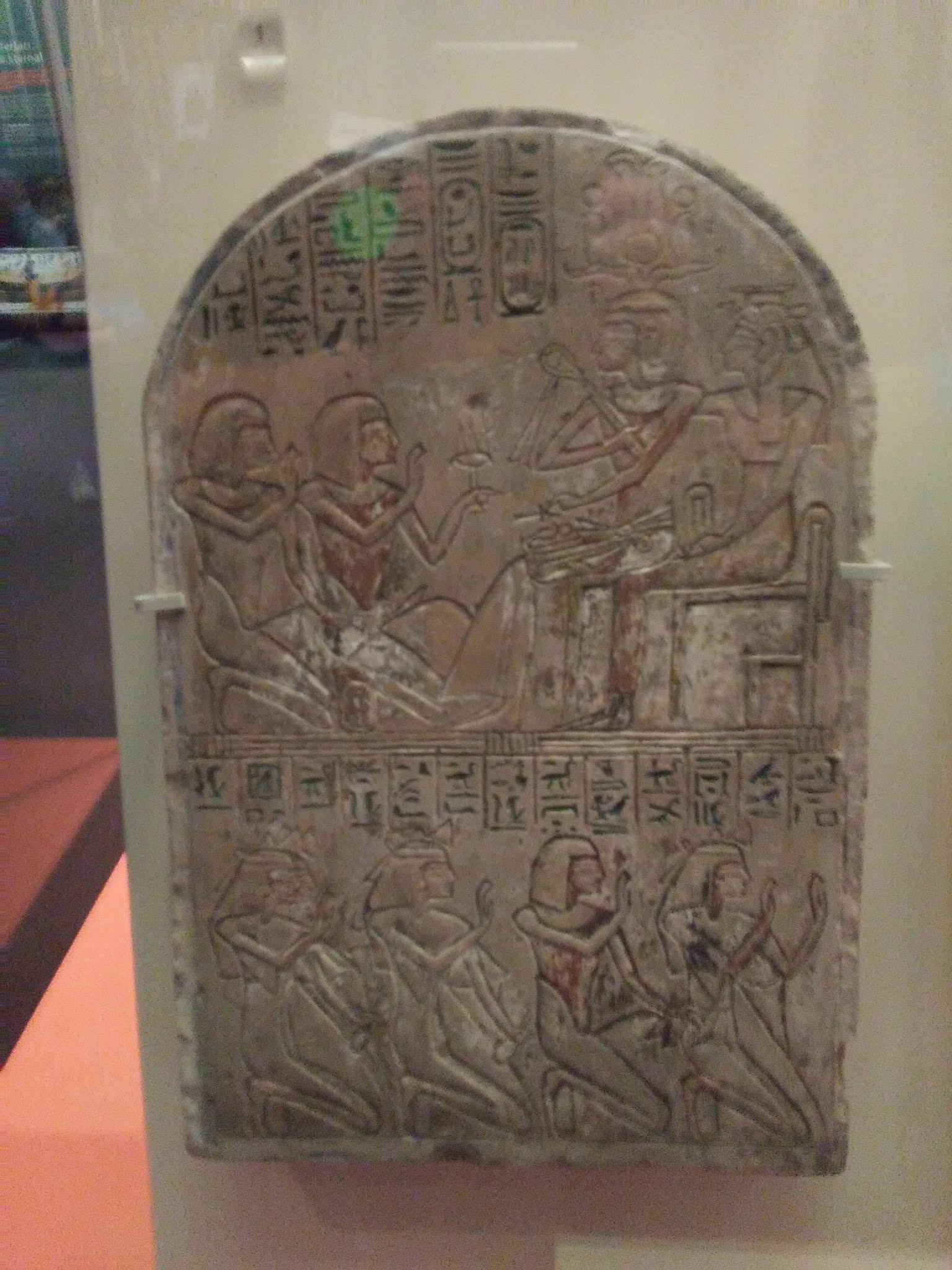
Artifacts linked to Ramses or his mother Tuya. They include scarab jewelry and small statues and votives.

Tuesday, August 24, 2021

Egypt

 I was particularly taken with a display area set up like a temple. Sekhmet was a lion headed goddess of the Egyptians, and this area included several large statues of her. Mirrors gave the illusion that there were many more statues.


One of the video projections I mentioned a couple of days ago, this one featuring what a temple of the period might have been like.


Close by, artifacts honouring the gods and goddesses, like a votive or a statue, both of a religious nature.


Another look at Sekhmet.

Monday, August 23, 2021

Egypt

The queens of Egypt exercised considerable power, associated with goddesses in the same manner that their husbands were associated with gods.

More artifacts of the times: busts, fragments of hieroglyphs, amulets, and figurines, some of which are associated with Queen Tiyi.


This is a portion of the face of a larger statue of Amenhotep III, pharaoh and wife of Tiyi.


The wooden statue in the foreground depicts Tiyi in the aspect of the goddess Tawaret.


Tiyi and Amenhotep would be succeeded by their son Amenhotep IV, who would later take on the name Akhenaten and radically transform Egyptian religious life during his reign, only to have his measures revoked and his name stricken from Egyptian history by later successors. His wife was Nefertiti. Akhenaten's son would be one of the most famous pharaohs of history, largely because of the discovery of his tomb in the modern era: Tutankhamun.


This is a replica of her bust.

Sunday, August 22, 2021

Queens

 The Queens of Egypt exhibit at the Canadian Museum of History comes to an end today, but my recent visit allowed for me to take it in and start presenting it to you now.


The exhibit looks at several queens from the New Kingdom period of 1539-1076 BC, their role in ancient Egypt, and the legacy they left behind. Ancient Egypt has always fascinated me, so of course I had to come see it.


The first artifact one sees upon entry is this bust of the goddess Mut. 


Beyond it is a large video projection: something quite contemporary that shows itself several times through the exhibit. The Assassins Creed video game concept includes scenarios set in ancient Egypt, and some of their footage is projected at various points of this exhibit, making one feel as if they're looking into ancient Egypt. We'll see more of them throughout this exhibit as I go along.


Hatshepsout was a queen who served as a pharaoh upon the death of her husband Thutmose II and took the name Maatkare


Artifacts linked to her time are here, including tools and decorative gems in the shape of scarabs.