Showing posts with label John Franklin. Show all posts

Thursday, April 9, 2026

Lost Into The Mists Of Time

 This topographical map of the Arctic includes the Arctic circle, as well as lines denoting the tree line, permafrost, and average distribution of sea ice.


Indigenous peoples of the Arctic are beyond those in North America- northern Europe and Russia have distinctive indigenous peoples.


This display case includes items of the Canadian Arctic Expedition, a scientific venture that spent some years in the first quarter of the 20th century exploring the Arctic.


While this display case includes remnants of an earlier expedition. Captain John Franklin took two ships, the Erebus and the Terror, in search of the Northwest Passage in the 1840s and disappeared into the mists of time. A handful of graves were found along with artifacts like this, but most of the expedition disappeared. The ships themselves were only found in recent years in shallow Arctic waters.


A section of the Arctic Gallery is given over to a rotating series on people and places in the North. At present, that is on Qikiqtait. Also known as the Belcher Islands, this is an archipelago in the vastness of Hudson Bay. Inuit people live off the land in this place, and the display area looks at their way of life and culture. As I was passing through this area, a woman was with her daughter, pointing at a specific house in a large photo of a village, and saying that was where she had grown up. 


The common eider is an essential part of life for these people- the down from their feathers is very, very warm.

Thursday, May 1, 2025

City Daily Photo Theme Day: Very Small

The first day of each month is a theme day for members of City Daily Photo. For May, that theme is Very Small. See how other members of the group are interpreting this theme right here.

I start with a couple of shots from the Canadian Museum of Nature back in January- photographs taken in the Arctic Gallery of lifeforms, algae and phytoplankton. They are very small indeed- the width or twice the width of a human hair.


Also in the same gallery in the Museum, these are items recovered from the Franklin Expedition- the ill fated 19th century British voyage under John Franklin in search of the Northwest Passage in the Canadian Arctic. It's been only in recent years that the two ships Erebus and Terror were found.


Another small thing, and in the same museum, but this time in the Earth Gallery. This is a piece of the Moon.


Further along in the Earth Gallery, this small specimen. Amber is fossilized tree resin, and this one preserves ancient insects.


And further along, three examples of the building blocks of sedimentary rock, and just how small they can get.


Further along in the Museum, in the Water Gallery, this jar contains preserved krill- tiny creatures that are the favourite food of the blue whale, the largest animal on Earth.


These are from home. As the expression goes, my people were Dutch. These small wooden shoes are fridge magnets on my fridge, from a Dutch shop out in Nepean. I stop by regularly for spiced Gouda cheese, which is one of life's pleasures.


I've got another one that's a keychain, usually hanging on my roll top desk at home.


These two are also keychains, and kept in one of the cubbies of that desk. These are actually Lego. I relate to Eeyore.

Tuesday, January 14, 2025

Far North Mysteries

 I start today with the skull of a mammoth.


This depicts the Jefferson's ground sloth, a three meter long animal that died out after the last ice age.


Another animal that passed into history after the ice age- the short haired bear, even bigger than the polar bear.


This is a contemporary sculpture, Inuit style. The snowmobile has become an essential part of life in the Arctic.


A large three dimensional map of the top of the world is here, with various lines denoting things like the tree line, but the most important line is in white- the Arctic Circle.


The Canadian Arctic Expedition was an extensive scientific mission into the Arctic from 1913-18 to document the Far North. Some of its artifacts are seen here.


An earlier voyage into the North, and one that met with disaster- the Franklin Expedition. John Franklin was commissioned to take two ships, the Erebus and the Terror, in search of the Northwest Passage. These artifacts were found on King William Island in the 1990s, remnants of that expedition, one of the great mysteries of all times. The sunken wrecks of the ships were only found in the last decade in cold Arctic waters, with the assistance of Inuit people. While some graves of the Franklin Expedition were discovered during the many searches for them, John Franklin himself has never been found.


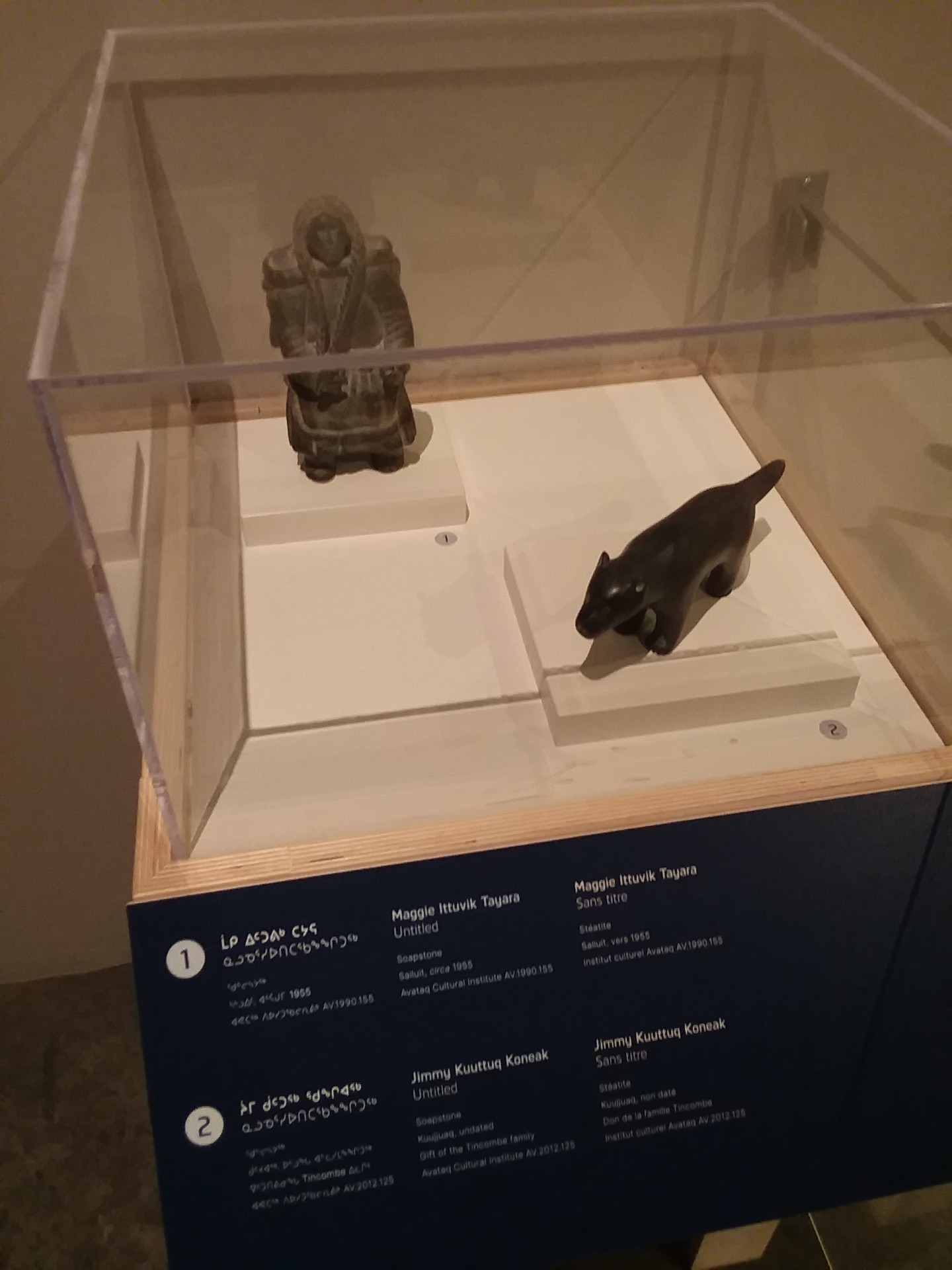
Here we have Nunami, by Taqralik Partridge. This is a traditional amautik, a woman's parka of the Inuit. It is paired with two sculptures below.


Photographs rotate through of life in the Far North.

Sunday, July 23, 2023

Polar Bear

Moving along, here we find an impressive resident of the North: the polar bear. 


The last great ice age saw the cooling of temperatures in the far north and different species emerge.


This is the skull of a mammoth.


Illustrations here include extinct animals of North America that ranged far into the northern reaches of the continent.


Here we have a three dimensional model of the Arctic.


Explorers would venture into the Arctic- some seeking knowledge, others seeking trade routes and riches.


Here we have items of the Canadian Arctic Expedition, a scientific endeavour that spent several years ranging through the North from 1913-18, learning much along the way.


A few decades earlier, the ill-fated Franklin Expedition went into northern waters and disappeared into the mists of time. The Erebus and the Terror, sailing under the command of Sir John A. Franklin in 1845, would be found in 2014 and 2016 in shallow Arctic waters. Some of the bodies of the men have been found, while other artifacts have been collected in the decades of searching for the ships and their crew. Items here from the expedition include things like a pipe, toothbrush, fish hook, or sheath. The story captivated the public back in the day, and the discovery of the ships has added on a new chapter to that story.


Of course, before white explorers, indigenous peoples had long been here. Items here include arrow shafts and tools.