Showing posts with label Andrew Mynarski. Show all posts

Thursday, February 15, 2024

A Centennial

Today I begin my series for Winterlude, and in a bit of an odd spot. Last year, the Canadian Forces joined in with an exhibit and ice sculpture on the grounds at the National War Memorial. It appears that they've decided to make the idea a tradition, as it's back this year. 2024 marks the centennial year of the Royal Canadian Air Force, founded in the years after the First World War. This was being projected onto the pavement.


A series of banners looks at aspects of the history of the Air Force, including NORAD, a joint partnership operation with the USAF that dates to the 1950s.


This includes individual profiles, such as Major Stephen Blizzard.


Two generals of the RCAF- Paul Manson and Bill Carr.


Women trailblazers of the RCAF are found here. Jane Foster and Dee Brasseur were the first female fighter pilots of the Forces. Karin Lehmann was the first female aircrew member in Canadian history to fire at the enemy from a helicopter during the Gulf War.


The RCAF have given rise to the Snowbirds, the squadron that does flying tours to demonstrate their exceptional flying abilities to the public.


When Canadians went to war as part of Desert Storm, Canadian fighter jets were part of that, and would fire on the enemy for the first time since the Korean War.


Colonel Jeremy Hansen is set to be the first Canadian astronaut to journey to the Moon later this year as part of the new Artemis program. Chris Hadfield, a former RCAF pilot, was a commander of the International Space Station, and made a big impression on the world during his last time on the ISS.


When Canadian participation ended in the Afghan War, it was the RCAF who brought the soldiers home.


During the First World War, Canadian pilots generally flew with the British, and the RAF was really the Royal Flying Corps, a part of the British army at the time. Canadian pilots like Billy Bishop became aces and legends.


During the Second World War, more examples of fortitude from those who served in the RCAF. Andrew Mynarski, seen second from left, was decorated posthumously with the Victoria Cross for his actions on his doomed bomber soon after D-Day. Willard Bolduc, an indigenous man from Ontario, became an air gunner during raids over Europe, and won the Distinguished Flying Cross. Leonard Birchall, at right, spent years as a POW after being shot down over the Indian Ocean, and later served in command positions with the RCAF.


One of the other functions of the RCAF is in search and rescue.


During the Korean War, some Canadian officers were seconded to the USAF.

Thursday, January 13, 2022

The Skies Of Europe

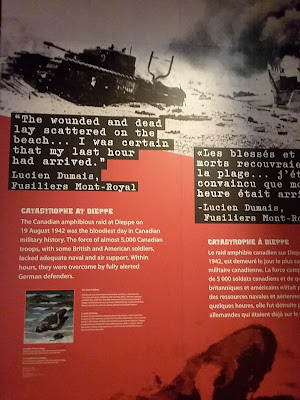
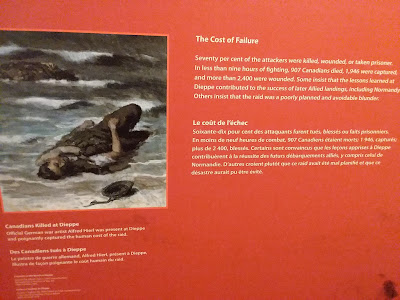
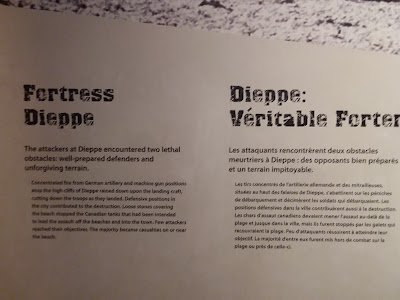
The Dieppe Raid took place on the 19th of August, 1942, the first real test of Hitler's Atlantic Wall at the port of Dieppe, France. Canadians, along with some British and American soldiers, took part in the attack, which failed, with over nine hundred Canadians killed and thousands more wounded or captured. Allied planners would learn from the raid, however, and apply those lessons to invasions of North Africa, Italy, and Normandy. 


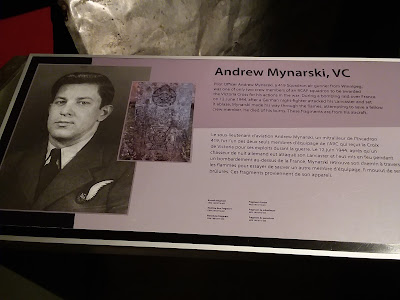
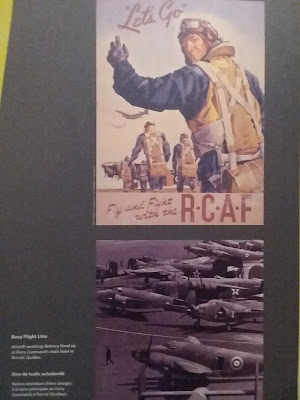
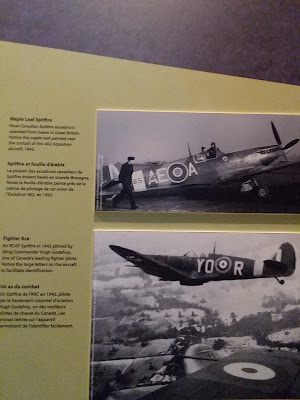
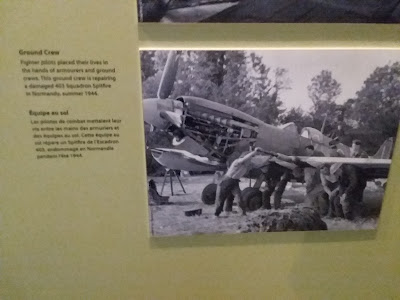
The Royal Canadian Air Force took to the air of Europe alongside other Allied air forces, bombing enemy targets and engaging the Luftwaffe. Andrew Mynarski posthumously won the Victoria Cross for valor in trying to save the life of a fellow crew member aboard his Lancaster. Pieces of the wreckage are displayed behind the panel.


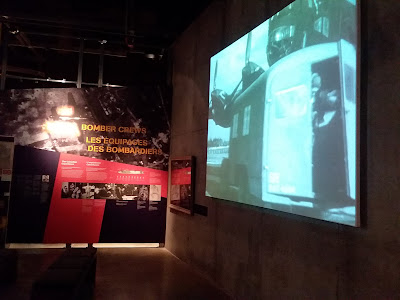
The bombing campaign occupies space here, with a large video screen featuring images of the period.


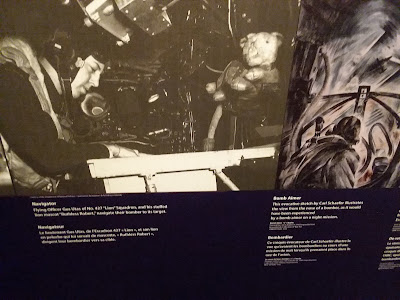
The display panel beyond includes a photograph of a navigator and the plane's mascot, a formidable fellow named Ruthless Robert.


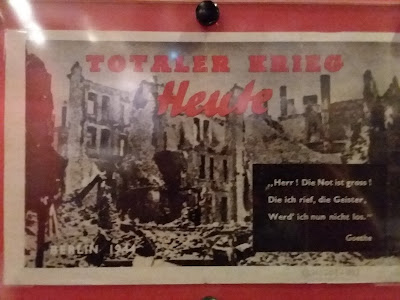
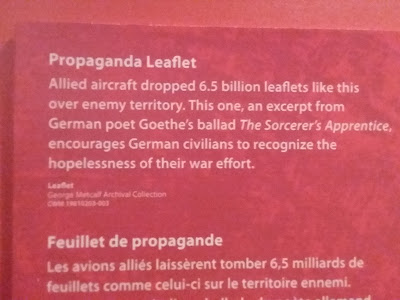
Allied bomber crews didn't just drop bombs. Leaflets were dropped over enemy territory.


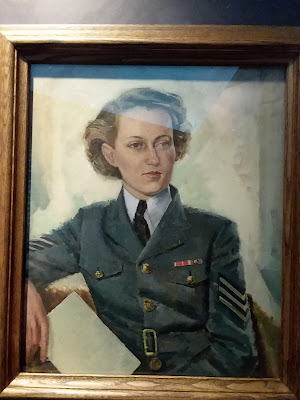
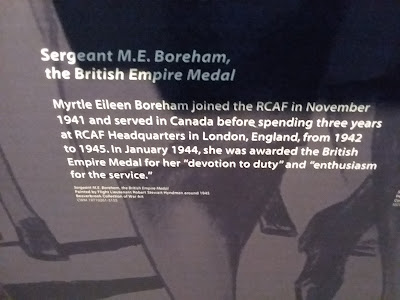
I finish today with this marvelous portrait by Robert Hyndman. Sergeant M.E. Boreham, The British Empire Medal, features Canadian Myrtle Boreham, who spent the war as part of the RCAF.

Tuesday, July 29, 2014

Warriors

The Valiants encircle the staircase leading down from Plaza Bridge. The top of the War Memorial can be glimpsed in the background; the site has been undergoing some work in recent months, but will soon be reopened to the public. Here I wanted a wider shot.


This rather large statue commemorates General  Sir Arthur Currie, who planned the attack on Vimy Ridge and led Canadian forces through much of the First World War.


Pilot Officer Andrew Mynarski was an air gunner on a Lancaster bomber during the Second World War. The plane had been hit in action, and was on fire; he was awarded the Victoria Cross posthumously for his attempts to save a trapped comrade (who survived the crash).

And this last member of The Valiants is Lieutenant Hampton Gray, a pilot who served all over during the Second World War, from Africa and Norway to the Pacific theatre. He won the Victoria Cross posthumously for his successful attack on and sinking of a Japanese destroyer on August 9th, 1945, in Japanese waters. He was thus one of the final Canadian casualties of the war, and has the unique distinction of being the only foreign military serviceman to have a memorial on Japanese soil, near the site of that engagement at Onagawa Bay.