Showing posts with label Georgina Pope. Show all posts

Saturday, November 22, 2025

Call Of Empire

The British empire at the end of the 19th century could be found around the world.


Queen Victoria had seen the British empire through a long and distinguished reign.


Here we have items from her Diamond Jubilee.


In South Africa, two breakaway republics tried to assert their own independence. Dutch-descended farmers called Boers challenged British authority in two wars. Canadians would get involved in the second one as part of the empire. Eventually, seven thousand Canadians served.


This is the hat of a Canadian soldier, who placed it on an ant hill to test the accuracy of a Boer sniper. Note the hole near the top.


Uniforms had changed, with earth tones dominating the colour. In an age of increasingly accurate weapons, fighting in red serge was a thing of the past.


This field gun saw action at the Battle of Leliefontein. In time, the empire would win the war, but it became a guerilla conflict, with the Boers striking and running away.


This is the medal set of Georgina Pope, a nurse who served in the South African War with distinction, and later the First World War. She would become the first matron of the Army Medical Corps, with responsibility over all nurses.

Monday, November 28, 2022

Warfare On A Larger Scale

 This field gun is a veteran of the South African War, where it saw service at the Battle of Leliefontein. Three Canadians won Victoria Crosses in that battle for extraordinary bravery under fire.


Georgina Pope served as a nurse during the South African War. She would continue on in that duty afterwards and see duty in the First World War, coming to command Canada's nurses in military service.


This Colt revolver was the personal revolver of one of those who won a Victoria Cross at Leliefontein: Richard Turner. It really isn't too different from a contemporary version.


Following the South African War came the build up towards the First World War. A large area introduces us to the causes of the conflict. Canada, as part of the British empire, would automatically be committed to the war, which would see conflict on a larger scale than ever seen before.


Here we have the uniform of a typical Canadian recruit from early in the war.


This large painting has always appealed to me. Canada's Answer is by Norman Wilkinson, and depicts the sailing of the first contingent of 32 000 soldiers for Europe in October 1914.


A few years difference between this field gun and our first one from the South African War, but advances were obvious. Artillery fire of the war was one of the real killers of the war. Canadian soldiers would first see combat at the Second Battle Of Ypres. The quotes on the wall to the right speak volumes of that battle.


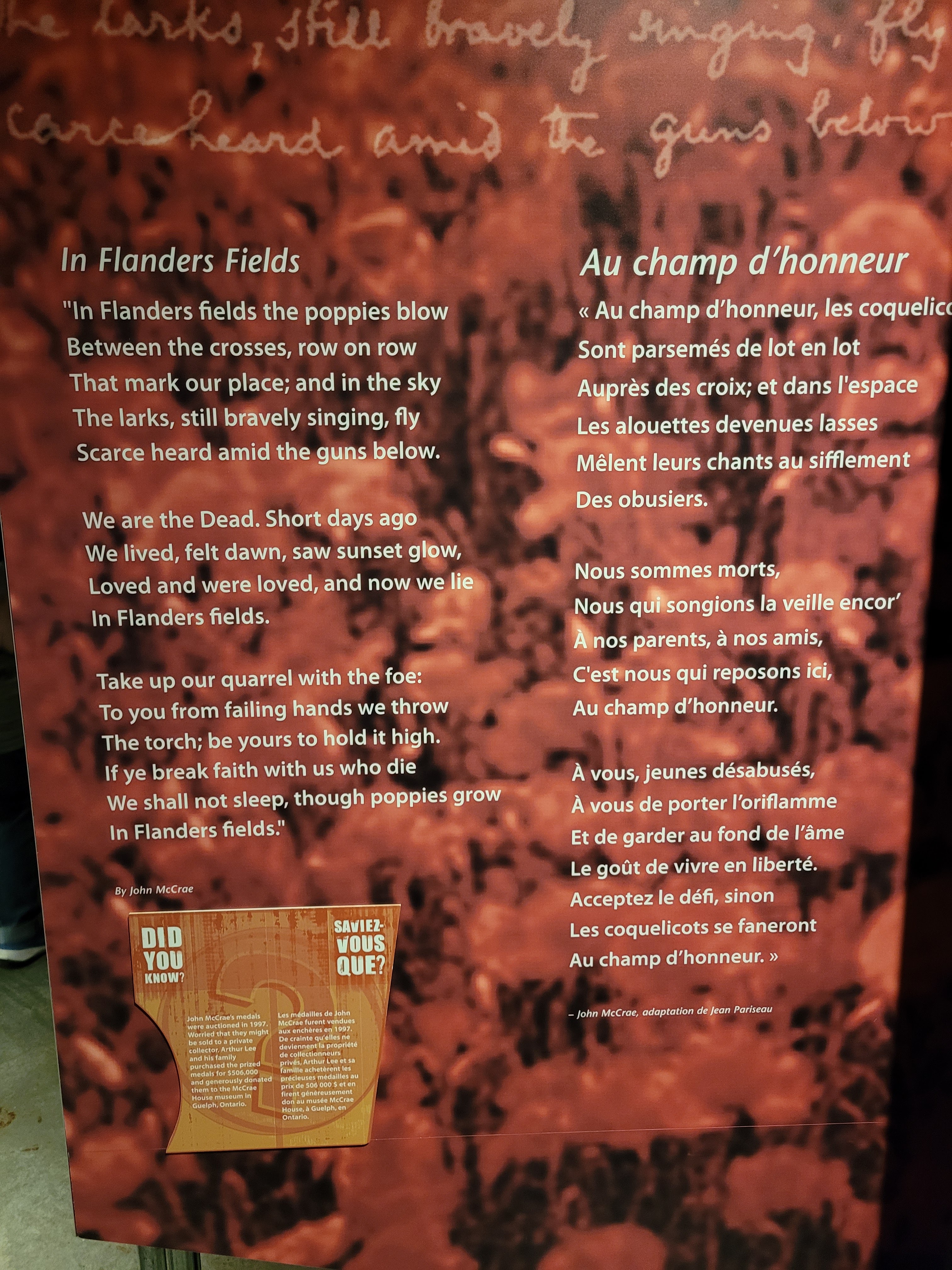
Canadian doctor, poet, and soldier John McCrae had served in the South African War, and came back for the First World War. At Ypres a friend was killed in combat. In Flanders Fields was McCrae's response.


His personal pistol is displayed here too.

Wednesday, December 15, 2021

Honoured By A Queen

 Below we have artifacts: a Canadian rifle and a distinctive scarf. Canadian Private Richard Thompson was the only Canadian recipient of the Queen's scarf; Queen Victoria knitted eight of these over the course of the South African War in honour of battlefield bravery.


Here we have a veteran of that war, a 12 pounder field gun used at the Battle of Leliefontein.


Georgina Pope was a nurse who signed up for duty in the war, and would later do it again in the First World War.


The South African War ended in victory after a prolonged but doomed guerrilla effort by the Boers. 7000 Canadians fought in the war, which is so often overlooked, if only by the fact that just a few years later the entire world would be drawn into the abyss of the Great War.


In its wake new challenges arose in the country as the Canadian government asserted more of a role in national defence. This included the establishment of the Navy and more building of military installations.


Here we have two editorial cartoons going back to the time of the debates over the establishment of the Navy.

Thursday, November 21, 2019

Empires

The War Museum's story carries on after the War of 1812, dealing with other military issues of the 19th century in Canada. I'm picking up with the second gallery, which moves into the idea of fighting for Queen (or King) and country in two different conflicts. The first is the South African War, otherwise called the Boer War. Thousands of Canadians went far from home to fight in what would become a guerrilla war as the 19th century gave way to the 20th, battling the forces of Boer states in South Africa. This conflict is covered extensively.


One of the panels here looks at Georgina Pope, a nurse who would serve with distinction during this war and the First World War. She is among the figures of Canadian military history featured in the Valiants statues downtown near the War Memorial.


Of course the other war in question was the so called War to End All Wars. In 1914, Canadians rallied for the cause, not knowing what was to come in the battlefields of Europe.


Art is featured extensively through the museum, including this large canvas. Canada's Answer is the title of this painting by Norman Wilkinson, depicting the country's First Contingent, 32 000 soldiers heading for Britain in October 1914.


The 18 pounder field gun was the most common type used by Canadian and British military forces during the war. An estimated 100 million shells were fired from guns like this over the course of the war. 


Another prized artifact. This is the personal Colt pistol of Lt.-Colonel John McCrae.


A walk through reproduction of a trench is found here.


Canadians took part in multiple battles throughout the First World War, developing a fierce reputation along the way. Vimy Ridge would be a watershed moment in the country's history, with Canadian soldiers emerging victorious against a tenacious German force. Vimy Ridge is covered extensively in this area.


The First World War was the first time aircraft were used in combat. Tactics were invented as pilots went along. Many of them died. Others survived. One of the Canadian aces is William Barker, whose medal set is displayed here.