Showing posts with label Isaac Brock. Show all posts

Thursday, November 20, 2025

Frontier War

 At the beginning of the American Revolution, rebels attempted to invade Quebec, as the city commanded control of the St. Lawrence and was deemed to be the key to the continent. They were driven out.


The Revolution would create two countries. The thirteen colonies would become the United States. And Loyalists would leave, going north into what was still British territory, and become Canada.


Loyalists included Richard Pierpoint, an escaped slave who joined Butler's Rangers, a force of men who fought against the Americans. After the Revolution, he went north, and fought again in the War of 1812.


Here we have weapons of both wars.


This is a model of the HMS St. Lawrence, which was sunk during the War of 1812 just outside the harbour of Kingston in Ontario. Naval weapons are also in the display case.


John Norton was a Mohawk war chief who fought in the War of 1812, including most critically at the Battle of Queenston Heights. His portrait, along with weapons, a wampum belt, and a medal, are displayed together.


First Nations peoples partnered with British regulars and Canadian militia to defend the country against multiple invasions by American forces through that war. In the end, American aims to take over the country never came to pass.


This coat dates to the Battle of Queenston Heights. This is the uniform coat the commanding general, Isaac Brock was wearing that day. He was shot by an American while rallying a charge, and killed instantly. A black hole, seen directly beneath the downturned collar, marks the spot where he was hit. His final resting place is at the base of a monument dedicated in his memory at that battlefield.


Long before her name got appropriated for a chocolate company, Laura Secord was a settler. She was also a spy for the British side, and took intelligence of an impending American attack through the woods towards British lines.


Saturday, November 30, 2024

The Very Heart Of The Continent

 Video screens on either side of the path show a re-enactment of the Battle of the Plains of Abraham, which took place at Quebec City during the French and Indian War. It would decide the fate of the continent- the city occupied the high ground over the St. Lawrence River, and thus was the very key to holding North America.


A model of the battleground is seen here, with the lines of British, French, and militia laid out.


Both commanding generals made mistakes, as noted on the display alongside the model. But the mistakes of Montcalm would set the stage for the British victory, even though both commanding generals would die of their injuries.


This is a Loyalist uniform, dating to the American Revolution. Rebels attempted to seize Quebec City early in the war, but were pushed back out by British regulars and militia. Loyalists would move to Canada following the Revolution.


The War of 1812 would see American invasions again. In this display case are weapons and tools of the Revolution and the War of 1812.


This display case includes a painting of a Mohawk warrior, John Norton, along with other items- a musket, war club, tomahawk, medal, and wampum belt. Norton would fight alongside the British during the War of 1812.


This coat has particular distinction. It is the uniform coat of Sir Isaac Brock, the commanding general at the Battle of Queenston Heights. Brock was shot leading a charge, dying instantly. The bullet that killed him left its mark on the uniform, directly beneath the collar.


It was a bloody war, but time and again, British military, First Nations warriors, and Canadian militia pushed back the American invasion.


This surgical kit would have been common to that war and in the decades that followed.


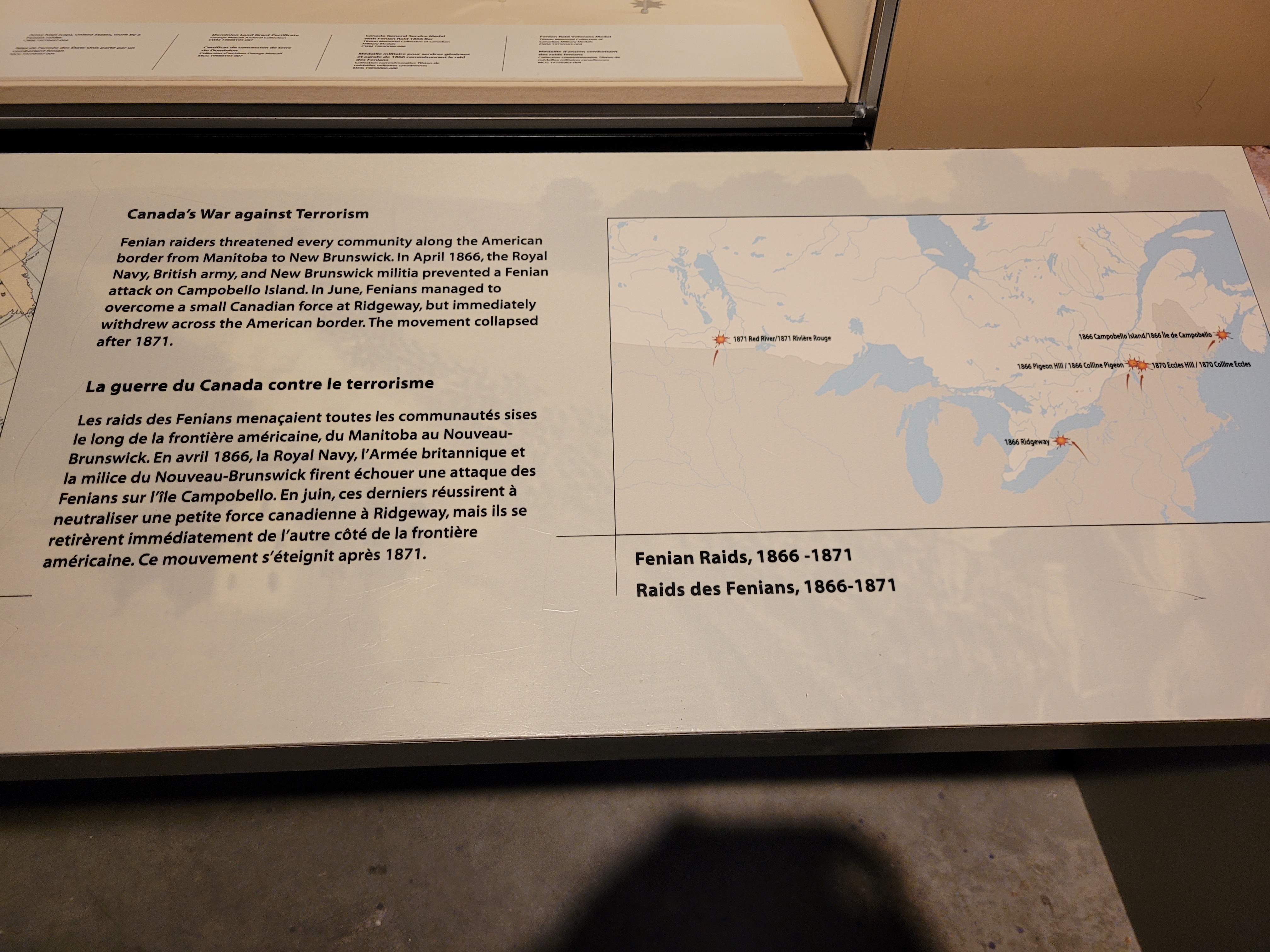
Later in the 19th century, as the bloody Civil War raged south of the border, Canadian leaders took from that as an example not to follow, and united in Confederation. After the war ended, Irish American veterans of the Union Army launched what were called the Fenian Raids- an attempt to hold Canada for ransom to get the British to grant Irish independence. Each time, the invasions were pushed back. The display case includes a Union service cap and medals. We'll get back into this series after the theme day.

Sunday, November 26, 2023

Canadian Conflicts

 The American Revolution would create one country of the thirteen colonies that had joined together. But in the influx of Loyalists heading north afterwards, it also helped lay the groundwork for the creation of another country: Canada.


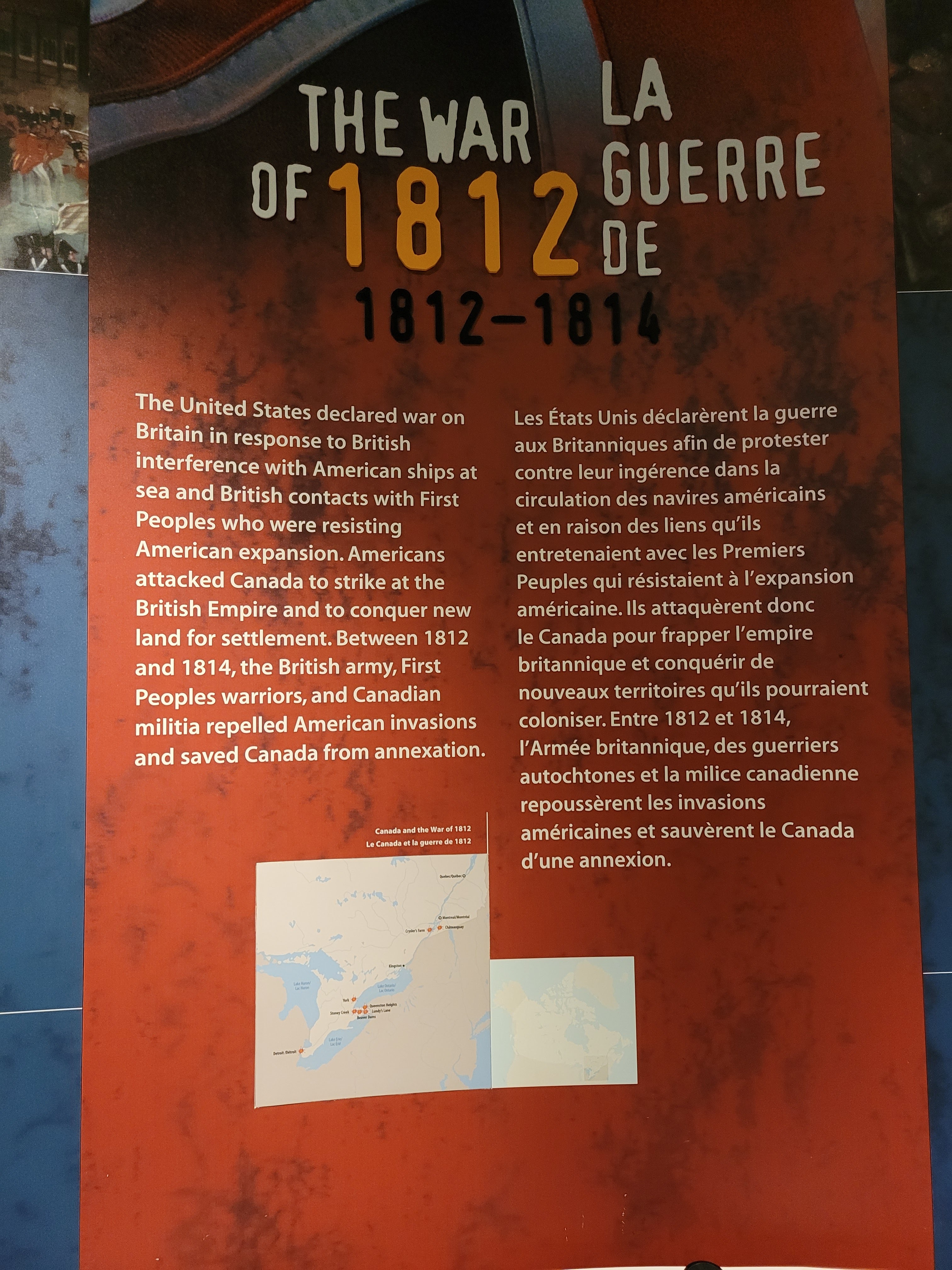
Distrust and hostility between Britain and the United States would later lead to the War of 1812. The Americans sought to drive the British out of North America once and for all. The British and the Canadians were determined to prevent that from happening.


This is a model of the H.M.S St. Lawrence, a veteran of that war, which today lies just off shore of Kingston, Ontario.


The painting here is of John Norton, a war chief who fought in the War of 1812. 


General Isaac Brock was a British general who commanded regulars during the war. His coat is preserved here- with the bullet hole visible on the material.


Brock was killed at the Battle of Queenston Heights against American invaders. First Nations warriors and Canadian militia drove the invaders back and won the day. Today, Brock is buried where he fell, and a magnificent monument is situated there.


Medical tools from later in the century, but rather familiar to those doctors who were engaged in the War of 1812.


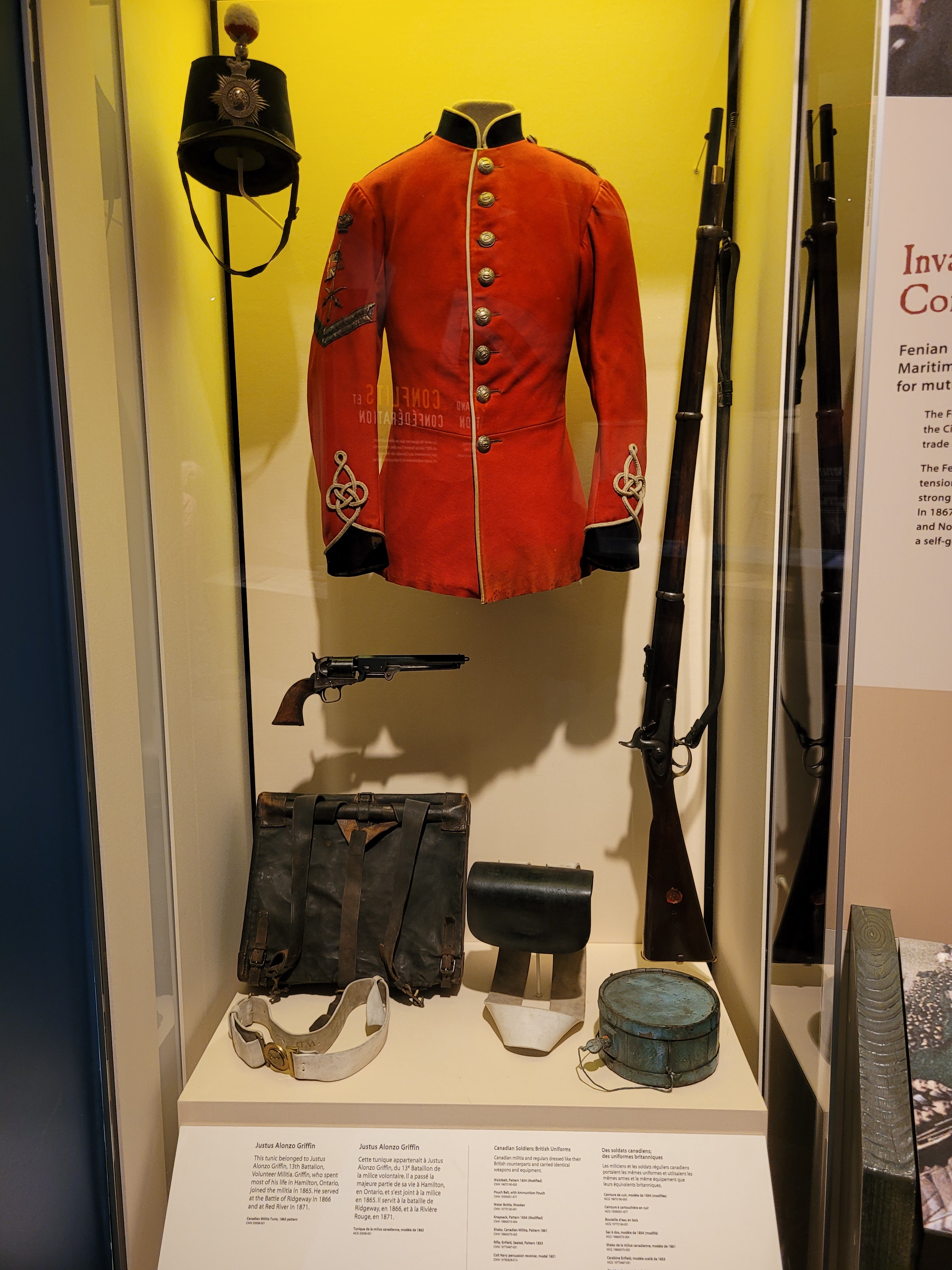
A uniform coat and other equipment for a Canadian soldier is here. The display also includes items like a Union soldier cap, medals, and a certificate. The American Civil War had a big influence on the Canadian colonies becoming one country in Confederation. The Fenian Raids came in the aftermath of that war- Irish American veterans of the Union Army repeatedly invading Canada in the hopes of holding it for ransom to force the British to grant independence to Ireland. Each time they were pushed out.


The Gatling gun was brought into use by the military in the Canadian West in the latter half of the 19th century.


This archway takes us into the next gallery, focusing on wars for empire.


At the end of the 19th century, the Victorian era was being celebrated across the empire.


Canadian soldiers would go oversea as part of the South African War, an endeavour by the British against the Boer Republics.

Saturday, November 26, 2022

Perpetual Tension

 The War of 1812 was a momentous time in Canadian history, with British regulars, colonial militia, and First Nations warriors fighting American soldiers across the frontier. The American objective was to push the British out of North America once and for all. Ours was to deny that. Guess which side achieved their objective.


Prominent in this display case is a uniform coat of particular significance. It is the coat of General Isaac Brock, who led our side at Queenston Heights and was shot down by an American. The hole where he was hit is still visible on the coat, just beneath the overturned collar.


This period was, to say the least, not the most ideal for battlefield medicine. Doctor's tools are seen in this display case.


Charles de Salaberry was a rarity of the time- a Francophone officer serving in the British military, born in Quebec and who distinguished himself time and again during that war.


Tensions with the Americans persisted for decades afterwards. This display case contains items pertaining to the culmination of that tension- the Fenian Raids. A certificate, medals, and Union soldier's cap are here. The Raids were in the aftermath of the American Civil War, when Irish American veterans of that war banded together and launched raids into Canada in an attempt to force the British to give up Ireland. Each time they were pushed back. The Civil War and the Fenian Raids solidified the Canadian provinces into Confederation as a response to seeing the chaos from south of the border.


This display case features items belonging to a typical Canadian militiaman of the time.


A look into what comes next.