Showing posts with label J.R. Booth. Show all posts

Saturday, August 15, 2026

Bytown

In the 1840s, Sister Elisabeth Bruyere and fellow Grey Nuns from Montreal came to Bytown, establishing a hospital, orphanage, school, and other social services. Sister Elisabeth's legacy remains today, with two hospitals in the city under the umbrella of the Bruyere organization, and a convent still active beside one of them.


After the Canal was built, timber was the dominant industry in the Ottawa Valley, and with both sides of the river being involved, the growing urban centers were keys to that industry. This is a remarkable artifact, a table carved by an employee of one of the lumber companies, done in three dimensions, showing the areas of the timber companies around the islands in the river.


The portrait on the wall is that of J.R. Booth, a lumber tycoon and railroad baron who established himself in what was Bytown and later became Ottawa. At one point, his lumber company was the largest in the world.


The actual work of the lumber men was a hard one, for months out of the year, out in the bush. 


This display case features some of their artifacts. 


Joseph Montferrand was one of the lumberjacks, a French-Canadian giant of a man who became a legend in the Ottawa Valley, today still remembered in folklore. It was said he once beat 150 men on the Chaudiere Bridge, members of an Irish street gang looking to make trouble.


Caulk boots, with nails or cleats on the soles, were used by the river drivers to pass over slippery logs. The bible box beside it was carved by Robert Spallin during time off in the camps.


This belt is an example of those worn by French-Canadian lumbermen.


Tools of the trade.


For a time, Bytown had a reputation as the most violent town in British North America, with riots, old-world biases spilling over into fights, and access to alcohol leading to troubles, all with minimal law enforcement in those early years.

Thursday, October 5, 2023

The Canal And Swing Of The Axe

John By being a military officer, it made sense that he brought soldiers and officers with him to spearhead the building of the Rideau Canal alongside the civilian workers.


One of his primary contractors for the job was the stonemason Thomas McKay, who would go on to found the village of New Edinburgh, today part of the city. And his family home would be expanded in time to become the residence of the governor general- Rideau Hall.


Some of the tools that went into building the Canal.


A period photograph of the Ottawa Locks, with the Canal offices on the far shore- now just a memory.


This door knocker once was part of the By home, which stood in what's now Major's Hill Park.


With the completion of the Canal, lumber became the big business in the Ottawa Valley, and timber barons rose up with their own businesses on both sides of the river.


The E.B. Eddy company was one of those timber companies, and manager James Hunnam crafted a work of art that would be displayed at the World's Fair in Philadelphia in 1876. Today the table resides here.


The most prominent of all of the timber barons was J.R. Booth.


The men who actually cut the timber led a harder life than those who employed them, and often a dangerous one.

Tuesday, May 10, 2022

From Dusk Until Dawn

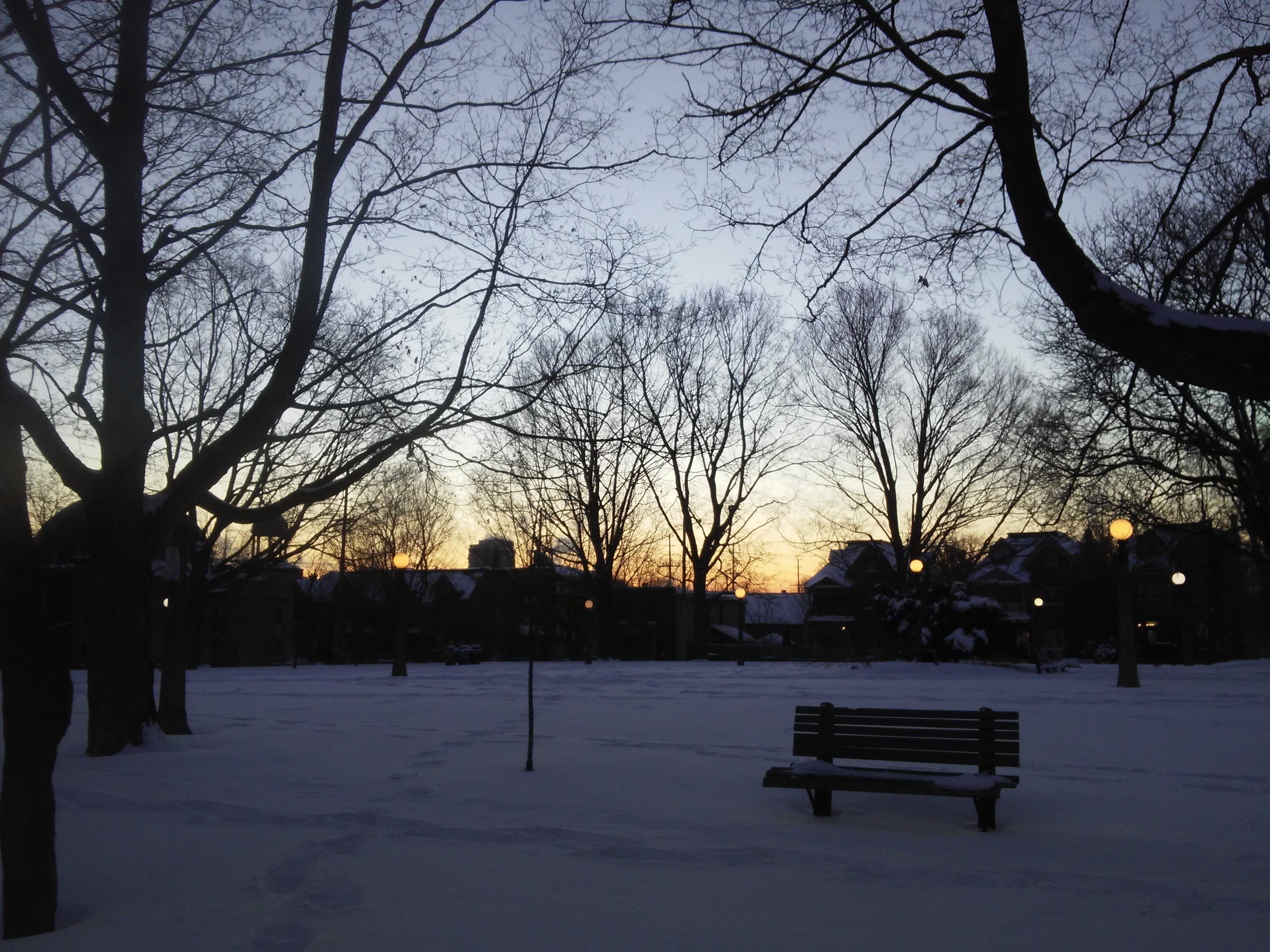
Today I have some sunrise and sunset shots from over the winter. I start with this shot taken near dusk in Dundonald Park downtown on a January evening.


This shot taken early in the morning was at Lansdowne Park, with the Aberdeen Pavilion in the background.


Dundonald Park, this time at dawn.


One evening a couple of days later I was on my way home and took this shot. The Laurentian Centre was once the home of J.R. Booth, the timber baron who left a big legacy behind. Today it is home to students in an internship program for Trinity Western University.


A few blocks away and a few minutes later, the last light of day.


This shot, taken in Centretown on an early February evening, gives us the last light of the day.


A few days later, another evening sky in the same neighbourhood.


And that same evening, the sky as it was in Central Park in the Glebe.


A few days beyond that, this was the view early one morning over the stadium at Lansdowne.


And some days beyond that, an evening view in the Glebe neighbourhood.


My last shot is an early morning view in Dundonald Park, perhaps a half hour or so past dawn the morning after the above shot. Sunlight was touching the tops of the trees, which had seen hoarfrost during the night, coating the trees in white. It's something we occasionally see here.

Saturday, August 11, 2018

19th Century Bytown

The second floor of the Bytown Museum includes some space for temporary exhibits. At present, that exhibit is titled Through The Eyes Of, and it examines various points of view from the city's earliest days to the present. Women are represented in a number of artifacts and display panels; this particular one features items from the era 1890-1930.


The child's point of view also gets a display case with a number of toys. The Legos bring back memories. I had no idea that Dennis the Menace had a toy line at some point.


The current day perspective is best seen in this display case- items of an immigrant. The guides and translation dictionary you'd expect to see, but the other items, on loan, are from a woman who immigrated in the 1990s from Africa, and took some reminders of where she came from. The cloth is kikoy cloth, handwoven cotton that is common in Kenya and Tanzania. The jewelry is of the Maasai culture.


The Museum's permanent collection concentrates on an era starting with the building of the Canal and leading to the conclusion of the First World War. This display area features items related to Colonel By- the bust and sketch of him (though in fact the only lifetime depictions of him were silhouettes he sat for, and the artistic likenesses of the man are based on physical descriptions). The chest belonged to him as well.


Tools and equipment related to the building of the Canal can be found here. Contractors supplied some tools, but tradesmen of the time often brought their own tools along. Thousands of men came to work on the Canal, bringing families into the region. Many of them stayed on and settled in the Ottawa Valley, and the town that grew up around the Canal's starting point was initially called Bytown. 


The uniform and some of the other elements in this display case belonged to Joseph Coombs, born in Wexford, Ireland in 1789. He enlisted with the Royal Sappers and Miners, saw action while attached to the Prussian Army during the Napoleonic Wars, and settled in Bytown with his family when the Canal was completed and his military career was concluded. He distinguished himself in the community as a private citizen, businessman, and organizer of the first fire company, and today is buried in Beechwood Cemetery.


Bytown had a rough reputation early on as a lumber town, something it would retain when the name was changed by mid-century. Some of the era's history shows up here in various display cases. The portrait on the wall is that of J.R. Booth, the distinguished timber baron whose footprints still have left their mark in the city. The table is a one of a kind, topped with glass. Built in 1874 by James Hannum, a manager at the Eddy lumber complex, it consists of ten thousand pieces of inlaid wood, depicting the grounds of the company business and its surroundings in what was then downtown Hull (today the core of the city of Gatineau). It was exhibited at the World's Fair in Philadelphia in 1876.


Another display case features items related to the timber era- spiked caulk boots, a Bible, and a cloth sash typical of French speaking peoples in the country. The larger than life story of lumberman Joseph Montferrand, a legend in the Ottawa Valley, accompanies the display.


This display case tells the story of the Sisters of Charity, the Grey Nuns, who came up to Ottawa in the 1840s, led by Sister Elisabeth Bruyere, establishing local institutions, including a hospital that still bears her name, and facing the typhus outbreak of 1847 with exceptional courage. 


Being a rough and tumble lumber town for particularly the first decades of its existence, Bytown had a reputation as a violent, largely lawless place with a lot of drinking and bad behaviour. That would change when the town ended up being designated as a colonial capital by Queen Victoria, as well as renamed. Items of that early era are found with panels in a couple of display cases near the staircase heading to the third floor.