Showing posts with label Joseph Montferrand. Show all posts

Saturday, August 15, 2026

Bytown

In the 1840s, Sister Elisabeth Bruyere and fellow Grey Nuns from Montreal came to Bytown, establishing a hospital, orphanage, school, and other social services. Sister Elisabeth's legacy remains today, with two hospitals in the city under the umbrella of the Bruyere organization, and a convent still active beside one of them.


After the Canal was built, timber was the dominant industry in the Ottawa Valley, and with both sides of the river being involved, the growing urban centers were keys to that industry. This is a remarkable artifact, a table carved by an employee of one of the lumber companies, done in three dimensions, showing the areas of the timber companies around the islands in the river.


The portrait on the wall is that of J.R. Booth, a lumber tycoon and railroad baron who established himself in what was Bytown and later became Ottawa. At one point, his lumber company was the largest in the world.


The actual work of the lumber men was a hard one, for months out of the year, out in the bush. 


This display case features some of their artifacts. 


Joseph Montferrand was one of the lumberjacks, a French-Canadian giant of a man who became a legend in the Ottawa Valley, today still remembered in folklore. It was said he once beat 150 men on the Chaudiere Bridge, members of an Irish street gang looking to make trouble.


Caulk boots, with nails or cleats on the soles, were used by the river drivers to pass over slippery logs. The bible box beside it was carved by Robert Spallin during time off in the camps.


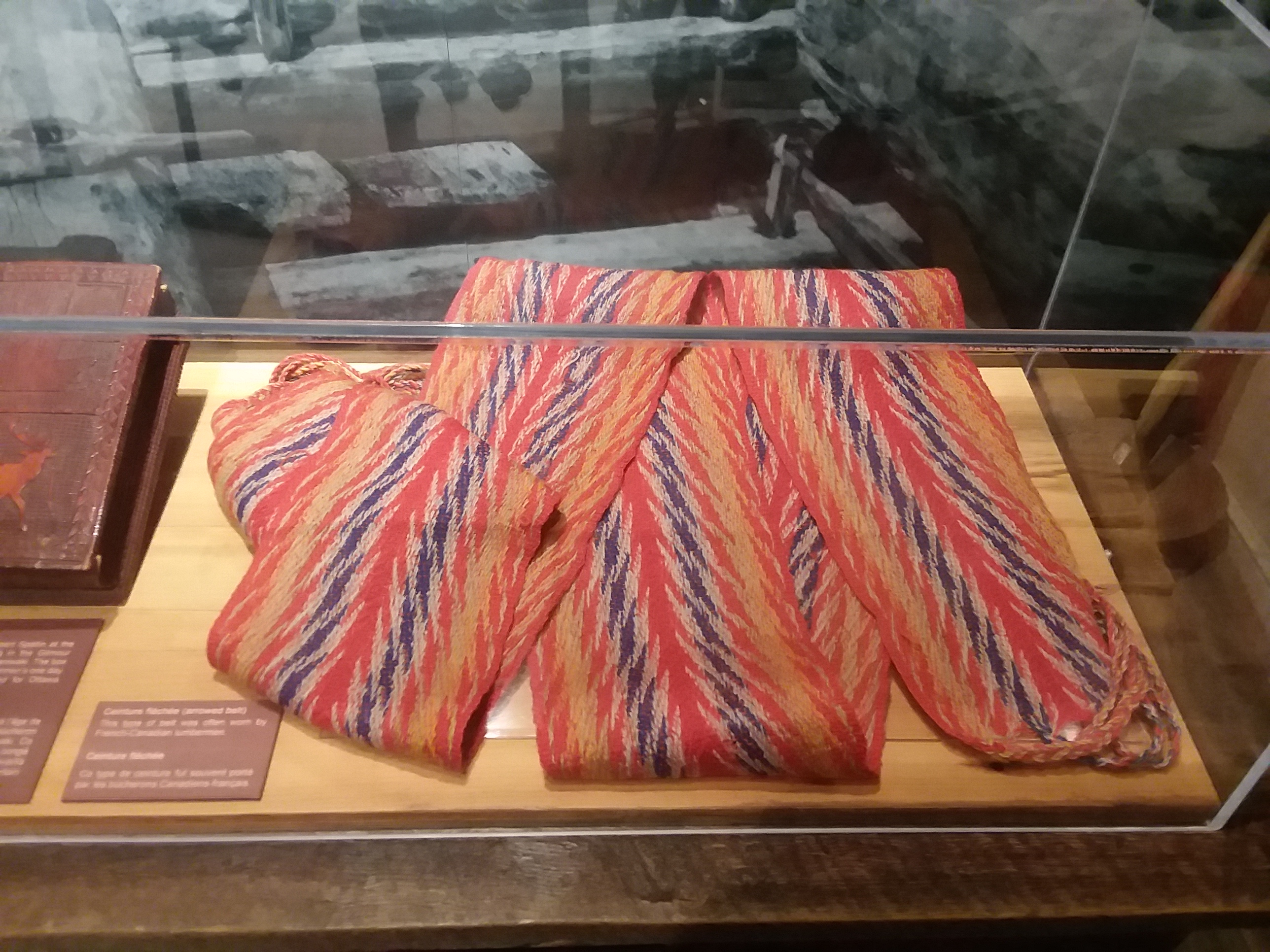
This belt is an example of those worn by French-Canadian lumbermen.


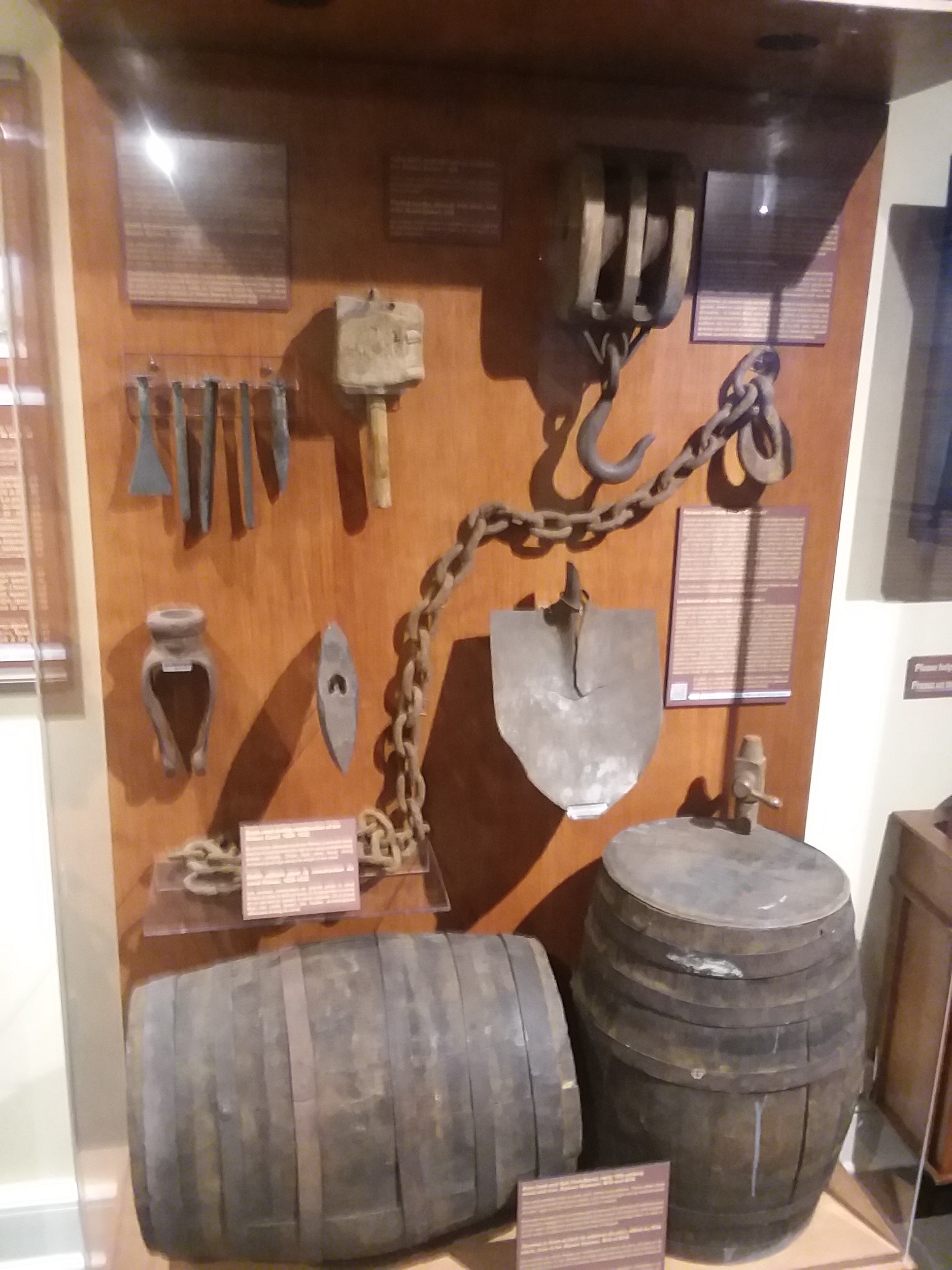
Tools of the trade.


For a time, Bytown had a reputation as the most violent town in British North America, with riots, old-world biases spilling over into fights, and access to alcohol leading to troubles, all with minimal law enforcement in those early years.

Friday, October 6, 2023

A Life That Became A Legend

Picking up where I left off yesterday, this period photograph of lumbermen in the background has artifacts in the foreground, like boots and the voyageur sash.


A display tells of a man whose life became legendary. Joseph Montferrand was a French-Canadian lumberman who became bigger than life throughout the Ottawa Valley, and stories began to be told about him. Stories are still told about him to this day, to the point that just where the real man leaves off and the stories begin is a blurred line.


Some of the tools of the trade- an axe and timber brands.


Another person whose life made a huge mark on Ottawa. Sister Elisabeth Bruyere led a group of nuns in 1845 to Ottawa, where hospitals, schools, and social agencies were quickly established by them.  Her legacy endures today. Speaking as a non-Catholic, if they ever make her a saint, that will be one that's well deserved.


This period was one of tensions in many ways in the growing town. This included the Stony Monday Riots, which added to the reputation Bytown had as the most dangerous place in British North America.


The Great Fire of 1900 was the biggest fire to ever hit here, destroying much of what's now Gatineau and leaping the river into Ottawa.


Fire is the subject of a temporary exhibit here. It includes photos of buildings destroyed by fire in the city over time, such as the original market building in what's today the Byward Market.


On Sparks Street, one building that went up in flames was almost certainly arson, in the aftermath of the D'Arcy McGee assassination.


Things change- the same location, different times.

Friday, October 14, 2022

A Rough Lumber Town

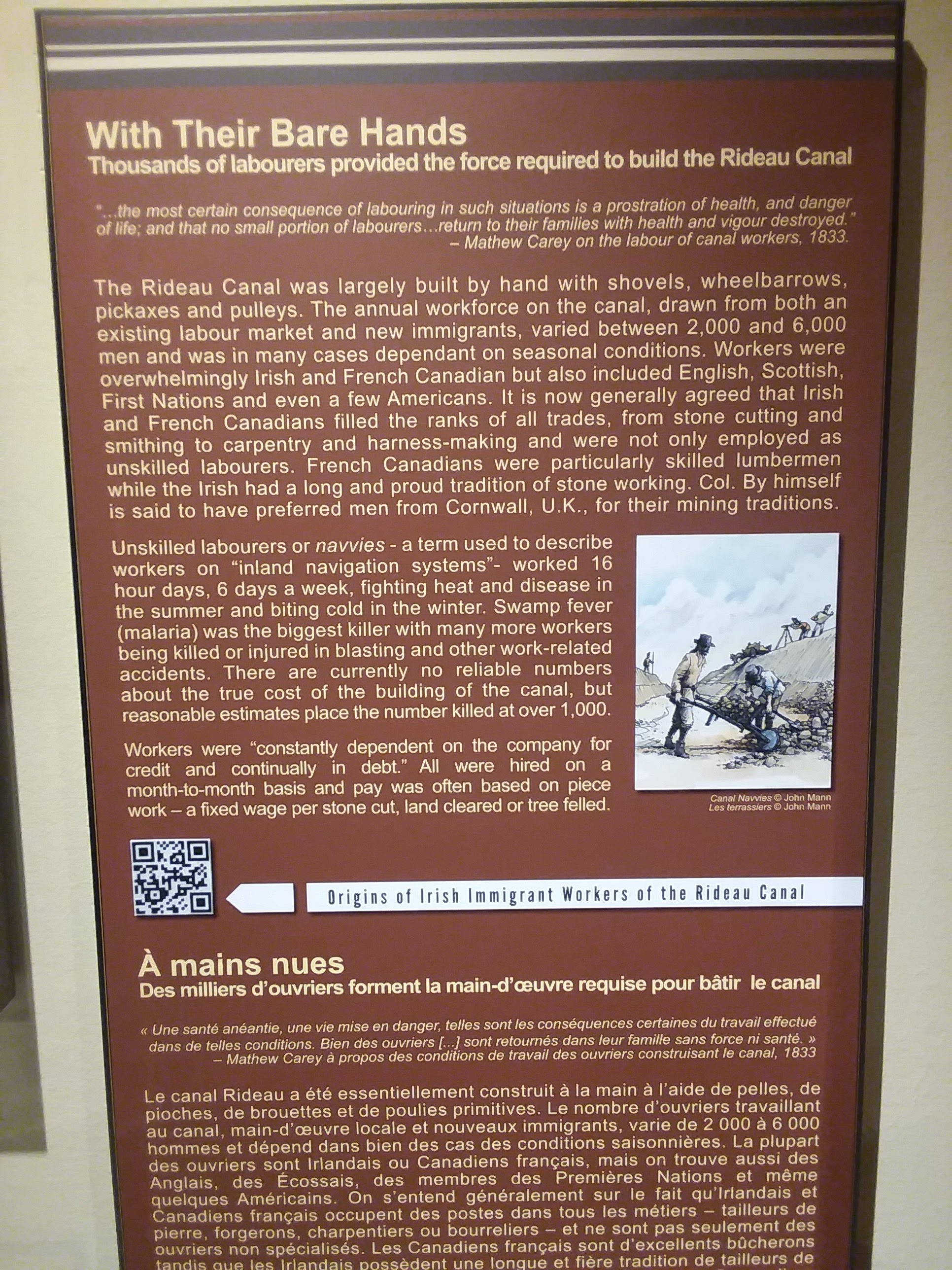
 John By being a military officer, it made sense for him to have enlisted military men, most of them of one trade or another, to be part of the Rideau Canal project, working alongside and leading the civilian men also working on it.


It was a project of thousands, and many of them died in accidents or of illness. This also applied to their families.


Some of the tools and equipment of that time are in this display case.


Bytown would become a focal point of the timber industry in North America at this time.


This table, featuring thousands of pieces of inlaid wood, was created by a manager at the E.B. Eddy company and displayed at the Philadelphia World's Fair in 1876.


The painting here is of J.R. Booth- the pre-eminent timber baron of the age in Canada. Artifacts of his life are below.


Throughout the Ottawa Valley and beyond in the 19th century and into the early 20th, the lumber industry went on- heedless of consequences, with no thought of sustainable logging- with many men taking part in it.


A display case here includes some typical lumberman's items. Note the studded boots- absolutely essential for maneuvering on a collection of logs in the water.


One of them led a life that became a legend. Joseph Montferrand ranged across the Ottawa Valley, and stories were told about him down through time that made him larger than life. Stories are still being told about him.


I close today with a close up of that sash.

Friday, April 15, 2022

Courtyards

 This snow sculpture was close to the ice sculptures in the Byward Market during Winterlude 2019. It depicts Joseph Montferrand, a lumberman of the 19th century and local legend who became larger than life.


A nearby courtyard hosted an ice sculpture set with items from the European Union encased into the walls.


Other displays could be found in the courtyard for the festival.


Photographing the photographer. Moments later she turned and saw me.


Down at the Lord Elgin Hotel, they used their terrace courtyard to host some ice sculptures too.


This included their traditional ice bench.


It was cold to sit on. I cannot keep a straight face for selfies.


For today I'll leave off with the sculptures outside the hotel's main entrance.