Showing posts with label Tommy Douglas. Show all posts

Wednesday, February 4, 2026

The Country Drives Forward

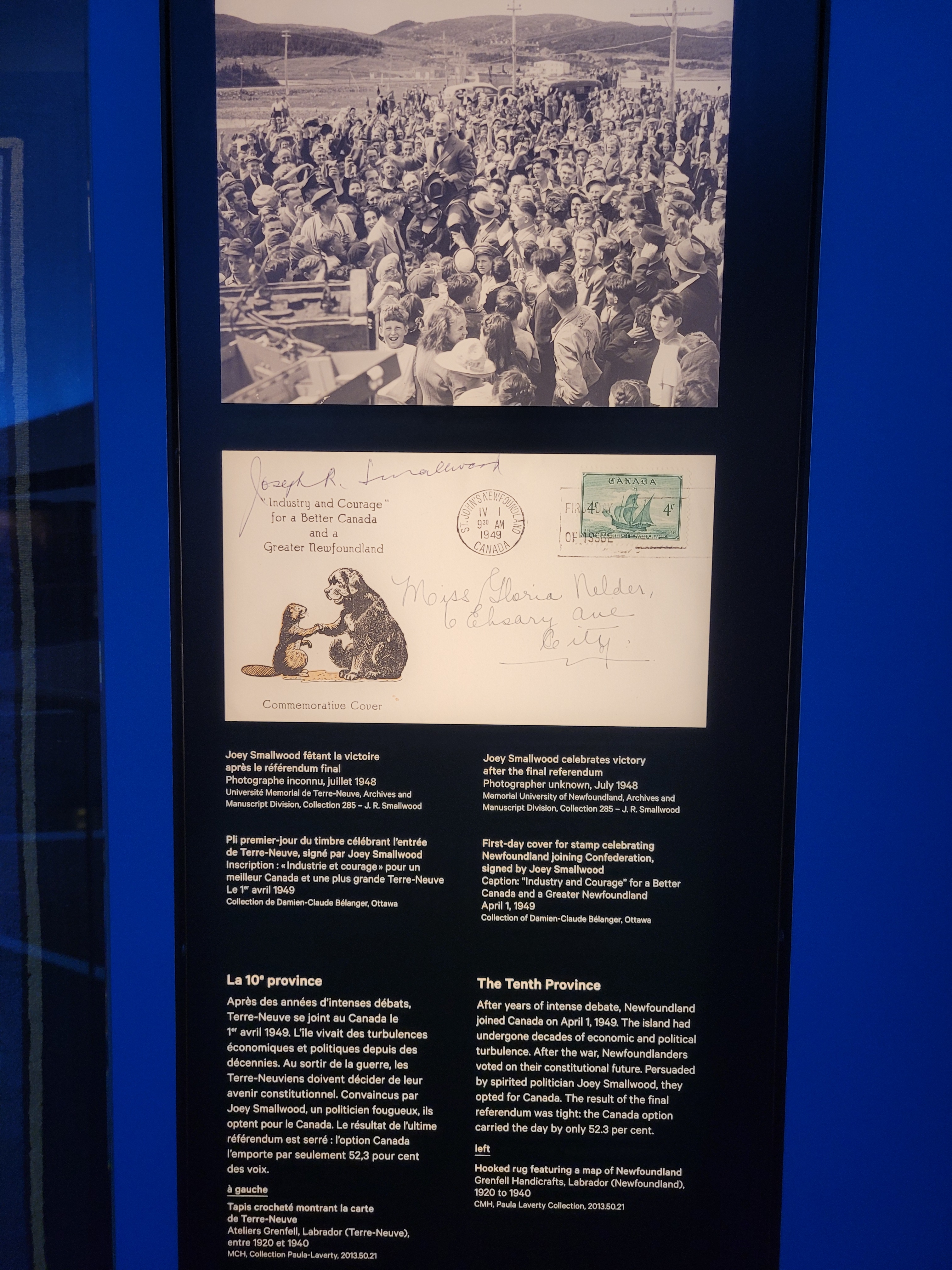
These are rug hookings, of a puffin and a fish. They evoke the entry of Newfoundland into Confederation, which happened after people there voted to join Canada in 1949, becoming the last province, known today as Newfoundland and Labrador. With the exception of the partitioning of the Northwest Territories into the Northwest Territories and Nunavut at the end of the century, it was the last major change in the country's shape.


Joey Smallwood led the effort to join the country as the province's premier, and he is thus seen as a Father of Confederation, decades after the others.


Tommy Douglas was a premier of Saskatchewan who founded what would become the New Democratic Party of Canada. He established universal health care in Saskatchewan before going into politics at the federal level, and the federal government followed up on transferring that concept to the country as a whole.


The post-war decades were a time of significant change in the country. Fashions of the era are seen here.


Canada had used the Red Ensign as an unofficial flag- a combination of the Union Jack and the Canadian coat of arms. But a movement rose up for a national flag, with Prime Minister Pearson advocating for change. Hundreds of designs were proposed. I'm biased, but the winning design was just right. I can't imagine a better flag.


This is the evening dress of Marjorie Gehl, the daughter of a Canadian diplomat working in the southern United States. She made it herself to mark the country's centennial in 1967.


This photo is from July 1st of that momentous year. What was called Dominion Day and is now called Canada Day, with Parliament Hill being the center of attention, including a visit from the Queen. This photograph is actually taken by the great landscape photographer Malak Karsh, who spent his professional career photographing the country he loved so much.


1967 was also the year of Expo 67 in Montreal. This model was the Indian Pavilion, which deliberately sought to provoke questions about how indigenous peoples had been treated in the country's history.

Friday, October 11, 2024

Societal Change

Tommy Douglas was premier of Saskatchewan as a leader of the Co-operative Commonwealth Federation, which would eventually become today's NDP in Canada. He would introduce universal healthcare in the province, ending up in federal politics as well, and the federal government followed his example in health care. One of his campaign signs and one of his hats can be seen here.


In addition, he was the father of actress and activist Shirley Douglas. Her son is the actor Kiefer Sutherland. I see a resemblance.


Society underwent momentous change in the years following World War Two, particularly with the baby boom, cultural change, and newly emerging technology.


This is the dress of Marjorie Gehl. Her father was a Canadian diplomat posted in the American south. During the centennial year, Marjorie made this evening dress and wore it to several functions.


Multiple Canadian institutions were created or strengthened after the war. This included Canadian born governor-generals, an act to firmly establish Canadian citizenship and passports, the Supreme Court becoming the final avenue of appeal in legal cases, and the creation of the Order of Canada.


As the Sixties began, the debate over a distinctly Canadian flag took shape.


There were over 1200 designs. Prime Minister Lester Pearson was part of the efforts in favour of a distinctly Canadian flag.


This is the sewing machine used to make some prototypes for the final decision. The Canadian flag we know today was the result.


1967 was the centennial year for Canada, with many events held across the country, but Expo 67 in Montreal was the biggest.

Friday, February 2, 2024

A Nation Going Through A Time Of Change

Continuing on with this tour at the Canadian Museum of History. Tommy Douglas was a political leader at the provincial and federal level, a premier of Saskatchewan from 1944-61. His policies there for universal healthcare would be a precursor for the concept at a federal level. 


The post war years would be times of momentous change in society. Fashion and culture were part of that.


A digital display allows one to call up a variety of music from the era, which plays and displays the lyrics of a given song. In this case, a great Canadian- Gordon Lightfoot.


The 1960s saw the flag debate in the country. Canadians had been largely using the Union Jack or the Red Ensign, but the government under Lester Pearson advocated for a distinctly Canadian flag. In the end, over 1200 designs were considered.


The idea of a single maple leaf on the flag would be chosen, and Pearson wanted to see some prototypes actually sewn and flown from his flagpole. This sewing machine is the one used to make the one we know today, courtesy of the daughter of a civil servant, as she did the work.


This elegant dress was made by the daughter of a Canadian diplomat for the centennial year. Marjorie Gehls' family was posted in the American south, and she made this dress to attend various functions with her parents that year. Now it calls the Museum home.

Saturday, February 4, 2023

Forces Of Change For Canada

The Second World War was as momentous a time for Canada as the First World War had been. The country was involved from the start until the end.


Photographs of the time: at the First Quebec Conference, Prime Ministers William Lyon Mackenzie King and Winston Churchill stand behind President Franklin Roosevelt and the Earl of Athlone, the governor-general at the time. Below is a photograph of King on V-E Day.


This photograph of a man and woman, both in the service, on V-E Day, always catches my eye.


After the war, Newfoundland, which had been a separate dominion under the British empire, voted to join Canadian Confederation.


Its premier, Joey Smallwood, was the driving force for that. As such, he is considered the last Father of Confederation.


Another political force in the country was the politician Tommy Douglas, whose policies from the left wing had a strong influence, both in his province and at the national level. Universal health care is his legacy, and today he is one of the most admired leaders in the history of the country.


The decades following the war saw a great deal of change. Women's role in society, the growing influence of the youth making up the baby boom, economic booms, all of it had an effect on the country. Some fashions of the time are here. 


A display screen features a wealth of Canadian musicians of the time. Clicking on any albums displayed allows the visitor to bring up a specific song. In this case, The Weight, a classic from The Band.


I close off for today with this.