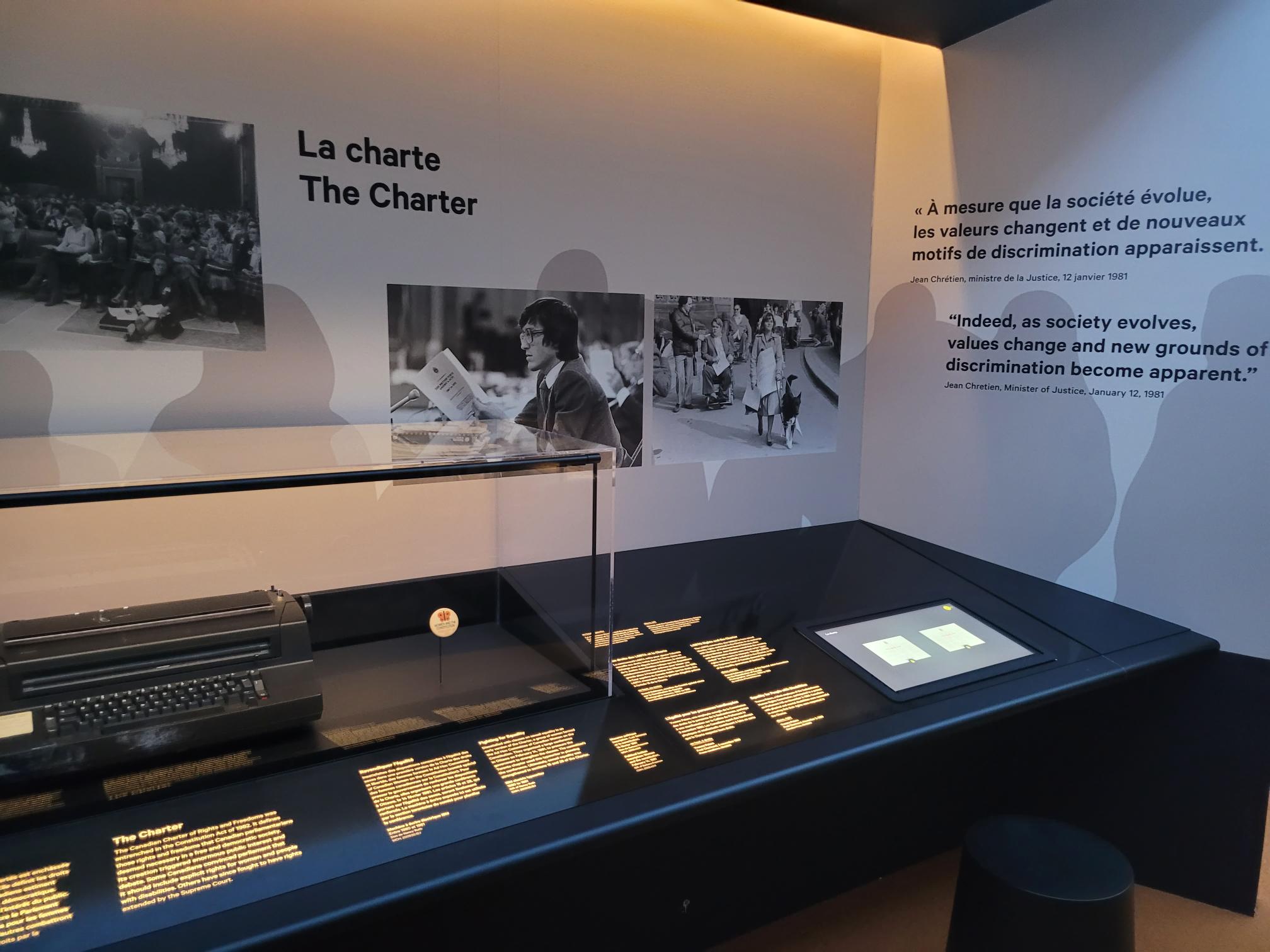
Women's rights, particularly gender discrimination and violence, are explored. The Ecole Polytechnique massacre of December 1989, in which fourteen women were murdered, had a huge effect on the country.
Showing posts with label Viola Desmond. Show all posts
Monday, February 9, 2026
Human Rights
The Roseland Theatre in Nova Scotia became the focal point of a human rights complaint back in the 40s. There was no law in the province for racial equality, and so private businesses could practice segregation if they wanted. In 1946, Viola Desmond, who owned a beauty parlour in Halifax, was in town and attended a movie- getting arrested for sitting in the whites only section. These days her portrait is on the Canadian ten dollar bill.
Disability rights and accomodation have evolved over time. From everyday AODA needs to those who shine on the international stage, Canadians have responded and adapted. Paralympic hockey sticks are seen here, along with a glove that has a story in and of itself. It is a glove that was used by Rick Hansen, who showed the world what a man in a wheelchair can really do.
Hansen went around the world on his wheelchair to raise money for spinal injury research, leaving a big impact on the world as a whole.
Disability adaptation includes a model for a full scale playground equipment seen here.
Human rights applies as well to around the world.
Lotta Hitschmanova was a refugee who came to Canada, where she founded the Canadian chapter of the Unitarian Service Branch and dedicated her life to working with refugees affected by war.
This is one of her uniforms.
Canadians also got involved in the fight against apartheid over successive governments- with the government of Brian Mulroney becoming even more assertive to convince the world to bring economic sanctions upon South Africa as a tool. Whatever else he was as a prime minister, it's something about him that I respect. It meant disagreeing with his allies, Margaret Thatcher and Ronald Reagan, both of whom wanted to go slower.
Nelson Mandela was made an honorary citizen of the country right here at the Museum. With Canadians so vocal in the fight to end apartheid, he had a warm relationship with the country as a result.
Wednesday, October 16, 2024
Rights
The 1995 referendum was the closest the country ever came to coming apart. The separation of Quebec was narrowly defeated. Premier Jacques Parizeau, in an infamous speech that night likely influenced by liquor, blamed the loss on money and "ethnic votes."
Bilingualism is a force in the country.
The next thematic area looks at human rights, including voting, which in the aftermath of the Second World War began to be extended to groups that had been excluded, including First Nations peoples.
Multiculturalism has become one of our strengths over time.
The rights of women is also explored, particularly as a response to violence. One of the darkest chapters of the country's history is the killing of fourteen women at the Ecole Polytechnique in Montreal by a man best described as a misogynistic terrorist.
The Canadian Charter of Rights and Freedoms is a bill of rights entrenched within the Constitution.
Race and religion have long been difficult subjects, evolving over time.
This installation is by artist Leila Binbrek, with each side of these two tables reflecting her western and Yemeni influenced backgrounds.
Viola Desmond was a civil rights trailblazer. Owner of a beauty school in Nova Scotia, she challenged the segregation policies of a movie theatre, a decade before Rosa Parks. Today her portrait is on the Canadian ten dollar bill.
I leave off here with where we'll pick up tomorrow, with a panel about the disabled- particularly disabled athletes.
Wednesday, February 7, 2024
Advancements Within Society
Bilingualism in Canada is a given thing, with the federal government providing services in both languages, as well as New Brunswick, where bilingualism is also part of official policy.
There are French speaking areas throughout the country, in fact.
The next thematic area looks at social issues in the country. Multiculturalism, a policy of recent decades, has added to the mosaic that is Canadian culture.
The rights of women has for many years been a prevailing theme in Canada. This display case looks at sobering matters- such as the incident report rate for sexual assault, or one of the darkest chapters in Canadian history- the Ecole Polytechnique massacre in Montreal, where women were murdered by a lone gunman with a grudge, a man who also wounded more women and some men before turning the gun on himself.
The Charter of Rights and Freedoms was entrenched into law in 1982 as part of the Constitution.
This dual display is the work of an artist, Laila Binbrek. Mirror, Mirror shows the dual nature of her background, with Western items on the left, and Middle Eastern items on the right table.
An RCMP uniform tunic is seen here, with a turban above it. Back in the day there was great controversy about the idea of a Mountie wearing a turban. Now the question would be, what was the fuss about? At lower right, a photograph of Viola Desmond, a civil rights pioneer who, years before Rosa Parks, would refuse instructions in a movie theatre that had segregated instructions, and be charged for it. Today her picture graces the ten dollar bill.
Disabilities and the ways to adjust to it are examined as well. This display case features a model for a playground that can accompany wheelchairs, hockey sticks for disabled players, and a glove that belonged to Rick Hansen. He was the Canadian who did a round the world tour in his wheelchair, raising money for spinal cord research and rehabilitation. During the epic journey, his gloves regularly wore out. Hansen remains one of the country's most admired people.
Moving along, the next thematic area looks at Canada on the world stage, particularly since the end of the Second World War.
Wednesday, February 8, 2023
The Country In The World
The second referendum on Quebec separation in 1995 is the closest the country ever came to breaking up.
Bilingualism is a way of life here, especially in the Ottawa area. Across the country, one province is officially bilingual- New Brunswick. But French-speaking populations can be found everywhere.
I love that t-shirt.
The next thematic area is about human rights and Canada's place in the world. Multiculturalism is a big thing here, especially starting in the second half of the 20th century when immigration from around the world became the norm.
Mirror Mirror is the title of this installation by artist Laila Binbrek, reflecting her dual nature- growing up in western society with Yemeni roots. Items on the two makeup tables facing each other reflect the two contrasts.
Race and religion have had their own influences in Canada- from the uproar over the idea of a Mountie wearing a turban (which seems to us today to be a meaningless issue) to civil rights pioneers like Viola Desmond, at lower right. The Nova Scotia businesswoman refused to sit in a segregated portion of a theatre, and was arrested for it. Today she graces the ten dollar bill.
Hockey sticks for paralympic athletes and a model of an accessible playground equipment are seen here, along with an odd item- a single worn glove. This was a glove worn by Rick Hansen on his Man In Motion journey around the world to raise awareness of spinal cord injuries.
The Canadian focus on human rights includes the struggle against South African apartheid. It was both a common feeling among the population and a standard policy of multiple governments for decades that the institution was wrong.
The Diefenbaker government opposed South Africa's place in the Commonwealth because of apartheid. This continued to be Canadian policy for decades. In the 1980s, Brian Mulroney took things up a notch by urging economic sanctions against South Africa by the Commonwealth- which had him at odds with his allies, Ronald Reagan and Margaret Thatcher, who didn't want to go quite that far. Despite his many flaws as a leader, for that stand on a point of principle, I can respect that about Mulroney.
South Africa abandoned apartheid, freeing Nelson Mandela, who never forgot the support of Canadians. He was named an honourary citizen of the country in a ceremony held in the Museum's Grand Hall.
Another form of service: RCMP officer Christine Briand was part of a UN mission in Haiti at the time of the 2010 earthquake and worked to rebuild an orphanage there.
Subscribe to:
Posts (Atom)