The Fenian Raids rose up following the American Civil War, with Union veterans of Irish descent trying to take Canada by force and hold it for ransom to make the British give Ireland independence. Each raid failed, with militia and regular troops driving them out. This is the rifle of a Raider; it was typical of them to wear their Union uniforms as well.
Showing posts with label John A. Macdonald. Show all posts
Wednesday, January 28, 2026
Fathers Of Confederation
Things were chaotic in the Canadian legislature during this period, with a stable majority out of the question.
Three leaders banded together to forge the way for Confederation. John A. Macdonald, George Brown, and George-Etienne Cartier were known in the Canadas, and the other parts of British North America. Macdonald and Cartier were co-premiers of the legislature. Macdonald and Brown despised each other. But they went to work together, recognizing the need for a strong federal union.
The most eloquent voice of the Fathers of Confederation was Thomas D'Arcy McGee, a close friend of Macdonald. A lawyer and journalist, he had been a radical years before in his native Ireland before immigrating. His world view changed entirely upon seeing the workings of Parliamentary democracy in Canada, and saw that as the way to go. That change in view enraged his old comrades among the Fenians, who never forgave him.
He was assassinated one night in 1868, coming home from a session at Parliament, shot in the back of the head. This is the revolver said to be used in the assassination. A Fenian, Patrick James Whalen, was convicted and executed for the murder, though he claimed innocence.
One of the defining photographs of Canadian history- the Fathers of Confederation at the Charlottetown Conference in 1864.
Queen Victoria would would sign Confederation into law. The Canadian colonies became provinces under a federal government, and the country became a reality.
This large photograph shows the first Confederation in Kingston, Ontario, in 1867.
First Nations peoples in the west had long standing relationships with traders, taking the European goods they bartered for and trading them even more in their own long established trade routes of the west.
Friday, October 4, 2024
The Fathers Of Confederation
One of the contributing factors into Canadian Confederation was south of the border. North and South fought the bloody Civil War between 1861-65. Leaders in Canadian colonies looked south, seeing an example not to follow, and understood the need for a strong federal union. This display case includes a rifle and a Union army coat.
Irish-American veterans of the Union Army wore their army jackets in another endeavour in the wake of that war, launching several raids into Canada, pushed back each time. The period was called the Fenian Raids, and the objective was to hold Canada for ransom and force Britain to make Ireland independent. The Raids contributed in their own way to the unification of Canada.
In 1864, leaders of the Canadian colonies began to meet with the goal of uniting under one banner. Three of them were referred to as the Great Coalition- John A. Macdonald, George-Etienne Cartier, and George Brown. Macdonald and Cartier were co-premiers of the Canadas. Macdonald and Brown despised each other. And yet they worked together for a common cause.
Another of the Fathers of Confederation was its most eloquent speaker and writer, very much a driving force in his own right. Thomas D'Arcy McGee had been an Irish radical in his youth, but had come to Canada and saw for himself how British parliamentary style government could work. He changed his world view, went into law and journalism, and ended up a member of Parliament, close friend of Macdonald, and staunch supporter of Confederation.
His change of perspective led to his assassination in 1868. Irish revolutionaries had long considered him a traitor to the cause. He was shot in the back of the head coming home from a debate on Parliament Hill.
This is the gun taken from the assassin, an Irish-Canadian named Patrick James Whalen, who was tried for the crime and hung- though there are doubts to this day that he was the actual killer.
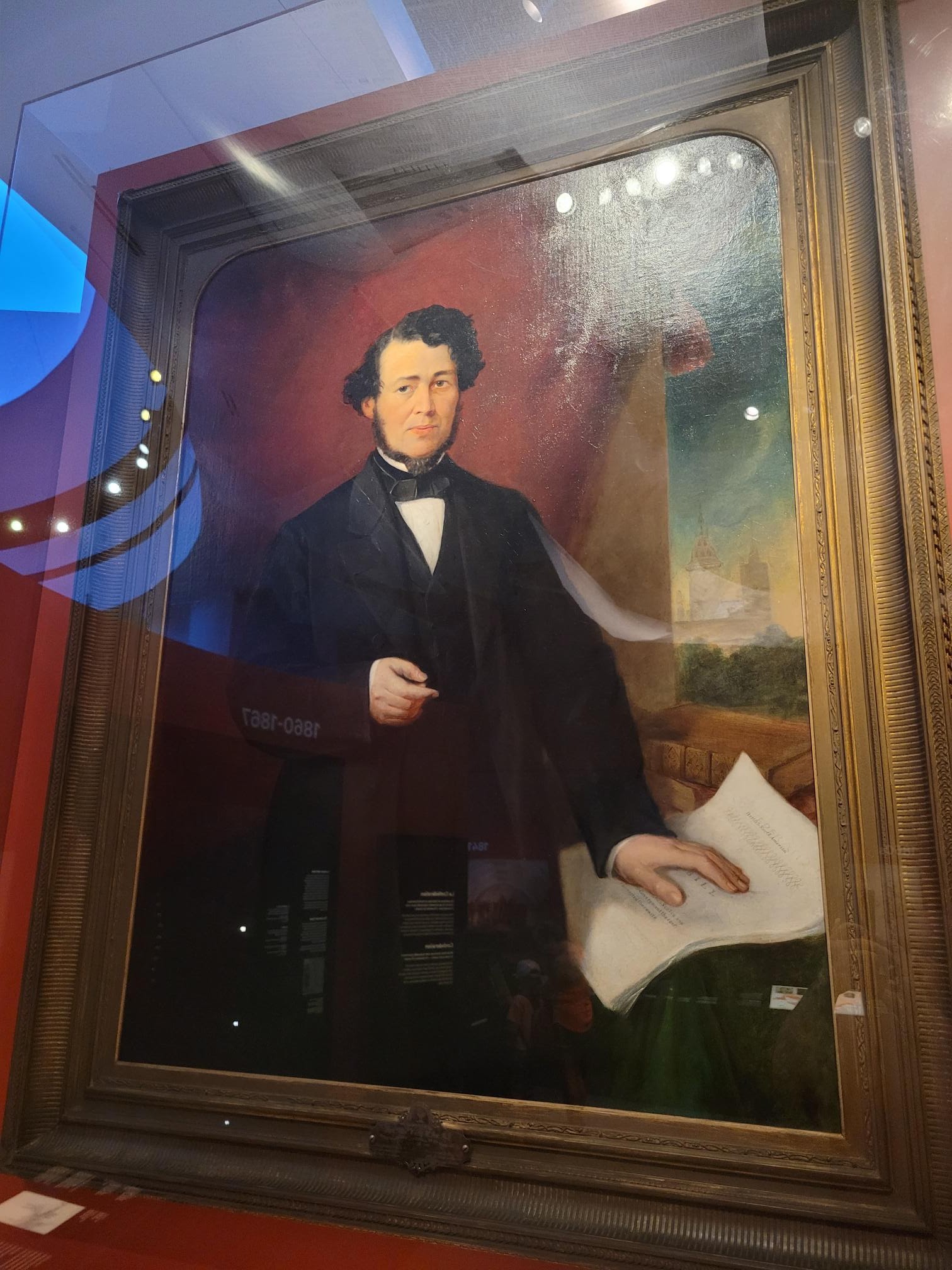
This remarkable painting of McGee hangs overhead.
One of the most famous photographs in the country's history- the Fathers of Confederation meeting at the Charlottetown Convention. Their discussions and work would lead to the creation of the country.
Out west, native peoples were already dealing with contact- both good and bad- with white people. These artifacts are displayed here.
One of the prize artifacts of the museum is this. The Blackfoot tribe had a tradition of a winter count- the most important event of a year depicted on an elkskin, starting at centre and spiralling out. This is one of them.
Saturday, April 27, 2024
Architecture And Monuments
Here along the path we have a good view of the Library of Parliament. In the foreground behind the fence is the statue of John A. Macdonald, the country's first prime minister.
A look out across the river at Gatineau.
Here along the path we also have this old bell, preserved for posterity. This bell was in the original Centre Block, which was destroyed by fire in 1916.
Plaques in English and French tell its story.
I have dearly missed walking this path with its wonderful views. The National Gallery and Notre Dame can be seen off in the distance.
A detail shot of the Library of Parliament.
We have the first signs of spring on the bushes on the other side of the fence.
Another monument- this to Robert Baldwin and Louis-Hippolyte Lafontaine, the co-premiers of the United Canadas, a colonial legislature consisting of what's today Ontario and Quebec, which was in place for a number of years in the first part of the 19th century. Their work towards responsible government paved the path for Canadian Confederation.
A sundial, restored a century ago and on this spot. Parliament Hill was once called Barrack's Hill, and soldiers lived here before Ottawa was selected as the capital. Colonel John By, who led the building of the Rideau Canal, had one erected.
Across the gap, where the Canal itself is, lies Major's Hill Park. A statue of the Colonel himself can be seen there near the cliff's edge.
Multiple signs around the fence go into detail on the ongoing work on the Hill. This one is actually outdated- the West Block was the first section to be rehabilitated, and is now where the House of Commons is sitting. But the process of work is accurate for all of the project.
The slope here is a steep one, with the trees waiting to wake up and leaf out.
Friday, January 26, 2024
Conflicts, Ambition, And Iron
A reminder to members of City Daily Photo that the theme for February is Street Corners.
During the 1870s and 80s, the Canadian government established control over the west, through a military and police presence. Among their objectives was the building of a transcontinental railroad, an ambitious project that would become epic before it was all said and done.
Like in the United States, settlement of the West became a driving force in the period- regardless of who was already out there. Surveyors went ahead of everyone else, charting out where future towns would be situated.
This display case features a ceremonial spike from the transcontinental railroad, and a watch given to Prime Minister Macdonald.
One of the iconic photos in Canadian history- the driving of the last spike.
It was a momentous endeavour, with challenging terrain, death, and hardship along the way.
One of its legacies was a distinctly Canadian solution to an old dilemma. Traditionally, towns had set clocks to local conditions. But this became problematic when you had things like trains going at a faster rate than had been possible before. Sanford Fleming, an engineer and surveyor for railroads, proposed and promoted the concept of twenty four time zones for the world as a whole to alleviate the problem of time variances between towns, and to create a fairly coherent understanding of time across the globe. The concept of worldwide standard time is still used today, and Fleming was knighted for his idea.
Tensions between the government and the Metis boiled over into armed conflict in 1885.
Some of the weapons of the period are seen here.
In the end, the Metis uprising was put down. Its leaders were tried, and some were hung. This included Louis Riel, who was executed. History has exonerated him, and today he is considered a Father of Confederation.
Subscribe to:
Posts (Atom)