Saturday, January 27, 2024

A Spiritual Home In A Museum

These are works by the Haida artist Charles Edenshaw, who had a prolific career as an artist over a span of more than sixty years. 


At the end of the 19th century, the Canadian government was busy working to promote the settlement of the vast interior of the West.


Among the many peoples who would shape new lives in the West were Ukrainian immigrants, who took to the soils of the Prairies and established themselves. Here we have St. Onuphrius Church, a Ukrainian Catholic church that was moved to the Museum in 1996, where it remains today. And it remains a consecrated church, with services still held from time to time. It is a treasure.


A video display monitor inside allows the visitor to view several topics. Members of the congregation talking about the church can be seen in these shots.


On the ceiling above, the all seeing eye of God.

Friday, January 26, 2024

Conflicts, Ambition, And Iron

A reminder to members of City Daily Photo that the theme for February is Street Corners.

During the 1870s and 80s, the Canadian government established control over the west, through a military and police presence. Among their objectives was the building of a transcontinental railroad, an ambitious project that would become epic before it was all said and done. 


Like in the United States, settlement of the West became a driving force in the period- regardless of who was already out there. Surveyors went ahead of everyone else, charting out where future towns would be situated.


This display case features a ceremonial spike from the transcontinental railroad, and a watch given to Prime Minister Macdonald.


One of the iconic photos in Canadian history- the driving of the last spike.


It was a momentous endeavour, with challenging terrain, death, and hardship along the way.


One of its legacies was a distinctly Canadian solution to an old dilemma. Traditionally, towns had set clocks to local conditions. But this became problematic when you had things like trains going at a faster rate than had been possible before. Sanford Fleming, an engineer and surveyor for railroads, proposed and promoted the concept of twenty four time zones for the world as a whole to alleviate the problem of time variances between towns, and to create a fairly coherent understanding of time across the globe. The concept of worldwide standard time is still used today, and Fleming was knighted for his idea.


Tensions between the government and the Metis boiled over into armed conflict in 1885.


Some of the weapons of the period are seen here.


In the end, the Metis uprising was put down. Its leaders were tried, and some were hung. This included Louis Riel, who was executed. History has exonerated him, and today he is considered a Father of Confederation.

Thursday, January 25, 2024

Looking Towards The West

The first day of the Dominion of Canada was marked in the nation's capital. Ottawa had already been the capital of the united Canadas for a decade by this point. It would serve as the capital for the entire country. Centre Block as it once existed is seen in this large photograph of that first Dominion Day. Pieces of the building, which was destroyed in the 1916 fire, are in a display case.


This is one of the prize artifacts of the Museum. The Blackfoot people of the Great Plains had a tradition called a winter count- painting the most important event of the last year onto an elkskin, starting at centre and spiraling out in a circle. This is one of them.


Across is a large voyageur canoe, suspended over empty space below. The fur traders of largely French Canadian stock had spent over a century venturing into the interior, establishing relationships with First Nations peoples along the way.


Those relationships usually included marriages, and children born into the tribes. In time, a distinct people who thought of themselves as a culture of their own would rise up- the Metis.


This display case includes Metis clothing, and a flag at upper right.


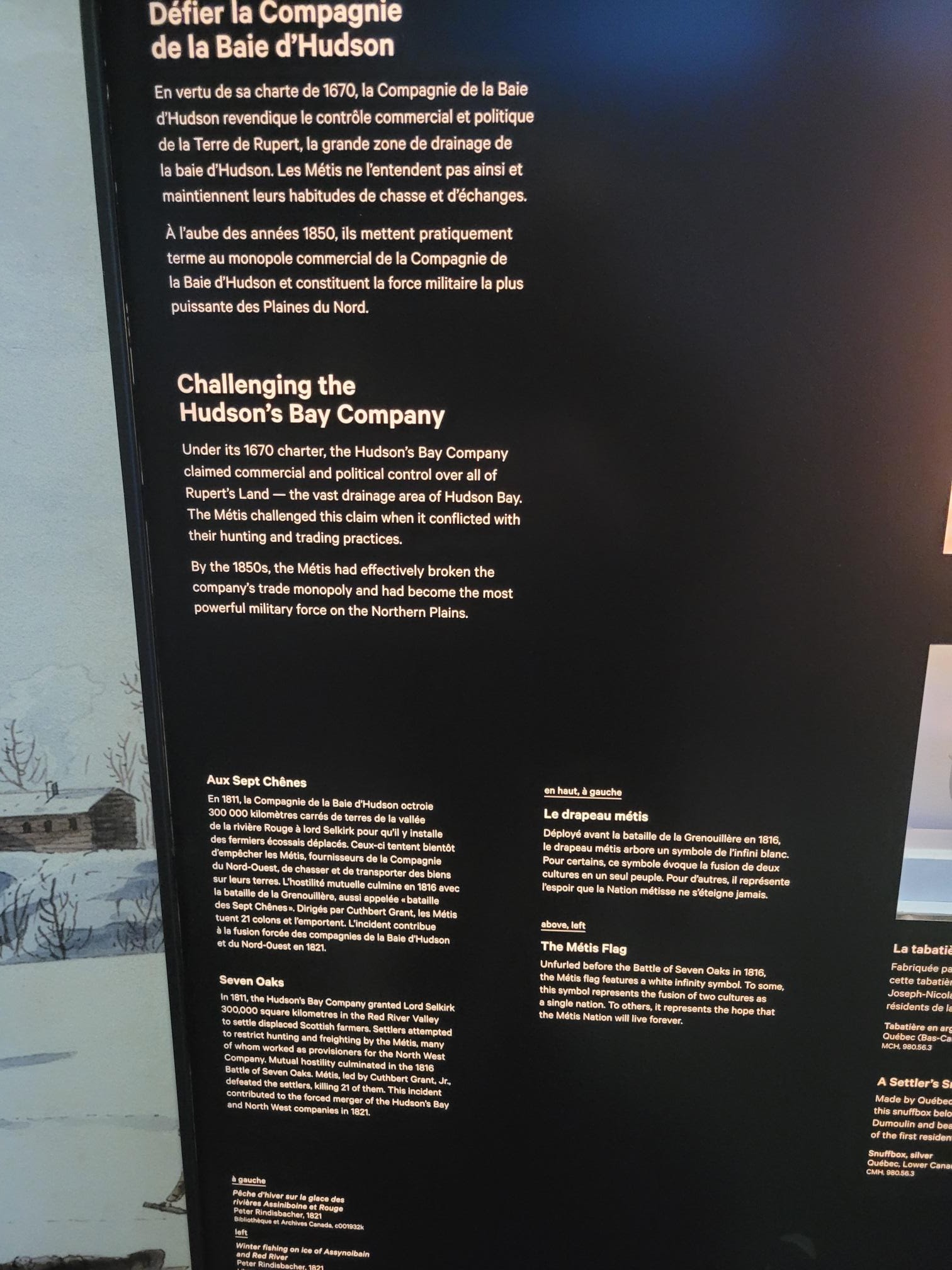
The Metis would in time begin to challenge the Hudson's Bay Company, which exerted commercial control of the vast drainage basin of the bay it was named for. This would ultimately bring them into conflict with the federal government.


The government sought to expand the country from sea to sea by incorporating new provinces and territories into Confederation. 


By 1870, the Hudson's Bay Company would sell their land holdings to the Canadian government. The Metis would find their strongest leadership under Louis Riel, who would in time be considered the founder of Manitoba.

Wednesday, January 24, 2024

Fathers Of Confederation

We begin today with three photographs of key Fathers of Confederation. John A. Macdonald, a co-premier of the United Canadas who would be the first prime minister of the country, is at top. His rival George Brown is at lower left. Macdonalds' co-premier George-Etienne Cartier is at lower right. Macdonald and Brown despised each other, but recognized the need to work as a team in uniting the colonies into one country.


Delegates would meet to discuss the concept of uniting as one country as the Civil War raged south of the border. 


This is one of the most famous photographs in the country's history- the Fathers of Confederation at the Charlottetown Conference.


The first to join the new country would be Ontario and Quebec (separated from their joint status as the United Canadas and back into two legislatures), Nova Scotia, and New Brunswick. Leaders would go to London to see their efforts approved by the British parliament. In the years that followed, more provinces would be formed, and the country as a whole would be established from sea to sea.


This is the dress coat and travel trunk of Cartier, who was one of the leaders who went to London.


The British North America Act was passed by the British Parliament, and Confederation gave rise to the new country.


One of its strongest leaders would only see a short period of it. This painting of Thomas D'Arcy McGee hangs here. McGee was a personal friend of Macdonald, as well as a member of the government, lawyer, and journalist. As a young man he had been an Irish radical, but after he came to North America, his world view changed.


He saw the value of British style Parliamentary democracy, and became one of its strongest advocates. His former comrades in the Fenian radical movement never forgave him for it, and he was assassinated in 1868.


This is the gun used in the crime.


The first Dominion Day- July 1st, 1867. 

Copies of the proclamation, in English and French, are seen here.