Wednesday, October 4, 2023

The Humble Beginnings Of Ottawa

 The Ottawa Locks have a series of structures around them as they climb the slope away from the river. Some, like the Commissariat, are still here. Others, like the similar structure on the east side of the Canal, are long gone. The lockmaster station at the top of the locks dates to the later part of the 19th century, while Sappers' Bridge was long since replaced by Plaza Bridge, though some of its foundation stones can still be seen today if you're beneath Plaza Bridge.


Historical plaques, in English and French, are mounted on the wall of the staircase going up to the second floor. 


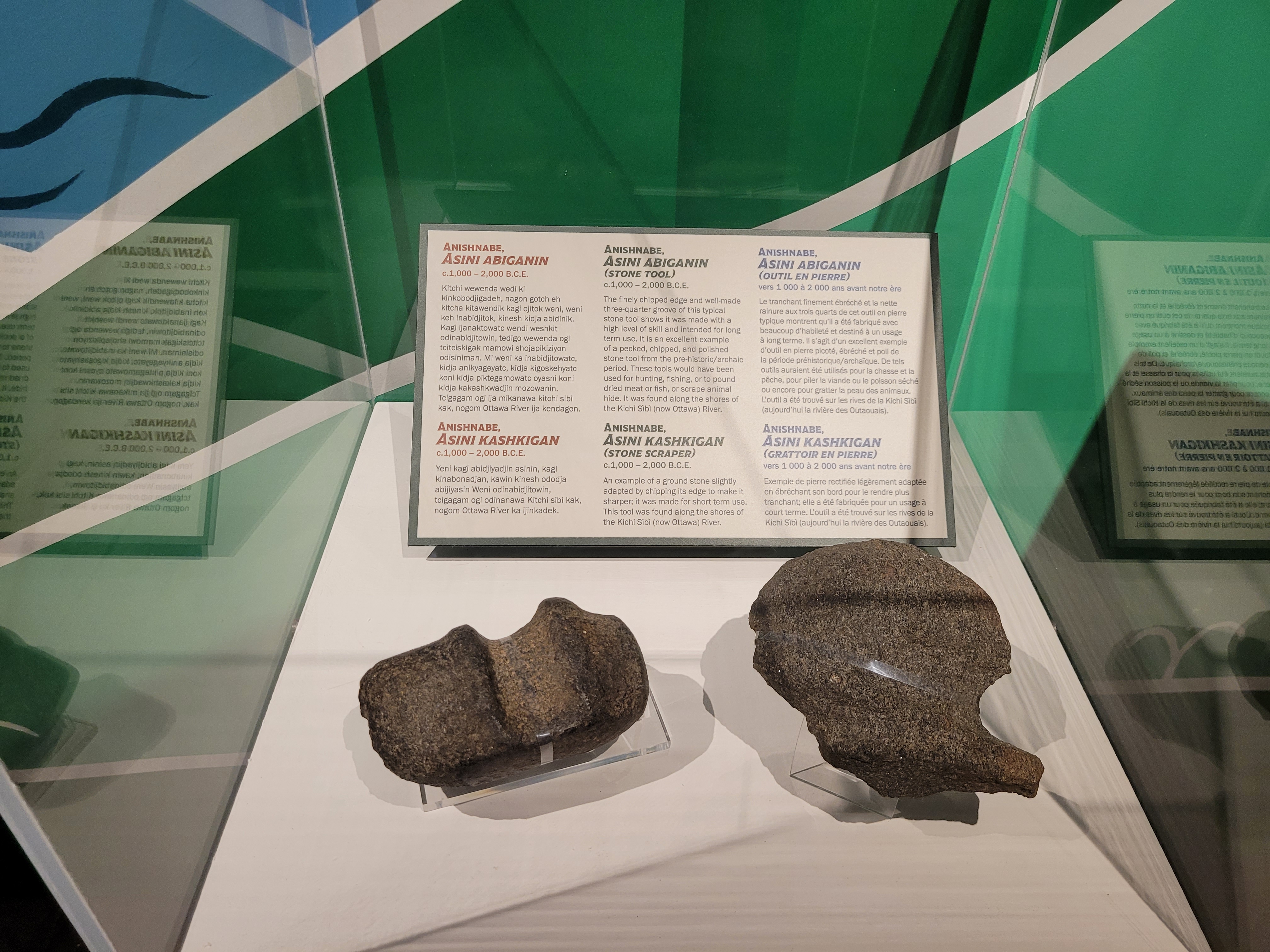
Here at the top of the stairs, plaques and displays note the presence of First Nations people through the Ottawa Valley for thousands of years.


These stone tools are a testament to their presence.

The Museum tells its story- of how with the building of the Canal, the town known as Bytown became a violent lumber town, but changed into the national capital after those turbulent early decades.


By would found the city, since it was the starting point of his Canal. After it was all done, he would return to Britain under a cloud of scandal for going over budget, and die soon after. However, he had done it because it had to be done or the project would have faltered, and history has vindicated him entirely. He'd be pleased to know his Canal is a World Heritage Site. This over-sized bust of him is here.


As mentioned before, the War of 1812 was a big factor in the decision to build the Canal. Tensions with our southern neighbours was common through the first half of the 19th century, ending after the Civil War.


This cannonball was shot from Ogdensburg in New York across the St. Lawrence at Fort Wellington. British defenders picked it up and fired it back. Now it rests here.


This is Colonel By's travel trunk. He and his wife came to British North America for the building of the Canal.


It was the men who did the hard work, overlooked at the time, but what they did was an engineering marvel.


By had commissioned cups to be given to some of the men who led work in their respective areas. This is the Drummond Cup, given to Robert Drummond, whose work area was around Kingston Mills.

Tuesday, October 3, 2023

Constructing A Route Through The Wild

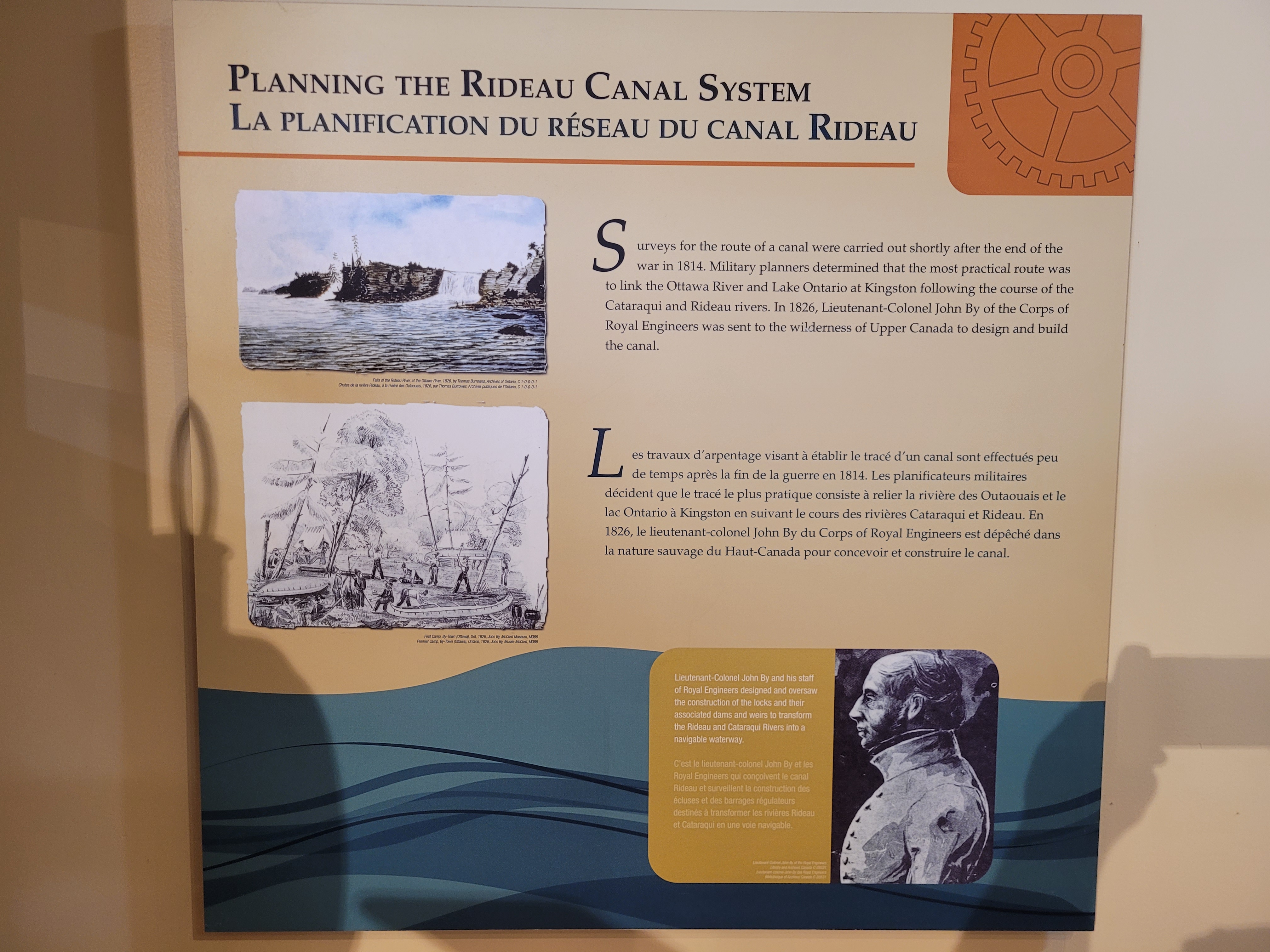
 The tensions of the War of 1812 pointed out the need for an alternate route inland from Lake Ontario, and the Rideau Canal became the answer. Lt. Colonel John By, a brilliant military engineer, was assigned to oversee the project, and organized and led it from 1826-32. Once he had boots on the ground and saw for himself what had to be done, he knew it would have to be different from what his superiors in London had imagined. 


It would be a difficult project, with the hard work of thousands of men, many of whom brought family with them. People died of sickness and accidents. 


Some of the tools of the time are displayed here.


It was once called Sleigh Bay, now called Entrance Bay. This wide stretch of the Ottawa River between Nepean Point (Kiweki Point) and Parliament Hill became By's starting point, with what became the Ottawa Locks as the biggest single stretch of locks in the entire Canal system, ascending up from the river.


A model of one of those locks is here.


By understood that steamships would be more important than the flat bottomed sailing ships that were primary in his day. He would oversee enlarged locks and wider canal areas to compensate. In doing so, he and those who worked on the project left a legacy that lives on today.


The Commissariat is part of that legacy, today serving as home to the Bytown Building, and solidly built.


A look into the entrance to the vault.


Looking up the narrow stairs. I must have missed this many time before I'd noticed it.


And into the vault itself, where goods and the payroll would have been stored in the time of the project.

Monday, October 2, 2023

A Place For Telling The History Of The City

 The Bytown Museum started its life as the Commissariat, a storehouse and headquarters for the building of the Rideau Canal from 1826-1832. It is the oldest stone building in the city, and today is home to a collection for local history focusing from time immemorial to 1920. It is a marvelous spot, with a few ghost stories, and well worth a visit.


Directly across the Canal from the Museum is a cliff- augmented halfway up by an artificial wall, which was once topped by a railroad track, long gone. A close eye might see the outlines of a building on that wall, long since gone, but which once housed offices for the Canal building process. An even closer eye might see a statue up above in Major's Hill Park.


That statue is Colonel John By, the British military engineer who led the building of the Rideau Canal in the first place. He's also considered the founder of what would become Ottawa.


The Canal is a delight.


Back up to have a look inside.


The Canal's first purpose was to be a military route inland from the St. Lawrence, at a time when there were high tensions with the Americans.


Its 202 kilometres from here to Kingston involve a series of locks and dams, noted here in red. A monumental project for the time, and one that lives on today.


It is now a UNESCO World Heritage Site.


Here we have a medical kit of the time, along with a display case containing mosquitoes. Malaria was a big killer of the men who built the Rideau Canal. More than a thousand of them died during the years the Canal was constructed.

Sunday, October 1, 2023

City Daily Photo Theme Day: Transportation

The first day of each month is a theme day for members of City Daily Photo, and for October that theme is Transportation. Check out how others are interpreting the theme right here.

My focus for this one is the Rideau Canal, a water route that passes between Ottawa and Kingston, built nearly two centuries ago and still used today as a recreational waterway. I was out at the Bank Street Bridge late one night, where the bridge crosses from the Glebe on the north side into Old Ottawa South on the south side. The Canal itself was still this time of night, reflecting the lit arches of the bridge. I was standing on Queen Elizabeth Drive- one of the parkways of the city- and a bike path was close by, separated from me by a strip of grass. Transportation in more than one way: water route, bike and walking path, parkway, and major city street going over a bridge.


The Canal was built as a military and economic project, at a time of tensions with our American cousins, requiring an inland route connecting Lake Ontario to the Ottawa River. Along its course, much of it involving the Rideau River, it crosses over heights or compensates for areas where the natural water course is too shallow for boats. The rise of the railroad ended its economic importance, but the Canal became well known for recreational boating. This shot looks east, taken from the bike path. The Canal is black in the night.


Crossing over to the west side of the bridge, I took these shots.


Some days later, I was downtown, where the final stretch of the Canal is found here, amid landmarks, like the Government Conference Centre at left. Canada geese were down below.


This view looks north from the same bridge, Plaza Bridge, over the Ottawa Locks, where the Canal descends to meet the Ottawa River. Parliament Hill is on the west side, while the Chateau Laurier hotel is on the east side. It is here at these locks where the Canal makes its most dramatic descent or ascent along its entire length.


I headed beneath Plaza Bridge, the most recent of the bridges that crosses this spot, and photogenic, with this graceful curve around the staircase.


The arches continue over the Canal itself.


A boat was in one of the locks.


Canada geese, who provide their own transportation, were having lunch and resting in the grass on the slope by the Canal. They'll be making their way south soon.


Walking out onto one of the lock bridges. The Bytown Museum, at left, is where we'll go next, starting tomorrow.


A look up. The Chateau dominates this view on the left.


Where the Rideau Canal meets the Ottawa River. The last lock opens here.


And here, where the Ottawa River is wide, we get a look across to Gatineau on the far shore. The Ottawa River, itself a major route of transportation for thousands of years, has seen much. This spot is a particularly appealing location for me.