Wednesday, September 4, 2024

Life In The First Gilded Age

 I continued along the path.


The age of metal changed society significantly, as people began to extract metal from the earth and learn how to work it. It became the Copper Age, and if you controlled the supply of precious metals in your area, you grew more powerful.


This display case features replica and original copper axe heads- the left of each pair being the replica and the right being the original. Copper starts out gleaming, but the gleam fades.


These ceramic models are from the period, depicting homes. At bottom, items of a gold hoard.


More gold.


A mix of items from the Yamnaya, a tribe of nomads that came into the area 6000 years ago. Animal sceptres, plates, jugs, or hair rings are seen here.


The copper age began significantly changing things, with trade routes growing. This ceramic wagon represents the sort that would have travelled those routes.

Tuesday, September 3, 2024

Back Through The Mists Of Time

 More today from this exhibit. This display case features ceramic altars.


These are thought to represent deities, and were kept in shrines in homes.


This is on a larger scale, with more questions than answers. The world of archaeologists.


Over time, villages began to grow.


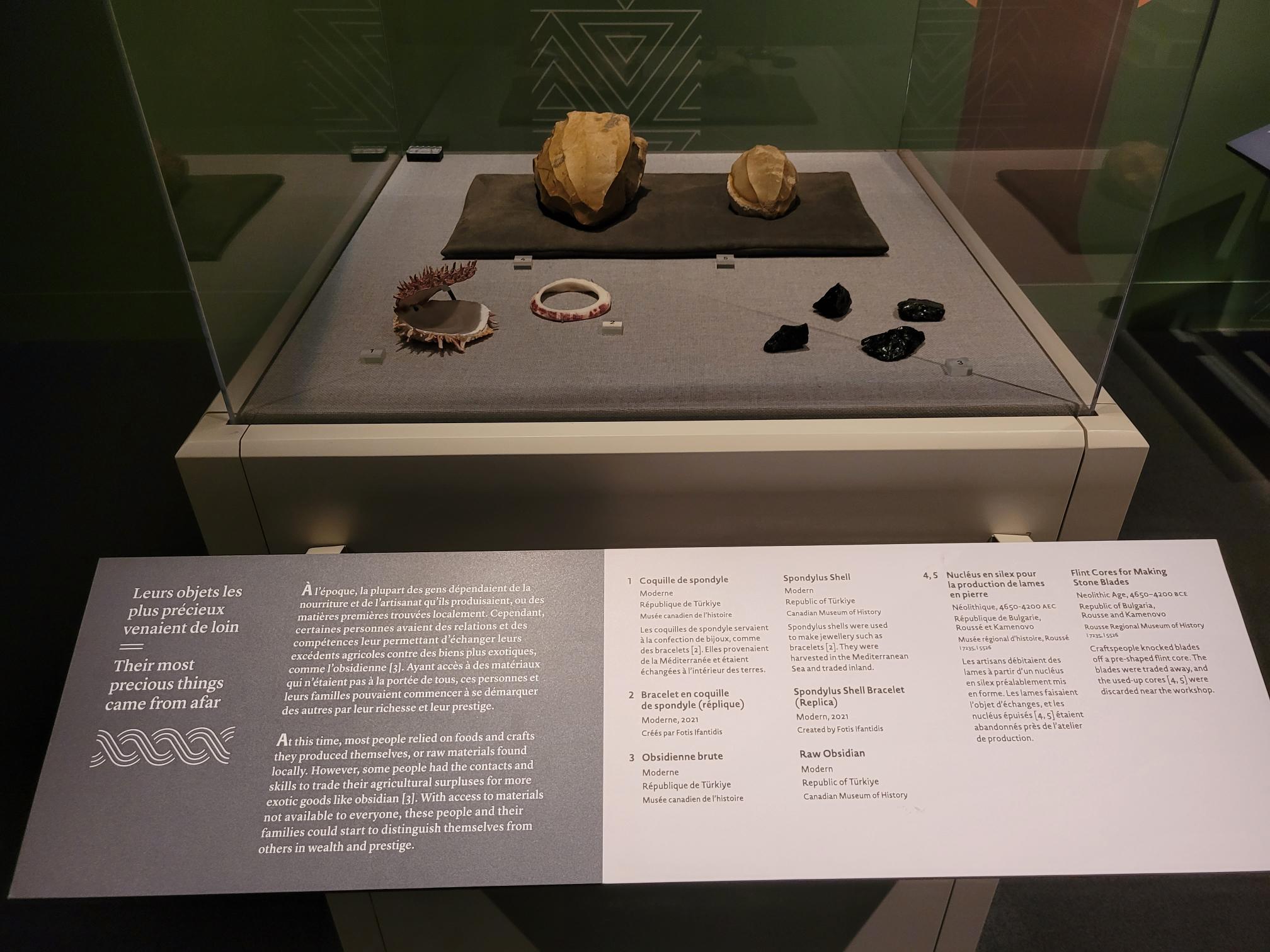
Items in this display case include raw obsidian, flint cores, and shells. Trade made acquiring such things possible, as long as you had an excess of your own resources in turn.


We can learn about them from their burial traditions. A display goes into detail on a woman who would have had some high standing in her community, based on what was found in her grave, long after her remains were gone.


They are arranged in this case as they were found, along with an interpretation of what she might have looked like.


Farming had become widespread in this part of the continent by this era. Barley and wheat were cultivated. Livestock were kept. If your family had excess harvest beyond its own needs, you could trade, and prosper.

Monday, September 2, 2024

The Canadian Museum Of History

 I went over to the Canadian Museum of History to see the current temporary exhibit. Here is a view of the curatorial wing from the east. The flowerbeds are quite different from my last visit in May, when they were filled with tulips.


The graceful curving lines of the Museum are the design of First Nations architect Douglas Cardinal, who lives in the area, and this place is deemed his masterpiece.


Between the wings, we look across the Ottawa River to the Ottawa shore. This museum is the only one of the seven national museums in the area to be on the Gatineau side of the river.


The current special exhibit looks at the early development of royalty in Europe, namely in southeastern Europe, in the pre-Roman era. It starts with an artifact that is, by comparison, relatively new.


This is a replica, but one of the last commissioned crowns in Europe, made for Queen Marie of Romania.


This exhibit is the work of the Field Museum in Chicago, which organized it in collaboration with a number of museums in southeastern Europe across multiple countries.


The story begins thousands of years before the current era, before the very idea of royalty existed in this part of the world.


These figurines date to the Neolithic era.

Sunday, September 1, 2024

City Daily Photo Theme Day: Bridges

The first day of each month is a theme day for members of City Daily Photo, and for September, that theme is Bridges. Take a look at how others are interpreting this theme right here.

I was down near the Rideau Canal on Colonel By Day in early August, and took this shot from the terrace of the Chateau Laurier. In the background is Plaza Bridge, the first of the bridges the Canal passes under on its route to Lake Ontario. 


This shot from on the bridge itself shows the Ottawa River in the distance, at the bottom of the Ottawa Locks, where canal meets river.


The underside of the bridge features graceful arches over the Canal and the adjoining walking areas.


Down at the bottom of the locks, this view over the river takes in the Museum of History on the far shore, and the Alexandra Bridge that spans the river.


Here we have the other side of Plaza Bridge, with the Chateau in the background.


On another day, I went out to the Chaudiere Falls, and took this shot of the Chaudiere Bridge, which crosses the Ottawa River just downstream of the torrent.


After my visit, I looked west and photographed the William Commanda Bridge. This pedestrian and bike bridge is a former rail bridge with a lot of history. I have never actually been on it. It spans a wide section of the river, passing over an island en route.


I proceeded on and found myself on another pedestrian bridge. I was familiar with this one, but always thought it to belong to the hydro operations around the falls, as the gate at the far end had been consistently closed. This provides an easy link between the parkland around the falls, and the Canadian War Museum, which can be seen at the end of the path.


I was on the Alexandra Bridge crossing over to Gatineau to visit the Museum of History. The bridge is in the midst of an extended rehabilitation project, and is presently only open to pedestrians and cyclists, occupying the central lanes where cars usually travel.


And lastly, I finish with the Portage Bridge. I come out here twice a month to photograph the view of the Ottawa River downstream, and from the spot where I generally take the shot, I turned and photographed this view of the bridge itself heading into Gatineau.