Monday, September 9, 2024

The Changing World

 Picking up where I left off yesterday, here we have items of the Iapoda people.


The developing kingdoms of Illyria, Thrace, and Paeonia had connections to the wider world, as these items, found in that part of the world, had origins elsewhere.


This funerary urn bears markings of the Iapoda people.


Here we have a stella, depicting the funeral of someone of importance.


Tumuli were the burial places of nobles in the region during this era, and many of the pieces were found in them. 


Here we have wine vessels.

Sunday, September 8, 2024

Exquisite Craftsmanship

 The emergence of craftsmanship during the Iron Age is a sign of a larger and more complicated society. This display case includes jewelry. 


Another case includes a magnifying glass- handy for looking at its occupant, a finely crafted gold earring that still shows remarkable detail after all this time.


This case caught my eye. They were found in the grave of an Illyrian woman of high standing.


Ceremonial items in this display case would have belonged to a priestess of the Paeonian people.


This amber breast ornament was found in Croatia, where amber was a rarity.

Saturday, September 7, 2024

Rituals And Supersititions

 A closer look at objects in the hoard I left off with yesterday.


Death ritual in the Bronze Age is examined. The custom was cremation.


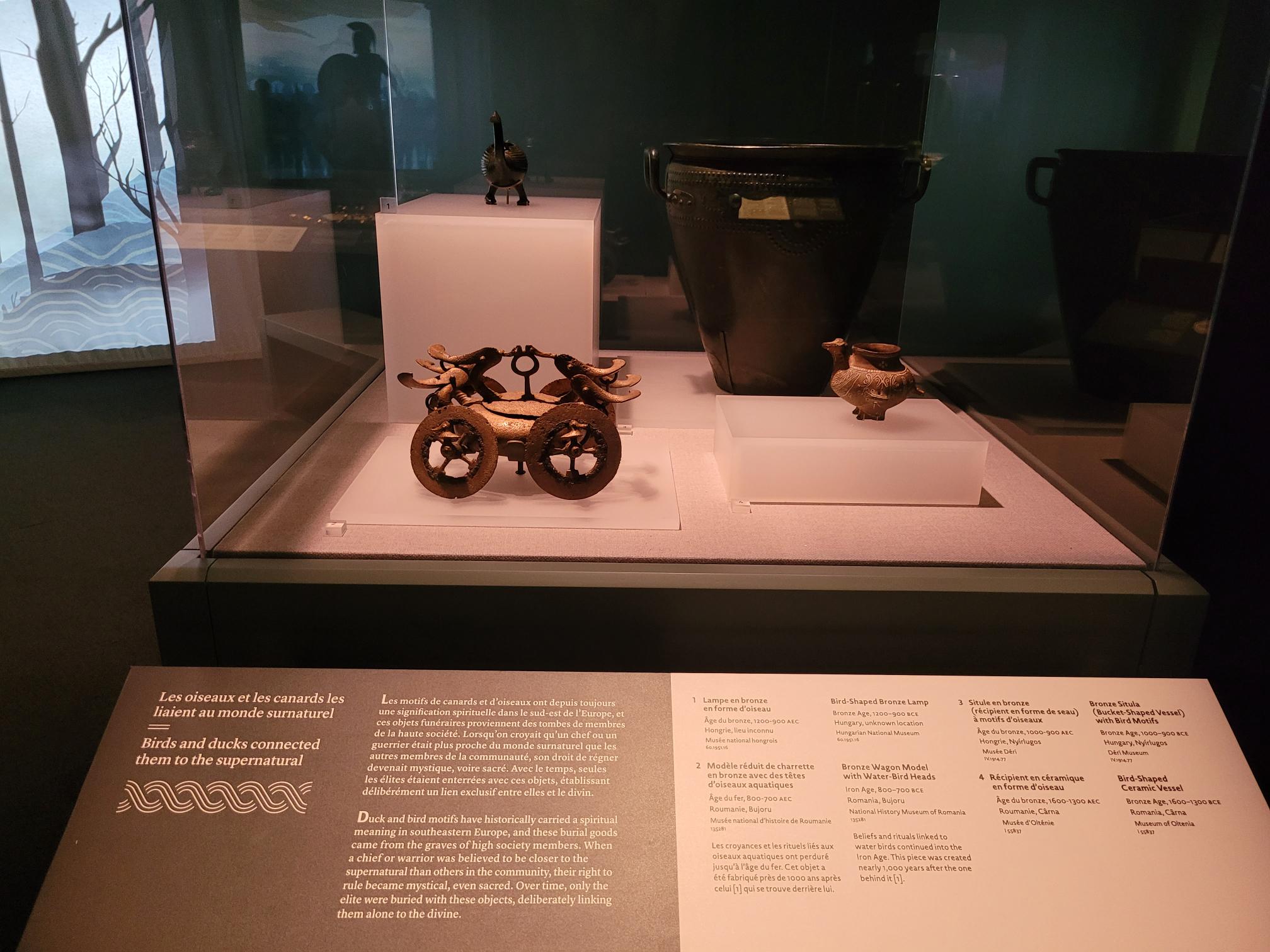
Ducks and other birds played a part in the spiritual life of these people, and if what was left of you was buried with such objects, it marked you as someone of high standing in that community.


An urn is part of the display, looking not that dissimilar to what is used today.


Trade with other regions brought in other ideas, with the Greek influence showing here.


A new era was coming. It would be the iron age, and the ascension of kings and queens.


Iron ore was hotter to work with, but by 900 BCE, people in southeastern Europe were doing so. In this display case is an iron sword- its wooden handle long since gone. Iron degrades over time too, but not as quickly.


Here we have a contemporary replica.

Friday, September 6, 2024

The Elite Warrior Tradition

The items in this display case come from different people, but are typical of that of the bronze age warrior.


More weapons in these cases, along with a contemporary replica.


A bronze sword, axe heads, and an arm guard. The sword when you see it in person is rather small.


You can touch this contemporary replica.


The next case over, another sword, and more axe heads.


The growing elites- the chieftain-warriors and their families- liked to show off. Examples are seen in these jewel pieces.


And they would dine well, with bronze and ceramic bowls, plates, and utensils.


This is the last of the Sarasau Hoard, found in the mid-19th century, with much looted after it was discovered. These remnants belong to two national museums in Hungary and Romania.

Thursday, September 5, 2024

Mysteries Of A Bronze Age

 Continuing on. The items in this display case were found in a cenotaph- a symbolic grave with no body in it. The word carries a slightly different meaning in the current era as a memorial for collective remembrance of the war dead in towns and cities.


A variety of objects- jewelry, tools, utensils.


The burial of precious items was a common theme in the era, as hoards continue to be found today.


When horses came into the region from the east, it would change everything, bringing new goods, expanding trade. And those who controlled the supply of horses would control the rest. Sound familiar?


Bronze came into being in this era- an alloy of copper and other metals like tin. It created a stronger metal and became the name of the new age.


Gold was known, but a softer metal to work with. Making weapons of gold was about showing off.