Monday, November 26, 2018

The Deepening Chill

"War is hell, Mr. Thornhill, even when it's a cold one." ~ The Professor, North By Northwest

Out of the aftermath of the Second World War came the Cold War between West and East, between NATO and the Warsaw Pact. The War Museum's next section starts to examine that with early causes and events, including the Berlin Airlift, which Canadians had a hand in.


The Korean War also rose out of this period, and the Canadian military sent troops, sailors and airmen off to the other side of the world as part of the effort against North Korea and their Chinese benefactors. Not all of them made it out of North America- this panel shows the aftermath of a collision of two trains in November 1950 near Canoe River, BC. Gunners of a regiment bound for Korea were on board, and seventeen of them were killed.


Ted Zuber had been too young for service in World War Two, but joined the Korean War as a soldier, enduring the harshness of the land and the ferocity of the opposition until wounded in combat. He had carried a sketchbook with him, and years later would start to paint his memories on canvas. The War Museum has several of his paintings from this war and Desert Storm in its collection. Zuber was commissioned by the military to create war art during that latter conflict, went to the Middle East with the troops, and is the only Canadian to receive medals for service in both the Korean and Persian Gulf Wars. A few days before Remembrance Day, the news came out that he had died after a bout of cancer.

This first one is a reproduction, as the original is presently out on loan, according to the accompanying display. Day Break- Gulf Of Korea depicts a Canadian destroyer off the North Korean shore, opening fire on enemy trains on the coastal railway. I chatted with an officer here about the cold look of the mountains. For whatever reason it's easy to not think of the Korean peninsula as cold and rugged, but that war proved otherwise. The Koreas can get brutally cold temperatures coming down from Siberia, and we talked about a novel we'd both read, The Frozen Hours, by Jeff Shaara, which tells the story of the Battle Of The Chosin Reservoir.


Other Zuber paintings are close by. First Kill- The Hook depicts a sniper and spotter position at the front.


Holding At Kap'yong is another, depicting Canadian soldiers on the high ground in the midst of battle. An accompanying quote from 1999 by Donald Hibbs, a corporal at the time and a survivor of the fight, accompanies the painting. "I believed that night that maybe we weren't gonna be here tomorrow. I believed that we had to go down fighting. You know the old gung-ho, but I wasn't gung-ho: I was praying that I could survive the day."


This panel featured a movie poster- I've heard of the movie but have never seen it. The panel beneath explains that it's based on the American Fred Demara, who posed as a Canadian medical officer during the Korean War using stolen documents.


A spot here in the Cold War section that I always liked to stop at is this set up of a command centre, circa the 1970s or so. On two large screens, different scenarios of World War Three play out.


Equipment and vehicles, such as this tank, can be found here, representing both NATO and Warsaw Pact armaments.


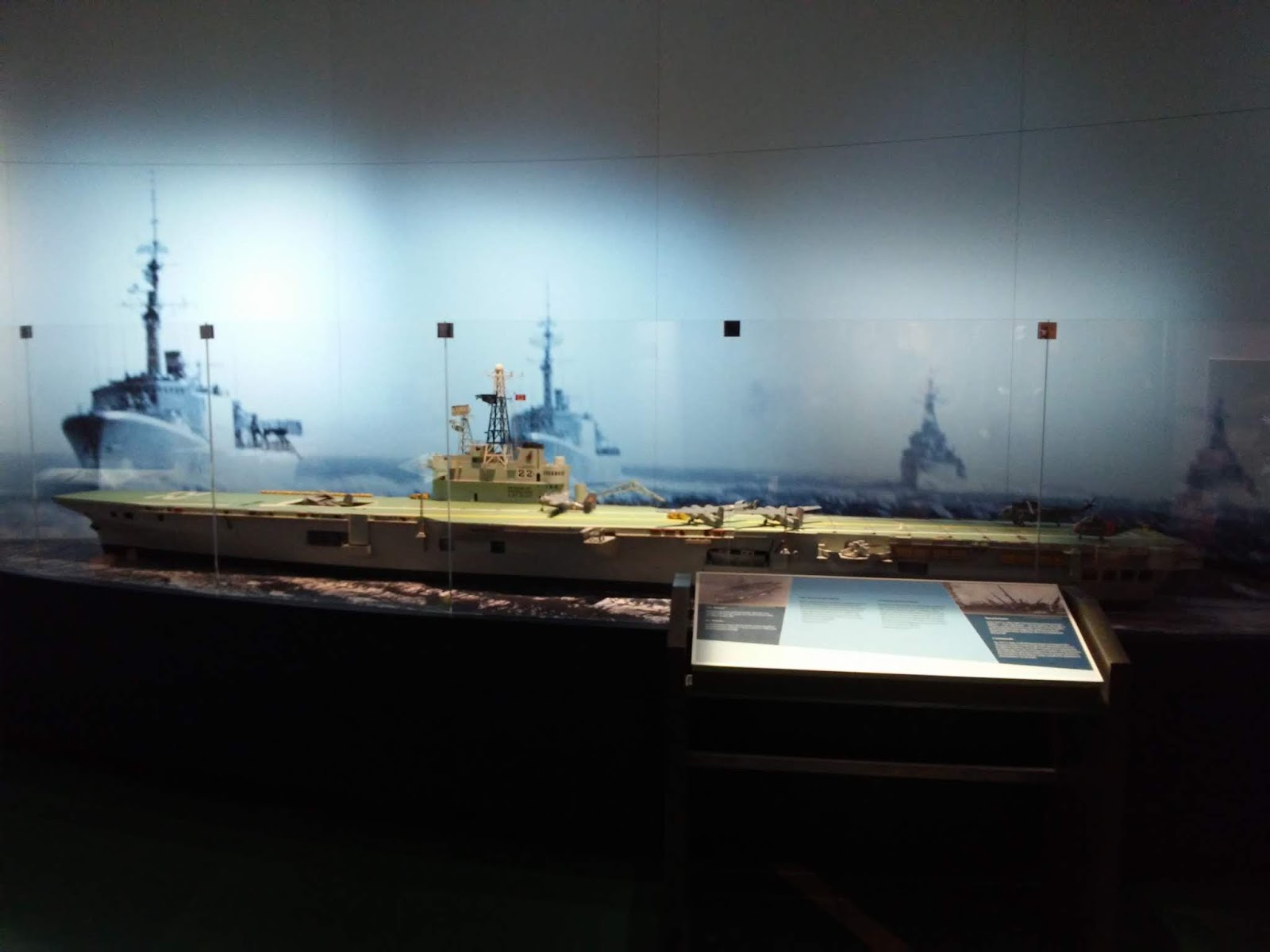
This is a full scale model of H.M.C.S. Bonaventure, a Canadian aircraft carrier that was in service with the navy from 1957-70.

This panel examines a tragedy involving a Canadian destroyer in 1969- an explosion and fire on board the H.M.C.S. Kootenay that cost the lives of nine sailors but was contained through the work of the crew.


While this panel looks at our complicated relationship with our southern neighbours.


NORAD has been a joint air defense partnership with the Americans that sprang up out of the Cold War. This is the crest.


And today I leave off with what was beneath the crest, something for a northern environment. This machine gun has been fitted with a toboggan mount for towing behind a snowmobile in Arctic conditions.

Sunday, November 25, 2018

Heading For Victory

The Canadian military put most of its efforts into the war in Europe and the Battle of the Atlantic during World War Two, but it did commit assets into South East Asia and the Pacific in a variety of ways. Panels and artifacts are found in this section as the Museum's focus on World War Two nears its end.


This display case includes wreckage and artifacts from a Canadian Dakota transport plane which crashed in Burma during bad weather on the 21st of June, 1945. All six crewmen were killed, and the site itself was only discovered by a local hunter in 1990. 


For the Pacific theatre, the war ended with the atom bombs dropped on Hiroshima and Nagasaki. The fragment of a roof tile in the display case was on a temple in Hiroshima, and exposed to temperatures in excess of 6000 degrees Celsius for one tenth of a second.


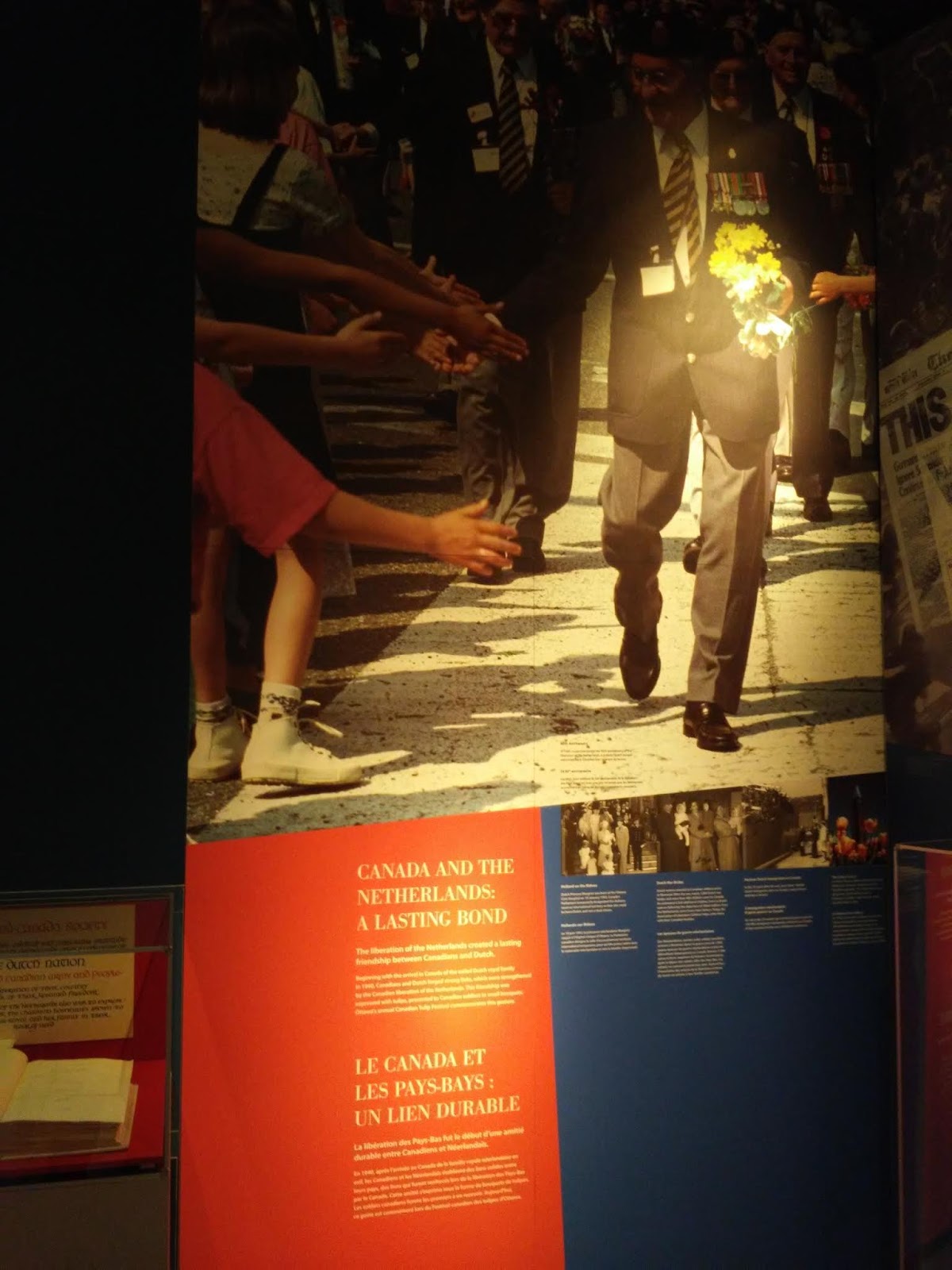
For the Canadian military in Europe, victory came in the Netherlands. The army, supported by air force elements, swept through the country and liberated it from Nazi occupation. This area examines the last months of the war for the Dutch, and the bond between countries that has persisted ever since. For me it's a personal area- my family came from the Netherlands, and both my parents were old enough to have clear memories of the war. The last winter was particularly harsh, called the Hunger Winter, and the stories we were told made it clear- had the war gone on for a few months more, one of them or both of them would have died. So I've always felt very strongly that I owe my existence to Canadian soldiers who freed that country.


A captured Nazi flag with photographs of newspapers and scenes provides the other part of the ending of this section of the Museum.


What lies beyond is a legacy of that war. Artifacts, panels, and photographs are found immediately beyond the end of the World War Two section about the Holocaust. The fate of a family is examined in this panel.


The photographs are haunting and difficult to look at, but necessary to do so, especially in an age where denials of the Holocaust still happen, and where tiki torch toting white supremacists defiantly march on city streets and scream, 'blood and soil' while their cheerleader in chief shrugs. The quote at the top of this shot, in English and French, is from an RCAF officer who saw the death camps and knew that this alone was justification for World War Two. The dress belonged to a survivor of the Holocaust, Helene Garrigues, a French Resistance member who was arrested and sent to Ravensbruck.

Saturday, November 24, 2018

The Bloody Battle

D-Day. June 6th, 1944 was months in the planning- the invasion and saving of Europe by Allied forces. With air and sea support and paratrooper insertions, Allied soldiers began turning the tide of the Second World War at five beaches in Normandy, France that morning- Utah and Omaha for the Americans, Sword and Gold for the British, and Juno for the Canadians. The Normandy campaign is extensively covered here in the War Museum.

A balcony here looks out onto Lebreton Gallery, which is filled with military vehicles and other equipment from Canada and other countries, and which is an area that concludes a visit to this museum. It is dominated by the CF-101F Voodoo fighter jet. 


Stepping back into the exhibit gallery we return to panels and artifacts of Normandy.


They include this Sherman tank, one of many that was involved in the Normandy campaign.


The Allied western military kept pushing the German army back through Europe. Canadians found themselves driving into the Rhineland and into the Netherlands as part of that effort.


Here we have another set of panels on individuals involved in the Rhineland campaign.


This painting, Scheldt Crossing, is by Orville Fisher, and shows the dismal weather that Canadians dealt with in the Rhineland.


Today I finish with this Jeep and another perspective on the panels of those soldiers. You might also note the pistol in the display case in the background. I didn't photograph it in close up this time, but it's one of my favourite artifacts here. A wounded Canadian soldier was taken prisoner by Germans, but grabbed one of their guns and forced them to take him back to his lines, taking them prisoner instead. That pistol is now given pride of place in the Museum.

Friday, November 23, 2018

Into The Storm

The section on World War Two at the War Museum opens with displays putting into context the global situation in the 1930s with the rise of what would become the Axis- Nazi Germany, Italy, and Japan, and the measures they were taking in their own ambitions in the years leading to war. Canada joined the war from the beginning, and it is covered extensively and chronologically in this area. This first shot, featuring a German torpedo at the base of a series of panels about U-Boats off the Canadian east coast. A map of the area is at the right, littered with dots indicating ship sinkings, shelling of shore positions, and insertions of enemy agents. 


Canada also found itself at war with Japan in December 1941. In the span of the same few hours in which Pearl Harbor was attacked, the Japanese struck at targets in Asia, including Hong Kong, where Canadians were among the garrisons stationed. The Battle of Hong Kong ended in defeat and POW camps for the Allied troops stationed there.


The home front was affected by the war, of course, and there are a series of propaganda posters of the era placed on a wall here. This is one of them.


This painting depicts another aspect of life at the home front. Massey Ferguson During World War II was painted by A.J. Casson (another member of The Group Of Seven). The Massey Ferguson plant in Brantford, Ontario, is the subject of this painting and captures men and women working on building naval guns.


Women served in various capacities in the military branches during the war, and there are displays on their role, including a uniform and panels on the Canadian Women's Army Corps.


Life at home also included rationing at grocery stores. This display features wartime products.


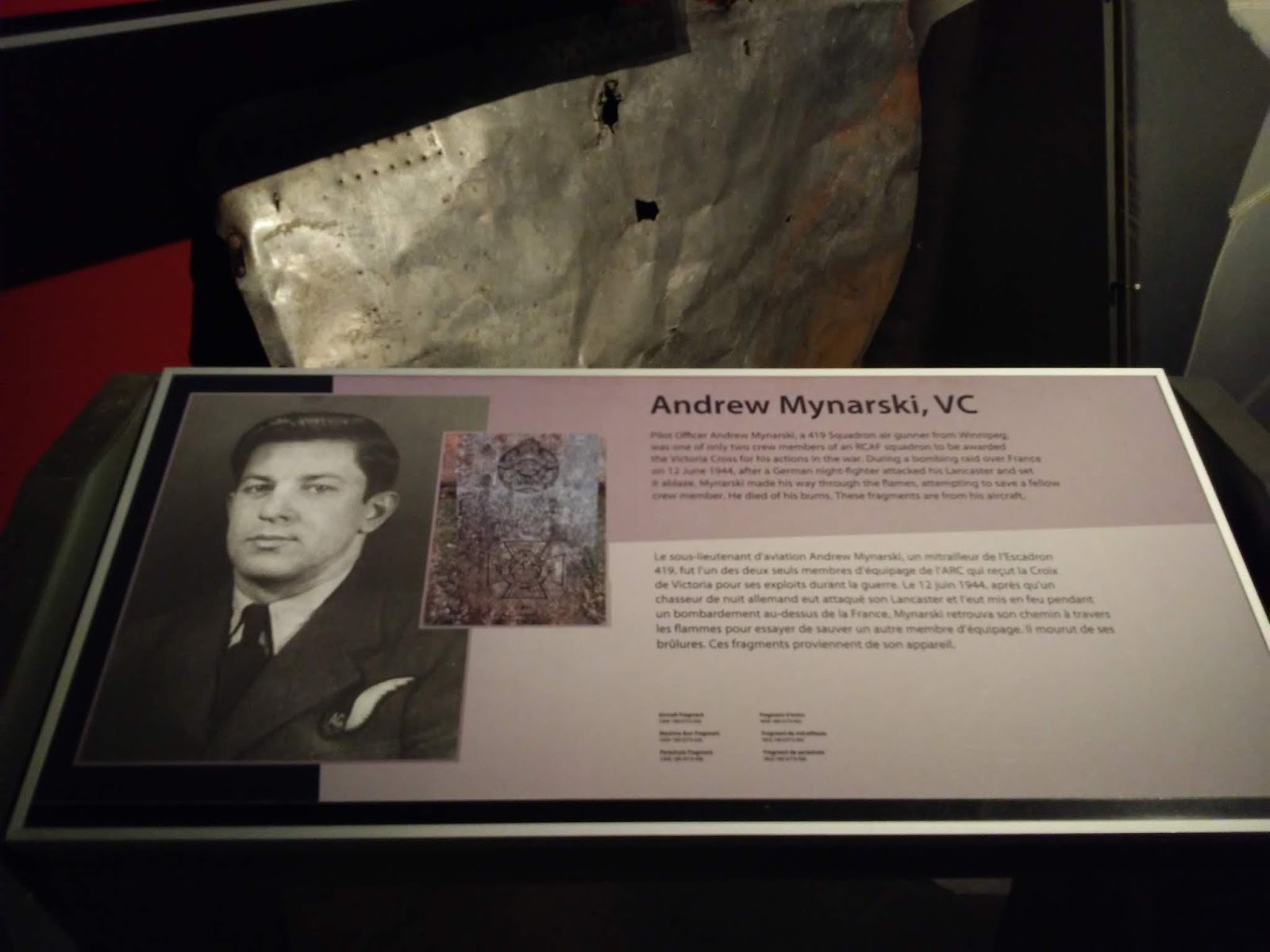
Fragments of a Lancaster are found here, with a panel on Andrew Mynarski, a bomber air gunner with the Royal Canadian Air Force, one of the crew members of the Lancaster in question. He posthumously won the Victoria Cross for his actions in a June 1944 raid over France in which the Lancaster had been attacked by a Luftwaffe fighter and set ablaze. Mynarski went through the flames to try to save one of his fellow crewmen, and died of burns afterwards.


The Spitfire was heavily used by the RCAF throughout the war.


Canadian troops were part of the Italian campaign, and that is examined here in the WW II section. William Ogilvie painted Entry Into Assoro, Sicily, depicting the entry of Canadian soldiers into the town on July 22nd, 1943 after fighting their way up the mountainous terrain.


Casa Berardi is a painting by Charles Fraser Comfort, an officer who by 1943 was commissioned as a war artist. He depicts the Royal 22nd Regiment in the midst of battle against Germans. Their victory would open the way to Ortona. 


Today I finish with another example of the panels one finds on individuals throughout the Museum- in this case a general and a private. General Burns and Private Smith both served in the Italian campaign.