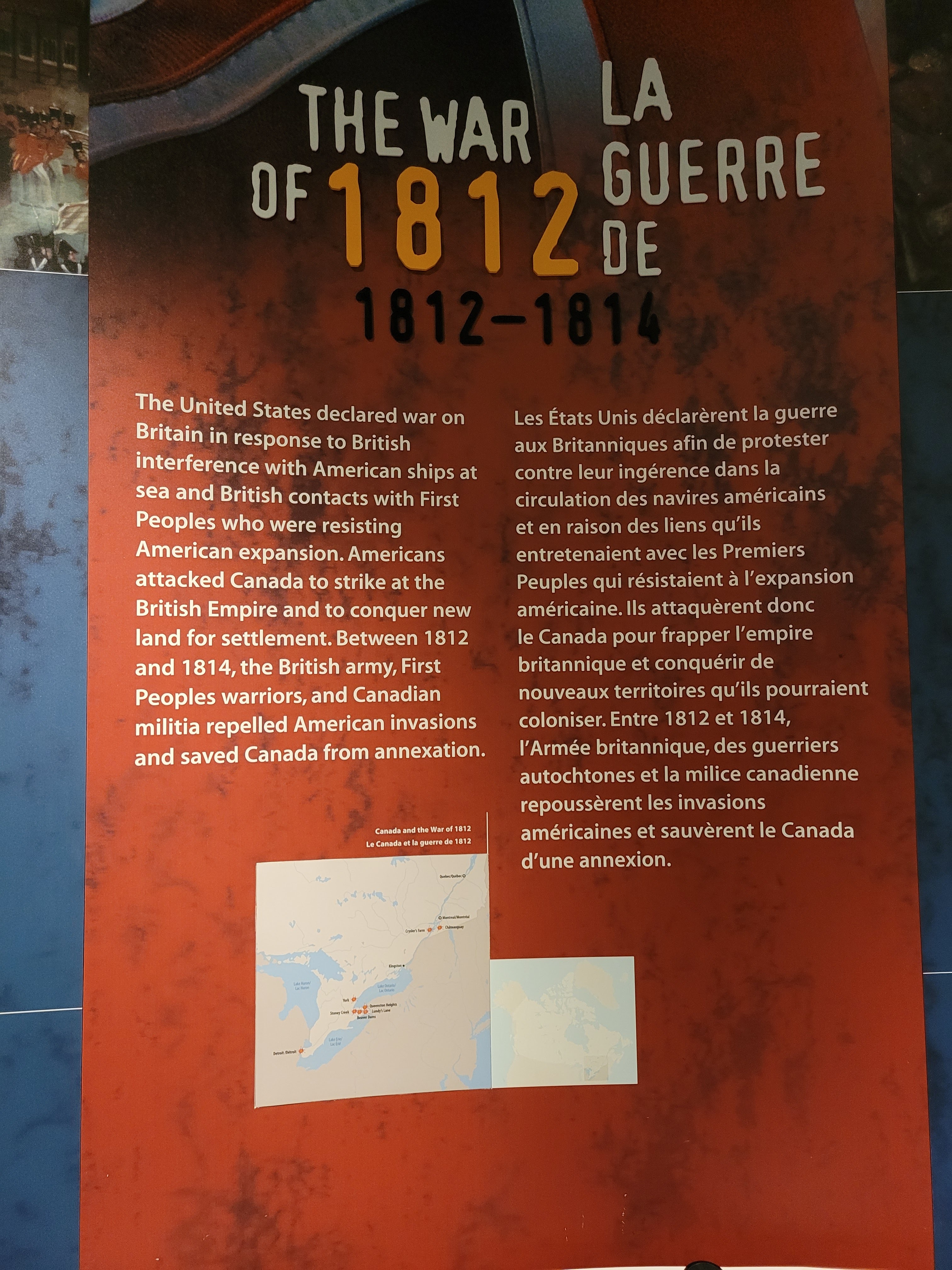
The War of 1812 was a momentous time in Canadian history, with British regulars, colonial militia, and First Nations warriors fighting American soldiers across the frontier. The American objective was to push the British out of North America once and for all. Ours was to deny that. Guess which side achieved their objective.
Saturday, November 26, 2022
Perpetual Tension
Prominent in this display case is a uniform coat of particular significance. It is the coat of General Isaac Brock, who led our side at Queenston Heights and was shot down by an American. The hole where he was hit is still visible on the coat, just beneath the overturned collar.
This period was, to say the least, not the most ideal for battlefield medicine. Doctor's tools are seen in this display case.
Charles de Salaberry was a rarity of the time- a Francophone officer serving in the British military, born in Quebec and who distinguished himself time and again during that war.
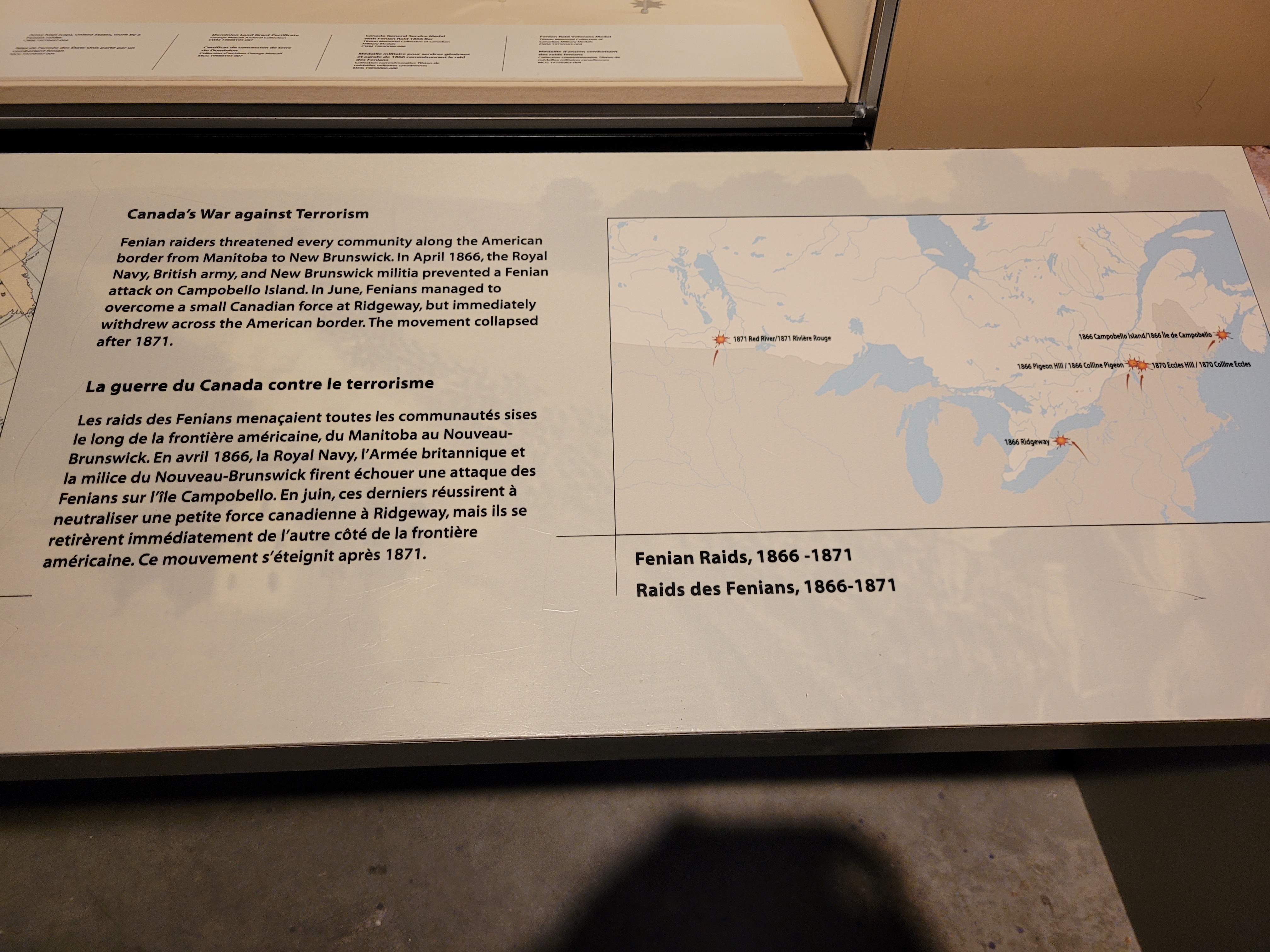
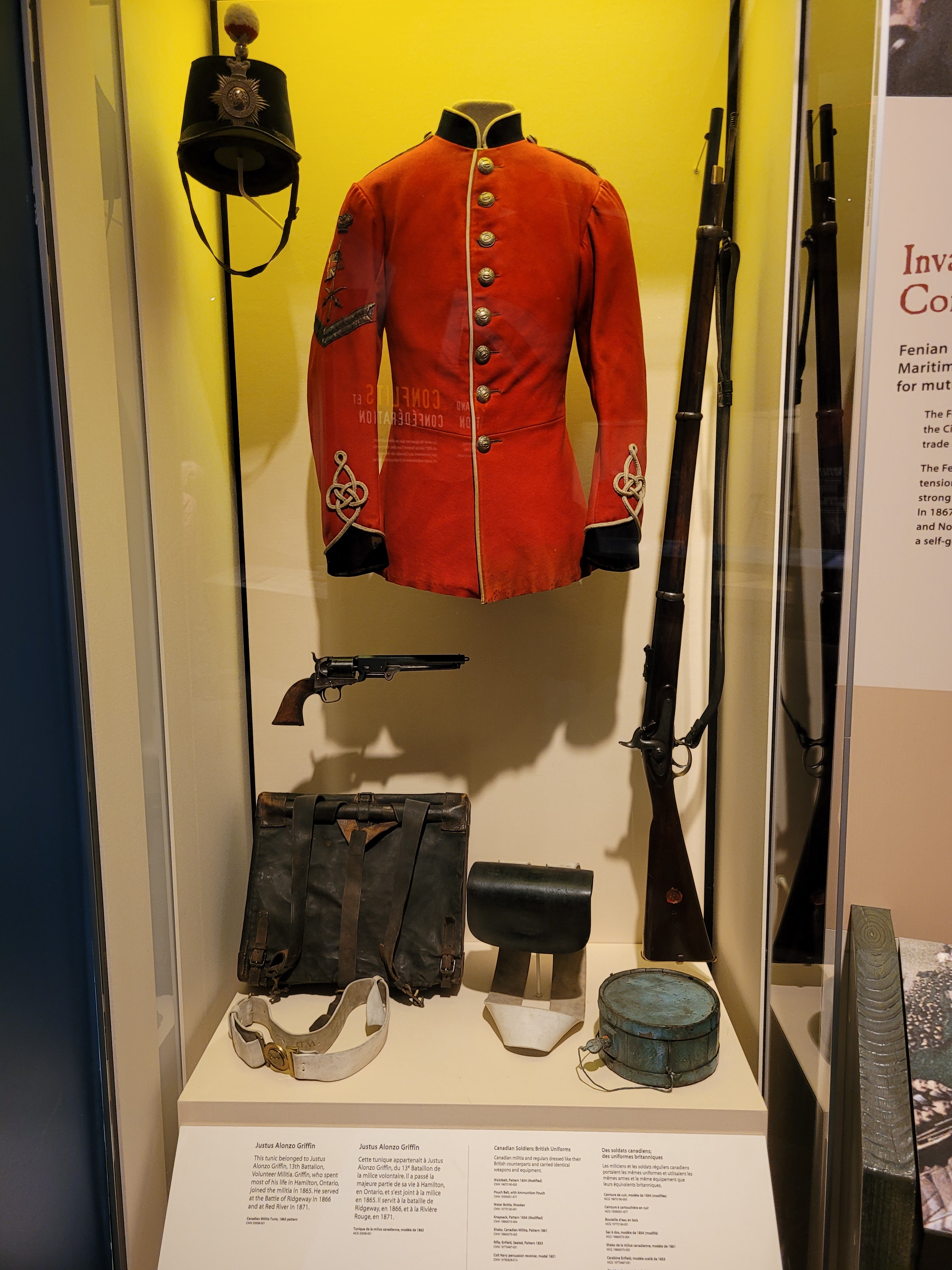
Tensions with the Americans persisted for decades afterwards. This display case contains items pertaining to the culmination of that tension- the Fenian Raids. A certificate, medals, and Union soldier's cap are here. The Raids were in the aftermath of the American Civil War, when Irish American veterans of that war banded together and launched raids into Canada in an attempt to force the British to give up Ireland. Each time they were pushed back. The Civil War and the Fenian Raids solidified the Canadian provinces into Confederation as a response to seeing the chaos from south of the border.
This display case features items belonging to a typical Canadian militiaman of the time.
A look into what comes next.
Friday, November 25, 2022
The Revolution
The years after the end of the French and Indian War would set the stage for the American Revolution in North America. What would come of it would, in the long run, be two countries: the United States and Canada. This is the uniform of a Loyalist soldier from New York who sided with the British. Following the Revolution, many Loyalists would start a new life in Canada.
Some artifacts of the time are displayed in a case here.
This reproduction of an engraving is one of history's ironies. Early in the war the Continental Army had sent troops into Quebec in an attempt to capture Quebec City. The effort failed. One of the commanders was Benedict Arnold- yes, that one. Had he died of his wounds at the subsequent Battle of Saratoga, he'd be remembered today as one of the great heroes of American history, instead of as a traitor to the cause.
The weapons in this case date from both the Revolution and the War of 1812, in which the Americans took on the British and Canadian settlers in an attempt to drive the British out of North America once and for all.
This is a model of the H.M.S. St. Lawrence, a ship of the British navy at the time. Today it rests at the bottom of the harbour at Kingston, Ontario.
Items in this case include things like a musket, club, tomahawk, and replica wampum belt. The portrait is of John Norton, who led First Nations warriors in the defense of Queenston Heights during the War.
Thursday, November 24, 2022
New Contacts
Viking sailors reached the New World a thousand years ago, settling for a brief few years in Newfoundland (and probably further elsewhere in North America) and coming into conflict with Indigenous peoples.
Centuries later other Europeans would make their way to the New World. By this time they had firearms- which changed the way First Nations peoples conducted themselves in war entirely.
The French made alliances with some of the tribes in what would eventually be called New France. This led to the Post Contact Wars.
The musket is reflective of that time. So too is the tomahawk- a new take on an old Indigenous weapon. French metal work replaced the old stone blade with a metal one, making what was already a deadly weapon that much more formidable.
Illustrations and a medal are displayed here dating back to the Post Contact Wars of French soldiers sent to the New World to assist,
The French had been at odds with the British for centuries in Europe. They brought their old rivalry to the New World.
This exploded into war in what is called the French and Indian War in North America, and the Seven Years War elsewhere in the world. Churchill would describe it as the first truly global war.
The expulsion of the Acadians was part of this period.
This mortar was used in the defenses of Louisbourg, which fell to the British.
The path leads between two projected screens, where re-enactors are seen, both from the French and British sides at the pivotal Battle of the Plains of Abraham at Quebec City.
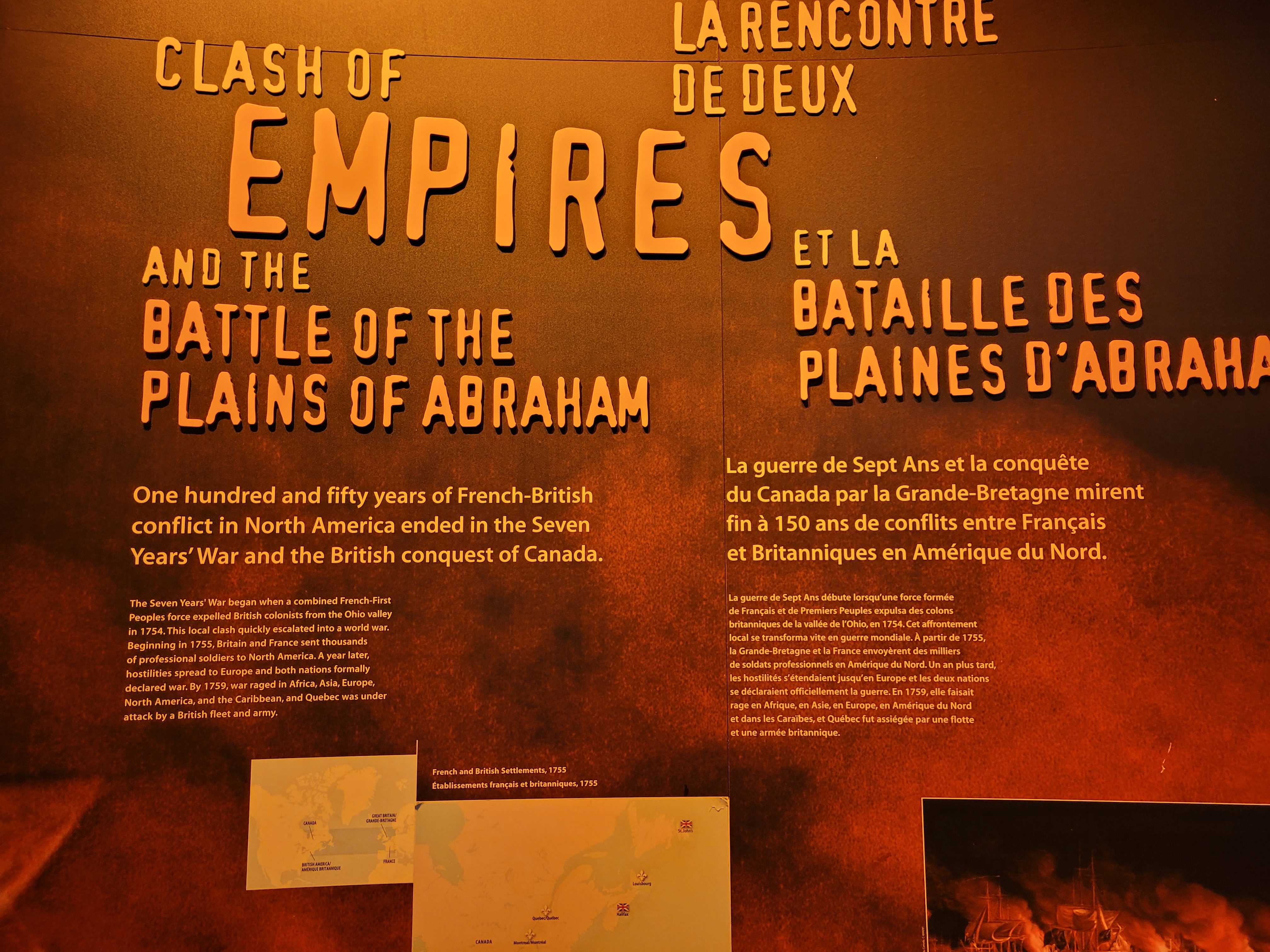
A topographic model of that place, outside the walls of the old city, is here, with lines designating military formations. Soldiers and militia under British general James Wolfe would meet their French counterparts under General Montcalm in battle. Both generals would die, and the British would prevail. It would be the end of New France.
Wednesday, November 23, 2022
Early Conflict
The walkway up to the War Museum's permanent collection features banners going back in history of Canadians at arms.
A central hub is here, with images of what's to come- the Museum's galleries are organized chronologically.
The first gallery starts from the beginnings of time up to the late 19th century. Armed conflict in Canada starts with the indigenous peoples, and so the Museum's focus begins there.
Reproduction weapons of Indigenous warriors are at left, while a model of an Iroquois village is at right.
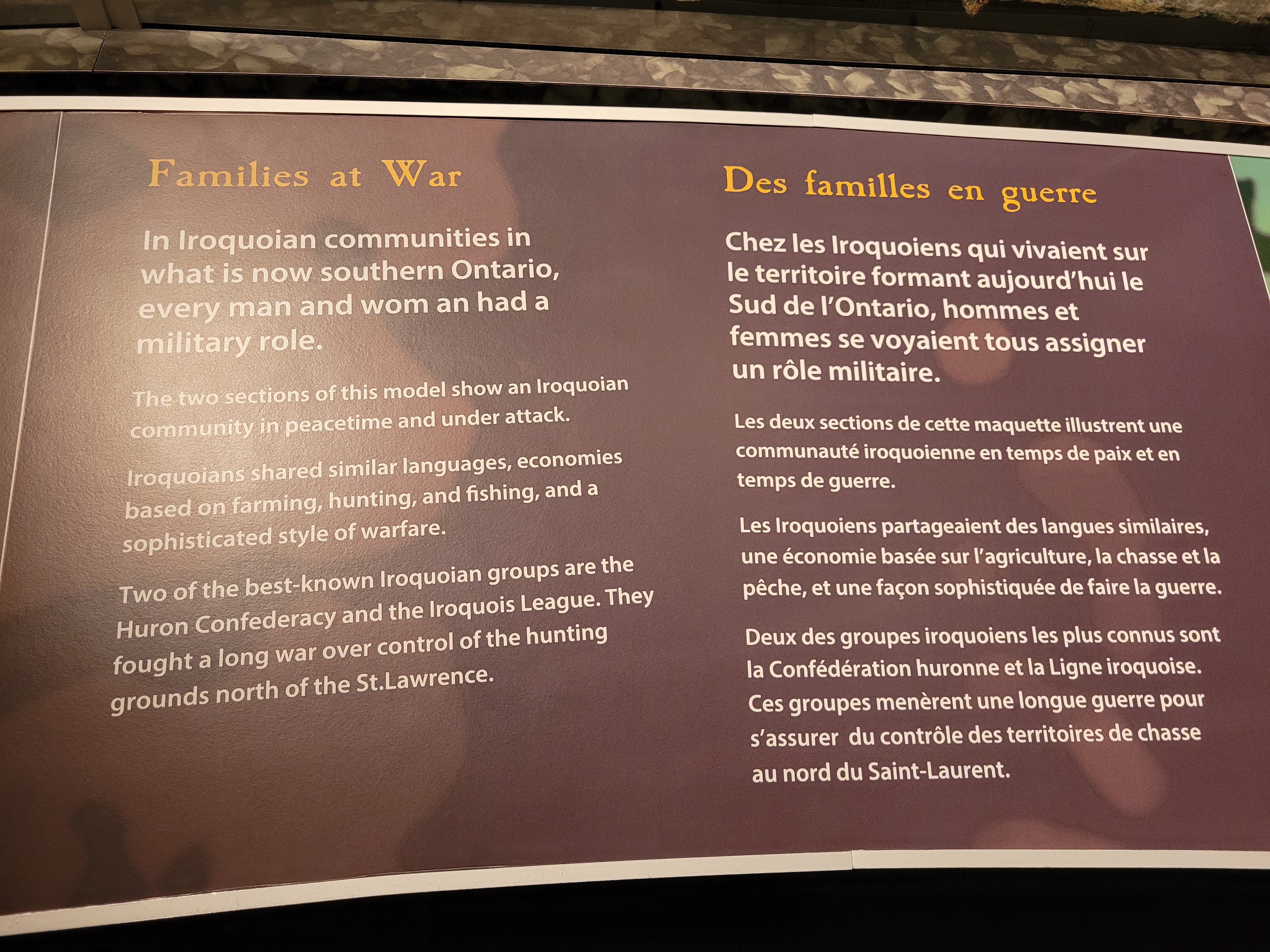
The village and its surroundings are very detailed, with interpretive panels explaining life both in peace and in war for Iroquois people.
Subscribe to:
Posts (Atom)