Tuesday, September 4, 2018

Summertime In The Gardens

The Landscapes Of Canada Gardens have been in place for the last two years at the west side of the property here at the Canadian Museum of Nature. I pass through on a regular basis, and like to feature it here each season. In this case I paid a visit in late August. Four ecosystems are presented with plants and trees drawn from each- boreal forest, prairie grasslands, Arctic tundra, and mammoth steppe. I start here with the boreal forest area, occupied by trees, shrubs, and small plants one would find in the vast section of the country that ecosystem occupies.


The prairie grassland has been growing well this summer in the heat, and of course doesn't just include the tall grass, but flowers one might see growing in the wild.


This steel sculpture, created by artist and inventor Bill Lishman, depicts an iceberg. The path flows beneath it.


Looking up gives us this view.


Arctic tundra plants here are placed amid rocks and have been growing well. They'll tend to grow taller here than they do in the far north.


This view is from the sidewalk seen above, taking in the view towards the museum.


Here we have more of the grasslands flowers and plants. Bees and butterflies were going about while I was here.


The Mammoth Steppe is the last area, with plants around the sculptures of a mammoth family that would have already been growing thousands of years ago during their time, and have survived into the current day. The Common Yarrow is one of those plants.


I close out with a view of the mammoth family and the museum.

Monday, September 3, 2018

A Summer Walk In The Garden

The Garden Of The Provinces And Territories is found downtown, on a slope between two churches on the south side, and the headquarters for Library And Archives Canada on the other side of Wellington Street to the north. It is a lovely area, a combination of flowerbeds, lawns, and terraces that pays tribute to the country itself. This view takes in the spire of Christ Church Cathedral. I recall taking a similar perspective some years back on the morning of the national firefighters memorial service, when bagpipers were standing here.


This shot is now dated, as the sculpture has been removed from this spot to prepare for its new location. 12 Points In A Classical Balance is a 1982 sculpture by Chung Hung, a Chinese born artist who ended up in British Columbia. Made of western red cedar, this sculpture is described by the artist as "a line whose end joins the beginning to form a loop." The Memorial To The Victims Of Communism will be placed at this spot at some point next year, quite different and in a different spot from the project that had been proposed by the previous prime minister. I passed by the Garden a couple of weeks after I took these shots, and 12 Points was missing. An inquiry with the National Capital Commission, which oversees federal properties like this, determined that 12 Points will be installed at its new location nearby in the fall.


The garden beds here have a variety of flowers and plants found across the country, from spring into the fall.


This view takes in Library And Archives Canada itself.


On the terraces in a couple of spots, the official flowers of the provinces and territories are represented, in this case in bas relief. Newfoundland has the pitcher plant.


Prince Edward Island has the lady's slipper while Nova Scotia has the mayflower.


New Brunswick is represented by the purple violet. Quebec selected the blue flag iris.


The trillium is the official flower of Ontario, and Manitoba is represented by the prairie crocus.


Saskatchewan chose the western red lily, and Alberta chose the wild rose.


British Columbia is represented by the Pacific dogwood, and the Yukon chose the fireweed.


Mountain avens is the designated flower for the Northwest Territories, and Nunavut chose purple saxifrage.


I finish with this sculpture and water feature, a tree in steel form that is a particular pleasure to see on a hot day.

Sunday, September 2, 2018

The Old Carbide Mill On The Island

This being the Labour Day weekend, I will be likely fairly scarce today and tomorrow, and will have to catch up after the weekend.

One day back in early July I came up to Portage Bridge to take a shot or two of the Ottawa River for the Change theme day. I decided to photograph the former Willson Carbide Mill that resides here on Victoria Island. Compare it to this winter visit from a post in February. The river itself and the Alexandra Bridge can be glimpsed in the background. I started walking around the perimeter, photographing as I went.


This final view of the structure includes the spires of Parliament Hill in the background.

Saturday, September 1, 2018

City Daily Photo Theme Day: Teach

The first day of each month is a theme day for members of City Daily Photo, and for September, that theme is Teach. You can see how others are interpreting the theme right here.

For this theme, I thought I would focus mostly on university campuses and architecture here in Ottawa, as we have several in the city. I'm starting with the University of Ottawa, which lies downtown in the Sandy Hill area. The university dates back to 1848, established first as a college by Joseph-Bruno Guigues, the Catholic bishop at the time, and rising to university status by 1866. It is the largest English-French bilingual university in the world.

I took a shot of this set of buildings in February while walking on the ice of the Rideau Canal, passing the campus. This is the STEM complex; it was still under final construction when I took this shot, but is due to open for the fall term. This is a centre for interdisciplinary studies in the faculties of science, technology, engineering, and math, hence the title.


Taken in March, this is Tabaret Hall, dating back to 1905, strongly contrasting with one of the newer campus buildings behind it, built just a few years ago.


This was taken one weekend in June. A large domed shelter structure has been erected in this area between academic buildings and the university centre.


Moving on to another institution, I took this in the latter part of April, in the Chinatown area. Dominican University College dates back to 1900 as a convent, then as a study centre for Canadian Dominican graduate students. Since 1967 it has had a civil university charter, and offers bachelor's, master's, and doctoral studies in the fields of philosophy and theology, with members of the priory serving as faculty. It has been associated with Carleton University since 2012, and includes a church within its walls. For a look inside, click here for my Doors Open visit this year.


On the last Sunday in April, I found myself up in the Rockcliffe Park neighbourhood. By chance my route took me past this campus. Ashbury College is an elite private school here in Ottawa, and this is its central building. Ashbury dates back to 1891, and has been here in Rockcliffe Park since 1910. Its students range from grades four to twelve.
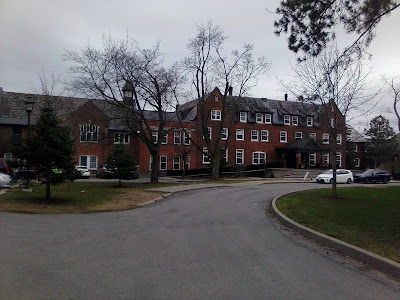

St. Paul University stands in the Old Ottawa East neighbourhood, and is associated with the University of Ottawa. In 1965 when the latter institution was reorganized as a civil and secular organization independent of its Vatican origins, St. Paul was renamed, retaining the pontifical charter of its roots. A smaller university with around a thousand students, it offers undergraduate and graduate studies in subjects such as theology, counselling, philosophy, canon law, and social communications. I stopped by a few days ago. This view outside Guigues Hall includes a sculpture put up last year, part of the city's public art program that is included when a major street has its infrastructure massively overhauled- such as the case with Main Street, which this university is on, and which was finished last year.  Main Squared is the title of the work by Stuart Kinmond, evoking the area's spiritual institutions in its stained glass. The green bench beneath represents the land, while the two blue benches represent the Rideau Canal and Rideau Rivers, which form the east and west boundaries of the neighbourhood.


The de Mazenod Chapel is part of St. Paul's, located in Laframboise Hall. It was named after Eugene de Mazenod, bishop of Marseilles and the founder of the Oblates Of Mary Immaculate, the order from which both St. Paul's and the University of Ottawa rose out of. It is regularly used for services and other activities. When I think chapels, I think of small side chapels off the main area of worship- this one is the size of a conventional sanctuary.


I finish with these views taken in June at Carleton University, the last of the universities here in Ottawa.  Founded in 1942, it attained university status in 1957. Its campus has been here since 1952, nestled between the Rideau River and Dow's Lake at the north and south sides, and the Rideau Canal and Bronson Avenue on the west and east sides. This is a view of MacOdrum Library, which has had some modifications in recent years, including a new glass dominated front facade.


The campus has some art here and there, including here in the quad outside the library. Locavore is the title of a 2015 bronze sculpture by Mary Anne Barkhouse, a First Nations artist from the British Columbia coast. It takes animals that some might see as "irrelevent or bothersome", such as the western coyote and the snowshoe hare, and puts them in close proximity; they are "given pride of place and nature is never subservient to culture". Later in the month I'll show you another of her sculptures at a different location.


Within the library, wooden sculptures can be found near the entrance, such as this canoe set.


This abstract carving is titled Justice, by the artist David Fels.


Part of the library's renovations included the installation of a spiral staircase. This is the view looking up.

Friday, August 31, 2018

Twilight In The National Capital

I have some twilight shots to close out the month. I took this on May one evening outside the EY Centre south of the city core, looking west.


This view was taken later in May from the Bank Street Bridge, looking west over the Rideau Canal.


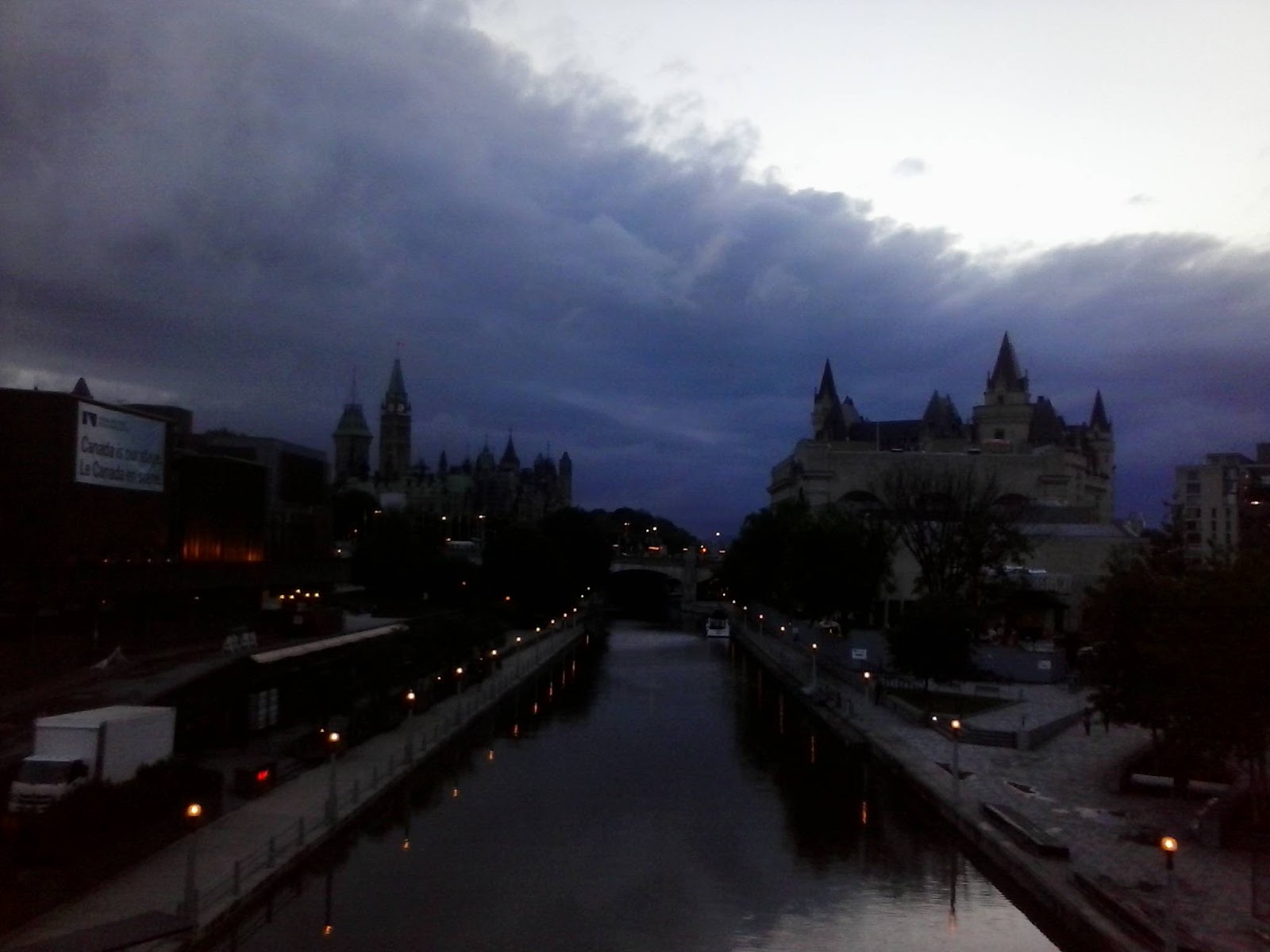
In June, a few days before the first day of summer, I was downtown running an errand over in the Byward Market. I crossed the Mackenzie King Bridge, and the setting sun was over the Canal. This is a mark of how much our perception of the sun's position changes over the year- this is looking to the northwest. No more than a half hour later, I headed back over the bridge- dark brooding storm clouds were moving in, creating a completely different mood as you can see in the following shot.


This I took on Canada Day on my way out of the Canadian Museum of History in Gatineau.


A few days later in July, this was the twilight over the Canal at the Bank Street Bridge once again.


Later in July, I attended the Fortissimo event on Parliament Hill, a military ceremony I'll show you in a few days. This dusk view of Centre Block was among the shots I took that evening.


I took these shots in the first part of August at the War Memorial. The last light of day illuminating the Chateau Laurier particularly stood out to me.


And this view was a few days later, looking over the Rideau Canal again from the bridge.