Friday, February 4, 2022

Artifacts In The Lebreton Gallery

Departing Regeneration Hall as seen in yesterday's post takes us into the final exhibition space of the Museum. Lebreton Gallery contains vehicles, equipment, and artifacts of multiple wars across time, and from multiple countries. Two large memorial plaques are found here, one for each of the World Wars. These were in the Toronto flagship store for the Eaton's department store company for many years, memorializing company employees who fought and died in those wars. Now the War Museum is their home. 


The vehicles range from trucks to tanks to planes and even naval equipment. I find this area particularly fascinating.


There is a model set up near the memorial plaques, and this is one detail of it. A German pillbox at Passchendaele has a cutaway roof to reveal the soldiers inside. A close look at one of the mudholes to the right will reveal a lone figure- a Canadian soldier about to throw a grenade. Sergeant Tommy Holmes won the Victoria Cross for his actions on October 26th, 1917.


This looks like a tank, but it's not. This is a mobile Howitzer. Most of the vehicles in the Gallery include panels explaining their technical specifications and histories.


What dominates the Gallery is a mounted interceptor jet. The CF-101F Voodoo was the standard RCAF fighter for twenty years.

Thursday, February 3, 2022

Vimy Sculptures: Everlasting Grief

Walter Allward created a masterpiece in the monumental memorial at Vimy Ridge. His half-scale plaster casts of figures placed at that memorial resonate with such emotional power.


Beyond them is a large painting. Unveiling Vimy Ridge Monument was painted in 1937 by Georges Scott, depicting a moment after the dedication of the memorial in 1936. King Edward VIII is seen among the crowd in the foreground (one of his few acts as a king before wandering off to marry Mrs. Simpson), but the spires of the memorial dominate the painting.

Wednesday, February 2, 2022

The Place Of Grief And Reflections

 Sacrifice is the title of a large painting by Charles Sims, done from 1917-19. It hangs high over Regeneration Hall, a place well suited for quiet reflection. This space is one of the key aspects of the entire Museum, designed by the architect Raymond Moriyama. This area rises like a great spike from the earth, and points directly towards Parliament Hill, which can be seen through the windows.


Moriyama was impacted by the war, as he was one of the Japanese-Canadians interned during the war. It influenced his design of the new home of the Museum, which was opened up in 2005 to replace its former home downtown.


The Hall contains a series of sculptures below, and an echoing soundtrack. When the building was under construction, Moriyama noted the sound of the wind coming through this space and had it recorded. It is a haunting sound that resonates through this space.


The sculptures are the half cast plaster sculptures created by Walter Allward for his Vimy Memorial. They are allegorical figures depicting grief and loss of the First World War, and were incorporated into the monumental memorial that stands at Vimy Ridge in France, where Canadian soldiers won an extraordinary victory in April 1917.


For today I leave off with a model of the Memorial itself.

Tuesday, February 1, 2022

City Daily Photo Theme Day: Power

The first day of each month is a theme day for members of City Daily Photo, and for February that theme is Power. Have a look at how others are interpreting the theme right here.

I am in the midst of a series from the Canadian War Museum, from a visit made in November. The material today felt entirely appropriate for the theme. This is a model of the National War Memorial, built in commemoration of the First World War and dedicated in the months preceding the Second World War. It occupies the heart of the Royal Canadian Legion Hall Of Honour, which features exhibits about the commemoration of war and military service. Fitting to feature today, as the events of this weekend in the city cast a dark shadow on the Memorial downtown.
 

A short way beyond, a passageway leads towards Regeneration Hall, one of the focal points of the Museum. This passageway is typically lined with rotating art or panels on a given subject. At the moment its subject is a powerful and moving one: the portrait art of Elaine Goble. Her subjects are veterans and others who lived through the Second World War. Some of them are seen in a composite here.


The Sailor Weds The Wren- Portrait Of Joan Amy Voller and Keith Voller is a dual portrait of a couple on their wedding day and decades later. Both served: he in the British Navy and she in the Women's Royal Canadian Naval Service. I remember chatting with her on several Remembrance Days near a display case in the Second World War portion of the museum that contained her uniform.


After The Holocaust: A Family Album depicts Valerie Blau and Mendel Good, survivors of the Holocaust who married in Canada after the war. They are surrounded by members of their family in this work, many of whom perished in the Holocaust.


Portrait Of Gwen is a dual painting of Gwen Paget, who also served in the Women's Royal Canadian Naval Service.


She Wears The Bletchley Medal is a portrait of Doris Hope, who spent the war intercepting German U-Boat signals, part of the work cracking the Enigma code.


Some of you will remember this painting from last fall, in a different spot in the Museum after it had been first unveiled. Normandy Warrior is a powerful portrait of Philip Favel, a First Nations soldier who served from Normandy through to the end, and worked for equal compensation and treatment of indigenous veterans. 

Monday, January 31, 2022

The War That Was Left Unfinished

 A video display panel shows images of the Afghan War, including a tank, seen here.


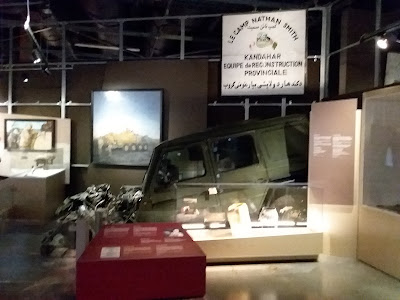
More vivid: this artifact. An IED was detonated beneath a G-Wagen in December 2005. It destroyed the front, but the driver and passengers were saved because of the vehicle's armour. The large sign in the background hung above a Canadian camp at Kandahar.


Here we have an example of the standard desert fatigue uniform of the Canadian military in Afghanistan.


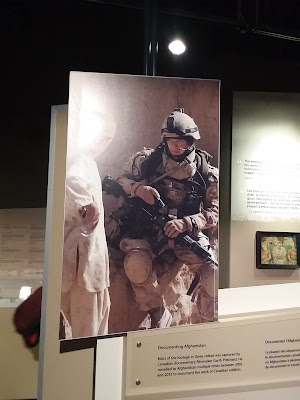
I've always found this picture poignant: the interaction of a soldier and an Afghan child.


War: Canadian Soldiers In Afghanistan is painted vividly by Douglas Laing.


A photograph of a Chinook helicopter is seen here with its crew. 


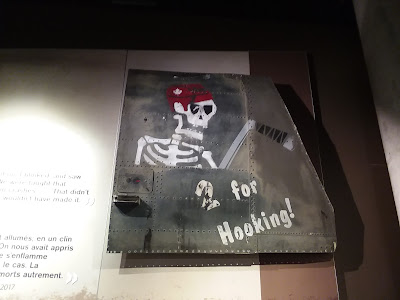
A portion of its fuselage is preserved as an artifact with the distinctive art. A hockey reference, with a double meaning, as the Chinook can ferry equipment with two hooks on its belly.


The Museum's permanent galleries wind down with this display panel. Afghanistan was left unfinished, and the events of the last year have been discouraging: the very same pack of lunatics with a 6th century world view and a skewed interpretation of their own religion who were in power in 2001 have returned to power after the collapse of the country. What was it all for, if not to get rid of them?