Tuesday, January 24, 2017

Faith And Light

I came up to the world art area in the National Gallery. There's a new concept going on a couple of times a week that I enjoyed- docents can be found in the gallery spaces during these times to talk about specific pieces. I've only had one previous occasion where I've chatted with a docent about works of art within a room, but this is now a scheduled thing.

This is The Assumption Of The Virgin, painted between 1455 and 1458 by the Italian artist Neri di Bicci. It was an altarpiece for the Spini family chapel at Santa Trinita, in Florence. It depicts Mary being taken up into heaven, watched over by angels and the disciples.


This painting, titled Eve, The Serpent, And Death, is a rather brooding, morbid oil painting by a German artist, Hans Baldung, also called Grien, done circa 1510-15. It depicts Adam and Eve after the fall from grace;  Adam has decomposed into the figure of death.


An Offering To Pan is the title of this oil painting by Italian artist Giovanni Benedetto Castiglione, painted at some point between 1645-60. It depicts worshipers before a statue of Pan, the Greek god of nature.


Abraham And The Three Angels is the title of this oil painting by a Spanish artist, Bartolome Esteban Murillo, done at some point between 1670-74. It shows the Biblical story of the patriarch greeting visitors to his home- angels who will deliver the news that he and his wife Sarah will have a child.


The Fortune Teller is by the French artist, Simon Vouet, an oil painting from around 1620. During travels in Italy, Vouet was inspired by the style of Caravaggio and his dramatic use of light and shadow called chiaroscuoro.  


Caravaggio's technique seems to show up in Italian artist Luca Giordano's oil painting The Crucifixion Of St. Andrew, an oil painting done at some point in the 1650s. It shows the saint being crucified on an X-shaped cross.


This last one is Lot And His Daughters, by the Italian painter Orazio Gentileschi, an oil painting dated to circa 1622. This work displays the Old Testament man and his two daughters in the aftermath of the destruction of Sodom and Gomorrah.

Monday, January 23, 2017

Retrospective

Here are more works from the Alex Janvier exhibit at the National Gallery. The first is Grand Entry, with more information beneath it.


This trio of canvases particularly caught my eye for their colours.


This particularly powerful work, less abstract than others, is O'Kanada. It was a response to the Oka Crisis of 1990, and is filled with rich symbols and references.


This last painting, with its explanation preceding it, seemed quite fitting- the painting feels like winter, so Cold Lake Air suits as a title. Tomorrow we'll start looking at some of the art up in the world art galleries.

Sunday, January 22, 2017

Alex Janvier

As I mentioned some days ago in my Morning Star post from the Museum of History, Alex Janvier is a Dene Suline and Saulteaux descended artist from Cold Lake, Alberta, one of the commonly referred Indian Group Of Seven. These were artists who exhibited together for some years, and continued friendships even after the formal disbanding of the group. Mr. Janvier painted Morning Star in 1993, which can be glimpsed in a projected form to the right in this first shot. His style is abstract and modern, weaving together First Nations culture and concerns with Western influences. For over a decade from 1966- 1977, he incorporated his treaty number, 287, with his signature on art as a protest against the treatment of First Nations people. He's still active today from his studios in Cold Lake, and his work is now the subject of a major retrospective at the National Gallery, until mid-April. 

The canvases found within vary in shape, from circles to squares and rectangles, and offer up bright, vibrant colours in abstract and representational forms. His use of the circle is perhaps most obvious in Morning Star, which I appreciated seeing in a video form in a different setting.


Mr. Janvier is a product of the residential school system, but officials there early on recognized his artistic skill and encouraged it; his formal education in art took place in Calgary. These early canvases show a mix of influences- his cultural background and the religious emphasis of residential schools.


This particular work, which I did note the name of, is an acrylic from 1966, Eternal Struggle, part of a commission of his work at that time from the federal department of Indigenous And Northern Affairs Canada. 


These three caught my eye. There were 150 of his works on display here, so I'll have to go back before the exhibit wraps up. Usually with modern art, whether or not the art speaks to me often depends on the particular work, but his vibrant style with rich colours really appeals to me.


For today I finish with this work, with its explanation preceding it. I have more from this exhibit tomorrow.

Saturday, January 21, 2017

The Gallery

I headed up to the National Gallery of Canada a few days ago. The collection has had a number of homes since its origin, but has been in this modern structure north of Major's Hill Park since 1988. The place was designed by architect Moshe Safde, and occupies a prime part of the city. The sculpture you see outside of the main entrance is Maman, a bronze casting of the original by Louise Bourgeois, and it is big. People with a fear of spiders must still have a problem coming in through this entrance.


This view, taken from the ramp heading up to the exhibits, looks north to the park, and takes in buildings like the American embassy, the Connaught Building, and the Chateau Laurier.


I like views of the ramp itself, both heading up and down, which follow in respective order. There are elevators, obviously, so you don't have to take this route up.


When I come here I also like getting a perspective of Parliament Hill from the glass tower. I liked the way it looked in the early evening light.


The Gallery has special exhibits going on at present, as well as the permanent galleries of world art. The Canadian collection is presently off limits until spring, undergoing a reorganization for this anniversary year. As art goes, I'm starting this series off with two installations from late in my visit. The first are a pair of camels by the American artist Nancy Graves, dating back to 1968-69. They are life sized and use a variety of materials- wool, steel, burlap, animal skin, and more. When you first walk in on them, they look very realistic.


These two are collectively called Shapeshifter, by an artist from British Columbia, Brian Jungen, done in 2000. They are a composite of what we expect out of whale skeletons- but the material itself consists of plastic chairs, cut up and reshaped.

Friday, January 20, 2017

Grand Hall

I'm finishing off my series from the Museum of History today with these views of the Grand Hall.


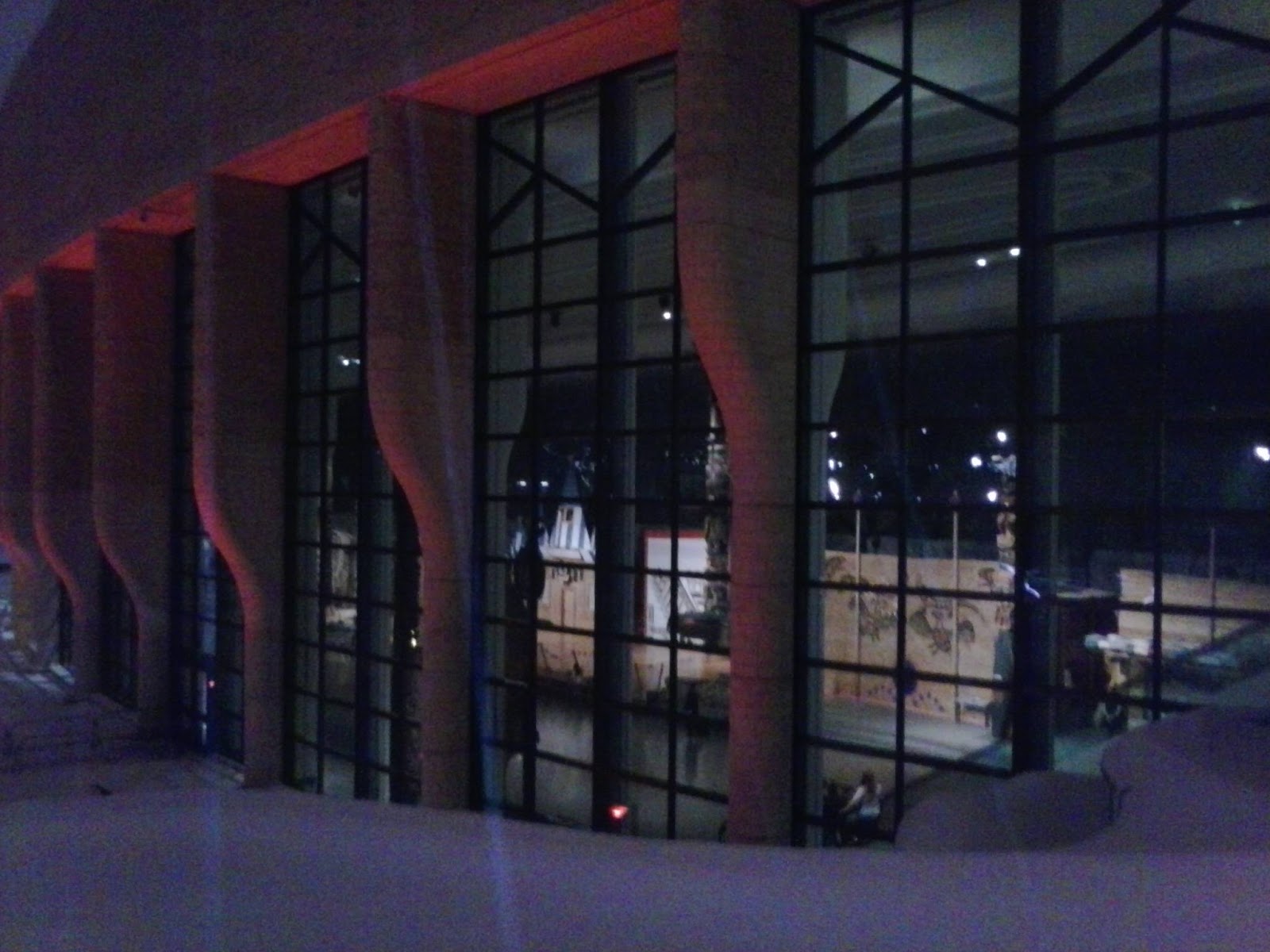
This includes exterior views looking in at the Grand Hall lit up for the evening, from where the fountain usually runs during warmer weather. The snow was still falling when I left the Museum, though not as heavily as when I arrived. The view across to Ottawa and the Hill was better.

Thursday, January 19, 2017

Grand Hall

The Grand Hall (which for whatever reason I tend to occasionally write as Great Hall) is a marvelous space in the Canadian Museum of History, with huge windows overlooking the Ottawa River. Totem poles of the Pacific Northwest coast can be found here, along with six distinct house recreations from First Nations homes along the coast.

Wednesday, January 18, 2017

First Nations

A note to members of City Daily Photo: the theme day for the first of February is Loving Life.

Off the Grand Hall at the Museum of History are several galleries and spaces dedicated to First Nations exhibits. This includes an area that has the layout of an archaeological dig, with artifacts strategically placed. Two canoes, one much larger than the other, can be found at the entrance; the Hall and one of its totem poles can be glimpsed in the background of the first shot.


Behind the wall of the Grand Hall, there are a series of rooms displaying First Nations artifacts, primarily from West Coast tribes. 


Within the Grand Hall itself, the plaster version of Bill Reid's Spirit Of Haida Gwaii sits. It's a sculpture I always enjoy looking at. A glimpse of Alex Janvier's Morning Star can be seen in the background of the first shot.