Showing posts with label Elizabeth Bruyere. Show all posts

Saturday, August 12, 2017

Historical Artifacts

This bust of Colonel John By occupies a prime spot within the Bytown Museum.


Close by is the Drummond Cup. One of four silver cups commissioned by the colonel, it was an acknowledgment of satisfaction from By to the construction crew chiefs, in this case, Robert Drummond, after the Rideau Canal was completed. Drummond's work crews were concentrated in the Kingston section of the waterway.


Here are more tools that would have been in use at the time of the building of the Canal.


This display is about Sister Elizabeth Bruyere and the Sisters of Charity mission, who came up from Montreal in the mid-19th century and established local institutions, such as the hospital that still bears Sister Elizabeth's name.


This formal portrait, an oil painting by an unidentified artist, shows the timber baron J.R. Booth, who was hugely influential in the latter 19th century and early 20th century in the city and beyond.


Some of you might remember this from a previous visit. The Hannum Table was crafted by James Hannum, a manager at the E.B. Eddy lumber property, in 1874. This table offers a bird's eye view of the complex, and incorporates over 10 000 pieces of wood, with 19 different kinds of wood used to construct it. This table was exhibited at the 1876 World Fair in Philadelphia. Today the Museum calls it home.


This view looks out one of the windows to the far side of the Canal, a different perspective than I gave you in yesterday's post. The Colonel's statue can just be seen to the left of the center pane frame.


Artifacts and a display panel factor into a section that deals with the Great Fire of 1900, which devastated both Ottawa and the Quebec side of the Ottawa River- what is today called Gatineau was then called Hull. 


Some of the Museum's artifacts have been shifted into a temporary exhibition, such as these two items. The arm chair dates to 1820, and belonged to Colonel By. The chest at its side is a carpenter's chest, one owned by Joseph Summers, a carpenter and foreman who spent fifty years working on Canal maintenance. His family donated the chest to the Museum's collection after his death- and before the Museum actually took possession of this building.


I finish for today with something else that caught my eye. This daguerrotype camera dates to around 1854, built of wood, brass, and glass. It was furnished by a New York company, Palmer & Longking. The fascination with the new technology quickly found its way to Bytown, as it was still being called, and numerous photographers were setting up shop in the city by mid-century.

Thursday, June 22, 2017

The Chapel

In yesterday's post about the Bruyere Hospital, I mentioned Mother House. The hospital was founded by Sister Elizabeth Bruyere, and the Sisters of Charity, an order founded in Montreal, still operates here. Mother House adjoins the hospital, no doubt with access points between the two. This is the main entrance to Mother House, which had its chapel open for Doors Open weekend.


The entrance lobby impressed me, and there were several nuns around the chapel entrance and in the chapel itself. I spoke with one about the founder of the Sisters Of Charity, St. Marguerite d'Youville, who has already been canonized, and about Sister Elizabeth, who by all rights deserves to be canonized. These things do take time, though it would please the sisters if Elizabeth ends up among those ranks.


I was astonished- what's called a chapel really is a church. It's beautiful inside, adorned with statues of saints, including St. Marguerite, and an angel. It feels very light inside. The current chapel dates back to 1936, while Mother House as a whole was built in stages from the earliest day of the mission.


Back at the entrance to the chapel, this is a portrait of Sister Elizabeth herself. While the order has a burial plot at Notre Dame Cemetery in Vanier, it turns out that Sister Elizabeth has been re-interred here at Mother House.

Wednesday, June 21, 2017

The Hospital

I have a photo post over at my writer's blog today, the first of two parts, about a street festival this past weekend in town called Glowfair. Go and check it out.

My final stop during the Doors Open weekend was the Elizabeth Bruyere Hospital in Lowertown. At that point in the day my camera battery was losing power, so I took several shots of the exterior of the building some days later. This building is named after the founder, a nun who led a mission of the Sisters of Charity to Ottawa from Montreal in 1845. They set up the hospital, schools, and other efforts, making quite a difference in the early development of the city. Today their legacy specializes in long term care.


The hospital was busy when I visited, with numerous specialists talking at tables that had been set up for the occasion about what they do. That included one who pointed out in a visual demonstration with hand cream and a black light device just how careless we tend to be when we wash our hands (let's just say most people, including myself, neglect the top of our hands). This squeeze toy was among the take homes I brought back from the hospital. 


I chatted at length about two people working extensively in speech therapy pathology. One was a therapist, while the other was a technician, and their work often involves patients unable to speak verbally in finding other ways to work around that. This saying caught my eye.


Here are more exterior views of the hospital, including this quiet area. 


This is an exterior view of what I'll be showing you in tomorrow's post. It's the chapel for Mother House, where the Sisters Of Charity are still based out of.

Thursday, May 11, 2017

Cross Of Sacrifice

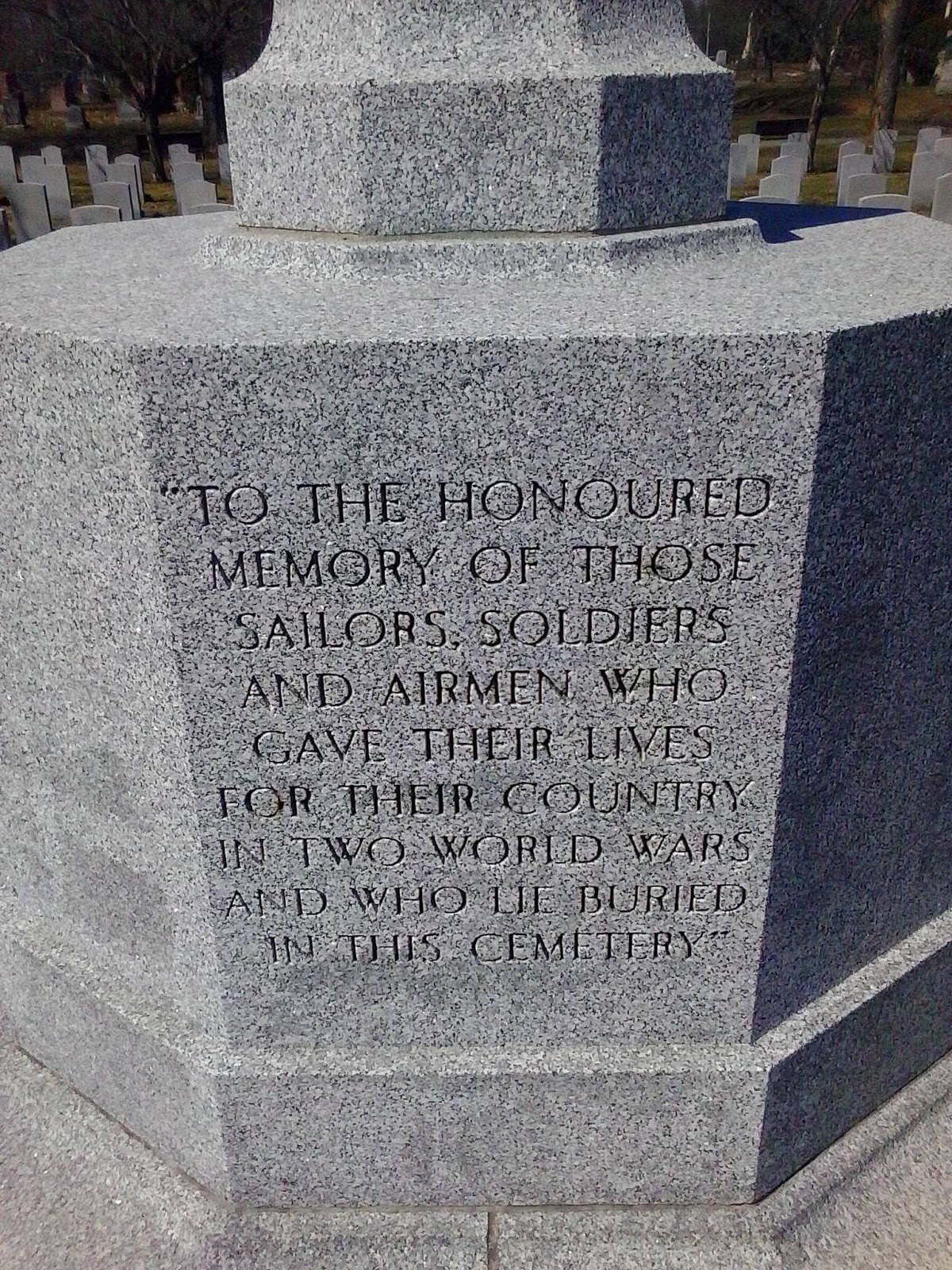
The National Military Cemetery at Beechwood features two sections. This older section is built around the Cross Of Sacrifice, a common feature in Commonwealth War Cemeteries. This first shot features the graves of two Canadian generals from the Second World War, Charles Foulkes and Henry Crerar. It is fitting that they are buried with the veterans who survived the wars. I decided to use my photos of the other section of the National Military Cemetery for my Remembrance Day post in November.


Beechwood features sections set aside for the graves of RCMP officers and support staff. I'll show you some of that in tomorrow's closing post.


Another prominent grave I found along the way is that of Ray Hnatyshyn, a well liked politician who later became Governor General.


There is a monument here created in honour of Elizabeth Bruyere, who I mentioned in my posts from Notre Dame Cemetery, as well as St. Marguerite d'Youville, the founder of her order.


The Ottawa Police Service has an area set aside for its members here too.

Saturday, May 6, 2017

A Peaceful Place For Eternity

I have a post in my writer's blog today scheduled to go live when this one does. It's part rant, part explanation of the stress I've been under in the last few months, stress which is fortunately now in the past. Go and have a look at it.

Carrying on, there are a number of these dark gravestones in Notre Dame Cemetery, each marked with the insignia of a religious order, with the names of nuns interred together. These are the Sisters of Charity, or Grey Nuns, as they are also called, a legacy of an extraordinary woman named Elizabeth Bruyere, who led a mission of nuns from Montreal to Ottawa in 1845, establishing schools, a hospital, and other services. Her hospital carries on today and is named in her honour. Her name is found among these graves, on the pillar at the heart of the group.


Here is the other section of the cemetery designated for war graves.


It was a pleasant day to be out and about visiting the cemetery. Tomorrow I'll start to show you Beechwood, the other cemetery in this area that I visited. There was a place between the two cemeteries where I also stopped in at, but that I'm leaving for the next theme day, along with some material for another theme day.