Showing posts with label John F. Kennedy. Show all posts

Saturday, October 12, 2024

A New Canada

 We start today with a model of the Indian Pavilion, which was part of Expo 67.


These display cases feature prominent Canadians of that time. Northern Dancer was the legendary horse that won the Kentucky Derby. Glenn Gould was the brilliant but reclusive classical pianist, and the case includes a pair of his gloves and one of his hats. Nancy Greene was an alpine champion skier who won gold at the 1968 Olympics.


The Canadian government moved forward with a Canadian constitution, signed into law by Queen Elizabeth in this historical photograph as the prime minister at the time, Pierre Trudeau, looks on.


Women's rights continues to be a preoccupation; as much progress has been made, there is more to go.


Our relationship with our American neighbours has long been an interesting one. Quotes by Kennedy and Trudeau accompany these displays.


The last portion of the gallery looks at various themes in Canadian history. Our darkest chapter is the first one, namely the treatment of First Nations peoples, and in particular the stain of the residential schools. The last of those schools closed in the 1990s, so this is something still very much in living memory.


It became the policy of the federal government after Confederation to establish residential schools as a way to get the Indian out of the Indian. The abuse and upheaval that would ensue would create damage spanning generations.


Not everyone saw it the same way. Peter Bryce was a medical doctor working as the chief medical doctor for Indian Affairs. He was alarmed by what he saw during inspections of residential schools in western Canada, calling it a national crime. He was largely ignored. Today his grave in Beechwood Cemetery here in Ottawa is a sacred place, even including a mailbox where people can leave letters.


This map of the country shows each location of a residential school.


But most poignant and heartbreaking is the testimony seen on a video display. The Truth and Reconciliation Commission was established to gather evidence, to hear the testimony of residential school survivors, and to make recommendations for making things right. Survivors talk about their experiences and the effect the schools have had on their lives ever since.

Saturday, February 3, 2024

Achievements In The Country And Beyond

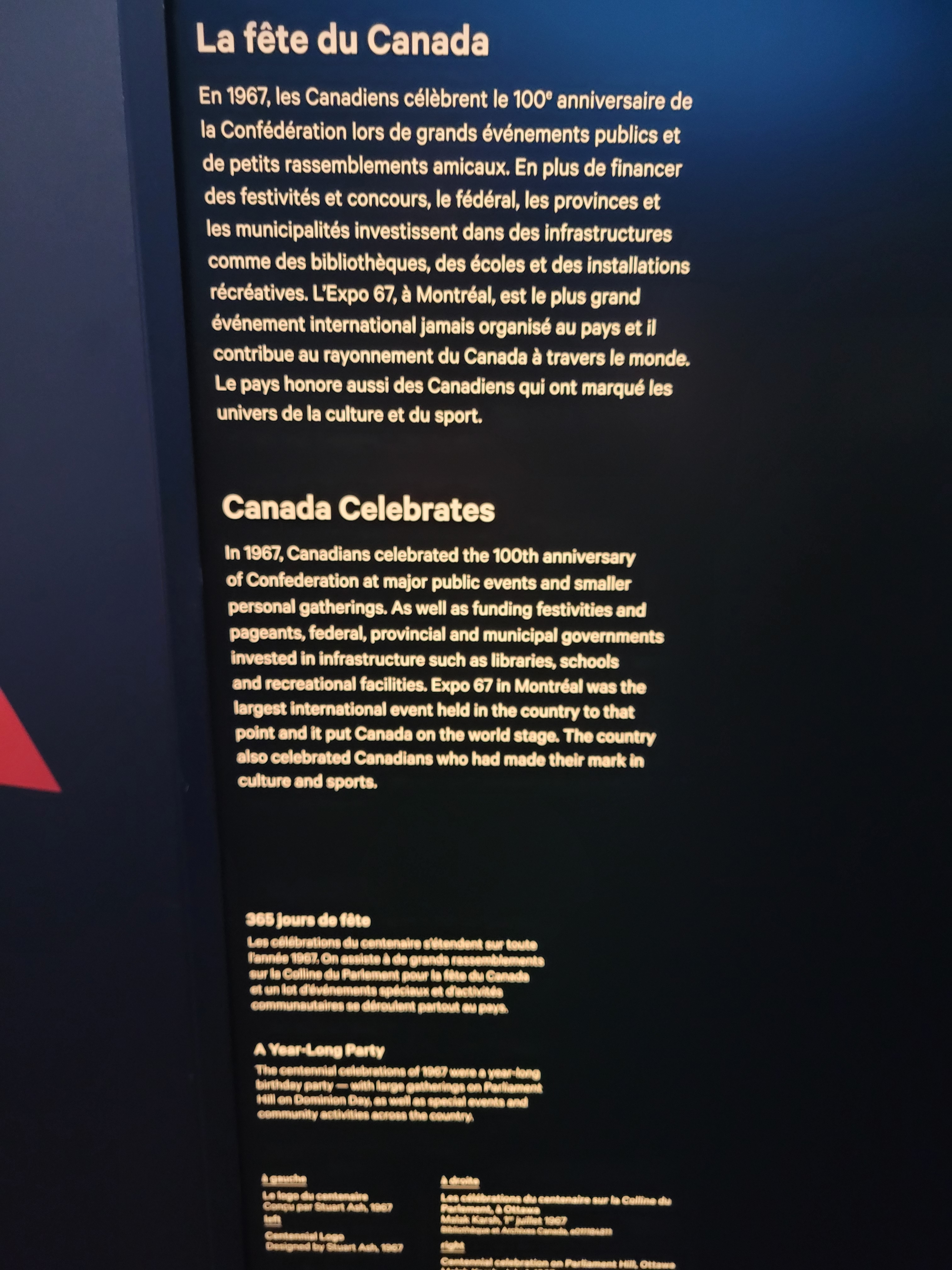
 1967 was the centennial year of the Canadian Confederation, and it was a big year for the country, with Canada Day that year in Ottawa being the centre of attention, while that same year saw Expo 67 in Montreal.


This is the product of the work of two Canadians, Peter Munk and David Gilmour- the Project G stereo.


One of the greatest race horses of all time was a Canadian- the mighty Northern Dancer, who won the Kentucky Derby, Preakness Stakes, and Queen's Plate in 1964. His lineage lives on today.


Another accomplished Canadian- the brilliant yet reclusive classical pianist Glenn Gould. Displayed here is a pair of his gloves and one of his caps.


Terry Fox lost a leg to cancer as a teenager. He set out on the Marathon of Hope in 1980 to cross the Canada from sea to sea ro raise money for cancer research, capturing the imaginations of the country in the process. Cancer returned and cut his journey short near Thunder Bay, later taking his life, but in the years since, runs are held around the world each year in his memory to raise money for the fight against cancer.


Women stayed in the workforce more and more after the Second World War, and with that came the fight for equality throughout society.


Our relationship with our southern neighbours has throughout our history been an interesting one. I like the quotes on these two displays from an American President, John F. Kennedy, and a Canadian Prime Minister, Pierre Trudeau. They speak volumes.


I finish today with this photograph from the time of the signing of the North American Free Trade Agreement.

Wednesday, December 13, 2023

A Cold War

 This is an M3 half-track, a mainstay transport of Canadian forces during the Korean War.


Ted Zuber was a young Canadian soldier who went to fight in Korea. When he returned home, in the years that followed, he transferred his memories to the canvas. The War Museum has several of his paintings. This one is First Kill- The Hook.


This is titled Reverse Slope, with soldiers at rest. Decades later, Zuber would return to war again as a commissioned war artist during Desert Storm.


A side by side comparison of a Canadian winter uniform at left, and a Chinese uniform at right.


Kap'yong was a tough battle of that war, fought in high mountain country, and a three dimensional reproduction of the landscape is in the display case below. Another painting by Zuber, depicting that battle, is at top.


The Korean War would end in a ceasefire, dividing the peninsula into two countries, with the North half being run by a family of insane autocrats and kleptocrats ever since. But the Cold War would go on. 

A command centre is reproduced here, with screens showing scenarios of what might have happened if the Cold War had ever broken out into a full scale war between NATO and the Warsaw Pact.


A map of Europe is displayed, with a news scroll showing various events breaking out, while the map changes and the death toll mounts. The effect is vivid.


Below is one of the few things ever made well by the Soviet Union- the Kalashnikov.


The Cold War went on, and the weapons became more formidable, like this tank.


Nuclear weapons added a whole new level to that. Canada, for a time, was a nuclear armed nation.


The Cuban Missile Crisis was one of the heights of that time. Quotes by JFK and Khrushchev speak volumes. A photograph of Kennedy meeting with Canadian Prime Minister John Diefenbaker is on this panel as well. In fact, Diefenbaker and Kennedy pretty much despised each other.

Sunday, February 5, 2023

History Has Made Us Friends

This evening dress was made by Marjorie Gehl, the daughter of a Canadian diplomat, as her centennial project, worn to diplomatic functions during the centennial year of 1967. She sewed maple leaf designs into the fabric. Now it is here.


The preceding years had seen much debate about a distinctive Canadian flag. The unofficial flag had long been the Red Ensign. Eventually after much debate back and forth, the flag we have today became the country's official flag.


1200 different designs, as noted at left. Imagine being on the committee going through all that. At right, Prime Minister Lester Pearson meeting with supporters.


The centennial year was a big one for Canada, with Expo 67 hosted by Montreal. The photograph of Parliament Hill dominating this wall was taken on July 1st, 1967.


Sporting and cultural heroes are seen here. Northern Dancer was a Canadian horse that won the Kentucky Derby. Glenn Gould was one of the greatest classical musicians to ever live; a pair of his gloves and one of his caps are included. And Canadian skier Nancy Greene is also seen.


Two quotes by two different leaders sum up our relationship with our southern neighbour. John F. Kennedy's remark is an eloquent one. Pierre Trudeau's comparison is a humorous one.


This period also saw great change for women in the workplace.

The Museum ends its formal collection with a series of themes. The first is that of indigenous peoples, and the great dark stain of Canadian history: the residential schools. Federal governments starting with the Macdonald administration sought to assimilate the indigenous population, as opposed to what had been done before by the British- accommodation through treaties. The residential school program was the result, and one of the worst things we have ever done.