Showing posts with label John Diefenbaker. Show all posts

Sunday, September 6, 2026

The Fathers Of Confederation

The views from Parliament Hill are delightful to take in. On the far shore of the Ottawa River is Gatineau, with the rise of the Gatineau Hills in the distance. 


Another of our sterling prime ministers. With the current work going on, most of the statues are behind the fence, but at least somewhat accessible to the photographer. This is John Diefenbaker.


One part of Centre Block is not having work done on it- because restoration work was done at the turn of the century. Nonetheless, it's cut off from access. This is the Library of Parliament.


Before it in this shot is George-Etienne Cartier, a Father of Confederation and co-premier of the United Canadas.


The barge down on the river had to do with a fireworks display going on at the time.


The Library of Parliament is a visual delight.


This next statue is of another Father of Confederation, Thomas D'Arcy McGee.


Here we have a remnant of the former Centre Block. This bell fell from the tower overnight February 3rd, 1916, during the fire that destroyed the original Centre Block. It is now displayed here, with signage in English and French.


Nearby, another statue, recently moved here. John A. Macdonald was co-premier of the United Canadas with Cartier, the strongest voice of the Fathers of Confederation, and the first Prime Minister of Canada.

Monday, February 9, 2026

Human Rights

 Women's rights, particularly gender discrimination and violence, are explored. The Ecole Polytechnique massacre of December 1989, in which fourteen women were murdered, had a huge effect on the country.


The Roseland Theatre in Nova Scotia became the focal point of a human rights complaint back in the 40s. There was no law in the province for racial equality, and so private businesses could practice segregation if they wanted. In 1946, Viola Desmond, who owned a beauty parlour in Halifax, was in town and attended a movie- getting arrested for sitting in the whites only section. These days her portrait is on the Canadian ten dollar bill.


Disability rights and accomodation have evolved over time. From everyday AODA needs to those who shine on the international stage, Canadians have responded and adapted. Paralympic hockey sticks are seen here, along with a glove that has a story in and of itself. It is a glove that was used by Rick Hansen, who showed the world what a man in a wheelchair can really do.


Hansen went around the world on his wheelchair to raise money for spinal injury research, leaving a big impact on the world as a whole.


Disability adaptation includes a model for a full scale playground equipment seen here.


Human rights applies as well to around the world.


Lotta Hitschmanova was a refugee who came to Canada, where she founded the Canadian chapter of the Unitarian Service Branch and dedicated her life to working with refugees affected by war.


This is one of her uniforms.


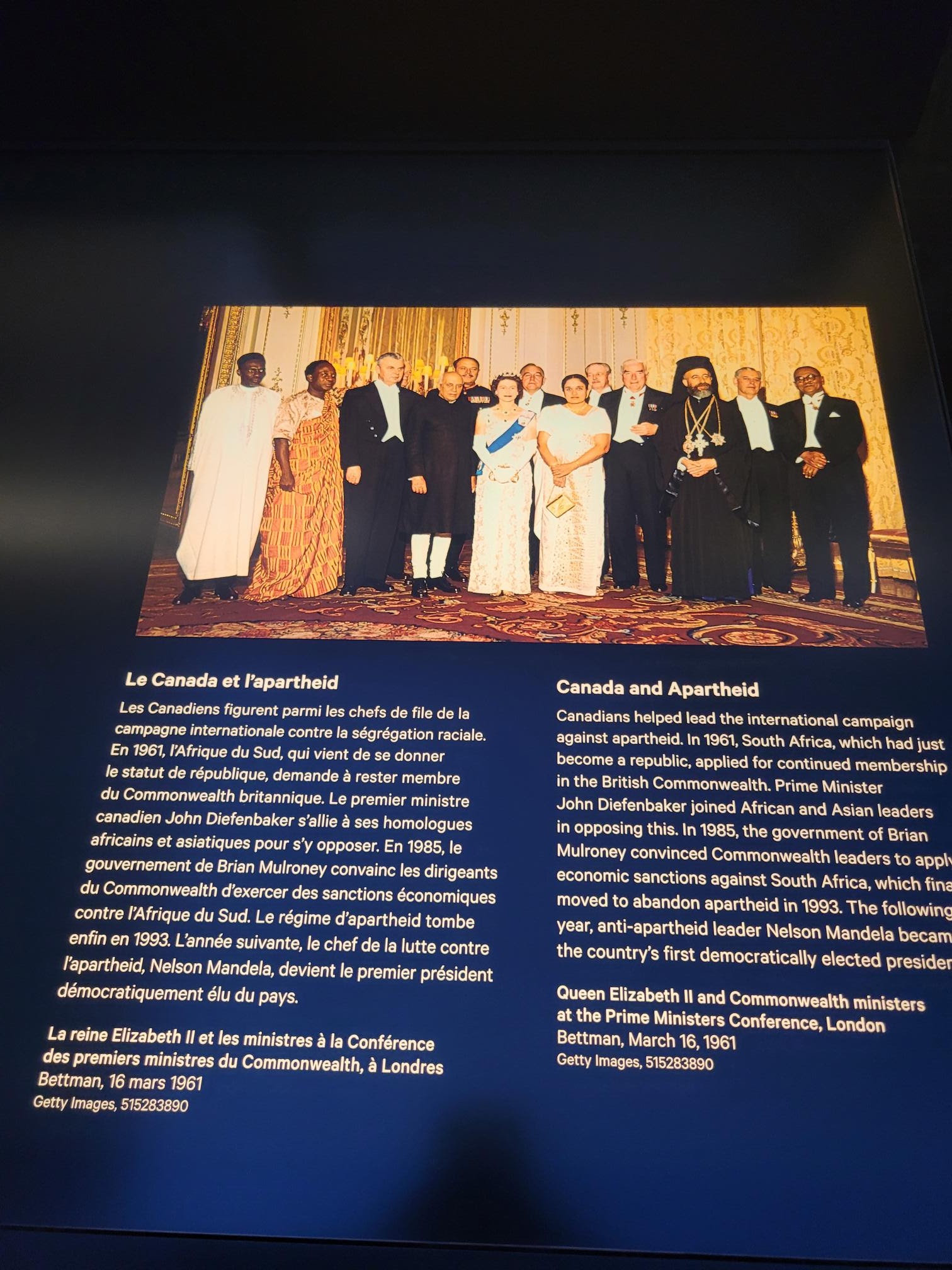
Canadians also got involved in the fight against apartheid over successive governments- with the government of Brian Mulroney becoming even more assertive to convince the world to bring economic sanctions upon South Africa as a tool. Whatever else he was as a prime minister, it's something about him that I respect. It meant disagreeing with his allies, Margaret Thatcher and Ronald Reagan, both of whom wanted to go slower.


Nelson Mandela was made an honorary citizen of the country right here at the Museum. With Canadians so vocal in the fight to end apartheid, he had a warm relationship with the country as a result.

Thursday, October 17, 2024

Rights

 Continuing where I left off yesterday. This glove belonged to Rick Hansen, who suffered a spinal injury. He didn't let that keep him down, launching the Man in Motion tour where he went in a wheelchair around the world in the 1980s, raising money for spinal cord research and becoming a national treasure along the way.


Sledge hockey sticks used by Canadian Paralympians are seen here, as well as a model for a wheelchair friendly playground.


One of our best ideas came from one of our greatest prime ministers, years before he occupied that role. Lester Pearson was the foreign minister during the Suez Crisis. It was his proposal to the United Nations that neutral soldiers serve as peacekeepers to resolve tensions that won him the Nobel Peace Prize.


One of the many Canadian peacekeepers who followed that example is Mark Isfeld, whose mother made little knitted dolls for children he met in his work clearing mine fields. He was killed on duty in 1994, but to this day, soldiers and humanitarian workers continue to give "Izzy" dolls.


The Peacekeeping Monument resides in Ottawa.


Canada is part of NATO, but has also advocated arms control, especially landmines, which continue to kill decades after war has ended.


The push for human rights on the world stage became an important matter for Canadians following the Second World War.


Lotta Hitschmanova dedicated her life to that cause. A refugee from Europe who came to Canada in 1942, she established a Canadian branch of the Unitarian Service Committee and spent her life working with those affected by war.


This is her service uniform.


For decades, the South African government's policy of apartheid resulted in opposition within and without the country. Canadian governments consistently spoke out against it. By the 1980s, Prime Minister Brian Mulroney advocated for economic sanctions in the Commonwealth, a policy of principle that put him at odds with his allies Margaret Thatcher and Ronald Reagan, who would have preferred a less strident approach.

Thursday, February 8, 2024

Canadians Out In The World

This is the service uniform of Lotta Hitschmanova. 


She came to Canada as a refugee during the Second World War, and at war's end founded the Canadian branch of the Unitarian Service Committee, which still carries on her work today. She spent her working life in service to those affected by war.


The apartheid question in South Africa was a thorny diplomatic issue for decades. Canadian governments in turn opposed it.


In the 1980s, the movement globally against apartheid resonated with society. The Canadian government under Brian Mulroney pushed for economic sanctions against South Africa- while his allies Ronald Reagan and Margaret Thatcher would have preferred less overt steps. Despite the many flaws of the man (as many a Canadian would attest to), this stance on principle is worth respecting.


Nelson Mandela never forgot that Canadians were outspoken in opposition to apartheid, having a warm relationship with the country and the people, and he was made an honorary citizen of Canada right here at the Museum.


This quote speaks volumes, and rings true.


Christina Briand was one of a number of Mounties posted in Haiti on a UN detail in 2010 when a massive earthquake struck the country. She worked on rebuilding an orphanage.


People in her hometown raised money in support of the reconstruction.


Both Canadian government and non-governmental agencies actively get involved in emergency response around the world.