In 1980, the country saw a referendum in Quebec, triggered by the separatist government under Rene Levesque. Prime Minister Pierre Trudeau led the side against the question of separation. This editorial cartoon pretty much personifies their relationship.
Showing posts with label editorial cartoons. Show all posts
Sunday, February 8, 2026
High Tensions
Here we have Trudeau and Levesque giving speeches in the run up to the referendum, with pauses in the video as the other person takes over. The effect is as though they're debating in the same room. In the end, the referendum was defeated.
A Conservative government under Brian Mulroney attempted to amend the Constitution with the provincial and territorial premiers, through the Meech Lake Accord to alleviate the concerns that had led to the referendum in the first place. In the end, the Accord failed.
1995 saw another referendum on the issue of Quebec separation. It was narrowly defeated- the closest the country ever came to coming apart.
Francophone communities are found throughout the country, and the nation is officially bilingual.
The next section focuses on human rights, and the country has evolved over time to embrace them, from voting rights to citizenship to discrimination
This is the work of an artist, Laila Binbrek, called Mirror Mirror. It has two sides of a dressing table, with her dual identities represented- western on the one side and middle eastern on the other.
Wednesday, October 16, 2024
Rights
The 1995 referendum was the closest the country ever came to coming apart. The separation of Quebec was narrowly defeated. Premier Jacques Parizeau, in an infamous speech that night likely influenced by liquor, blamed the loss on money and "ethnic votes."
Bilingualism is a force in the country.
The next thematic area looks at human rights, including voting, which in the aftermath of the Second World War began to be extended to groups that had been excluded, including First Nations peoples.
Multiculturalism has become one of our strengths over time.
The rights of women is also explored, particularly as a response to violence. One of the darkest chapters of the country's history is the killing of fourteen women at the Ecole Polytechnique in Montreal by a man best described as a misogynistic terrorist.
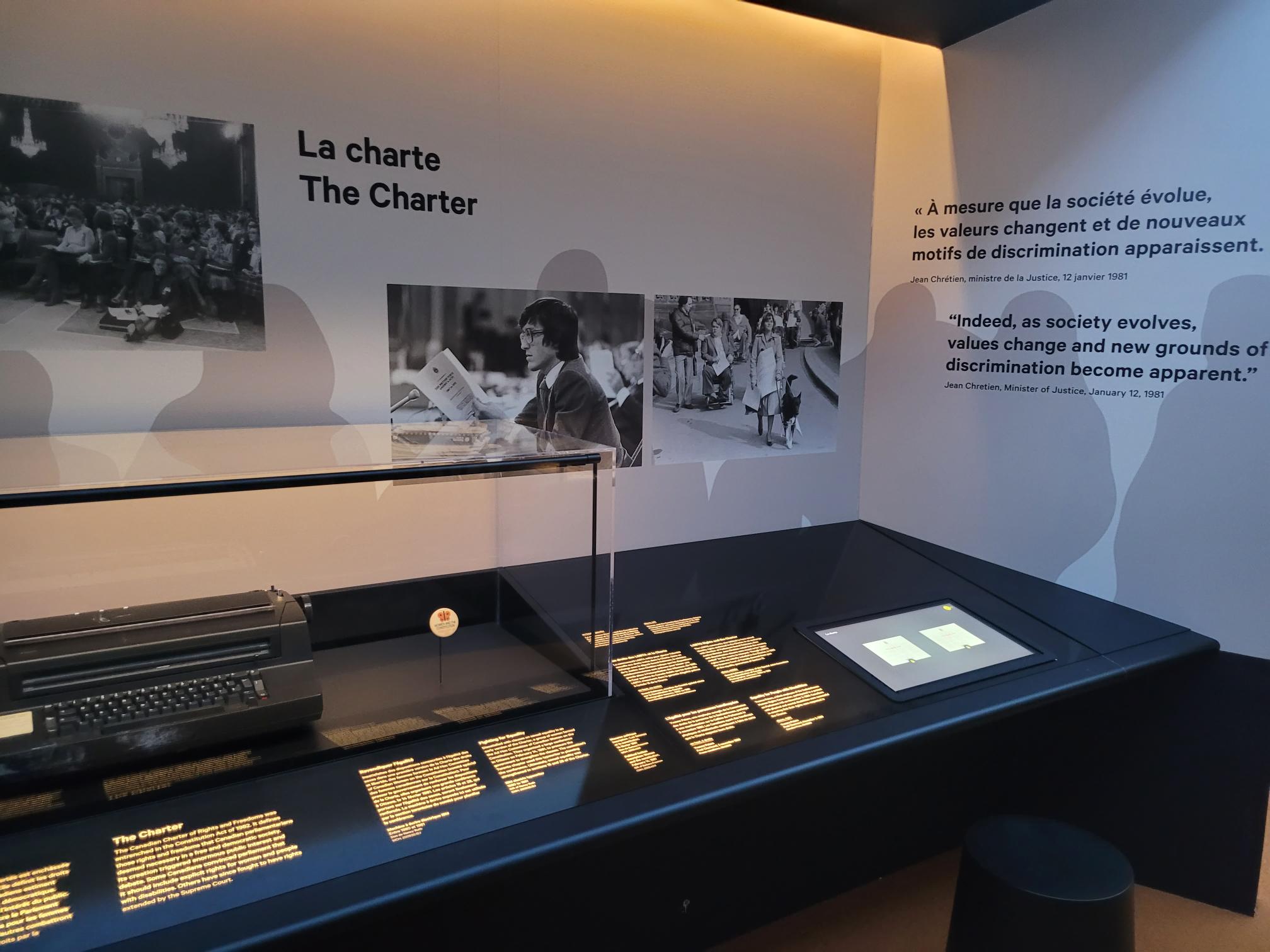
The Canadian Charter of Rights and Freedoms is a bill of rights entrenched within the Constitution.
Race and religion have long been difficult subjects, evolving over time.
This installation is by artist Leila Binbrek, with each side of these two tables reflecting her western and Yemeni influenced backgrounds.
Viola Desmond was a civil rights trailblazer. Owner of a beauty school in Nova Scotia, she challenged the segregation policies of a movie theatre, a decade before Rosa Parks. Today her portrait is on the Canadian ten dollar bill.
I leave off here with where we'll pick up tomorrow, with a panel about the disabled- particularly disabled athletes.
Tuesday, October 15, 2024
The Crisis
Picking up where I left off yesterday. The actions of the FLQ culminated in the October Crisis in 1970, with the kidnapping of a British diplomat and provincial cabinet minister. The federal government invoked the War Measures Act. By the end of the crisis, the diplomat was released, but the minister was murdered.
The province continued to question its future- as a province within country or as a country on its own. By 1976, a separatist party would win power in the province.
License plates reflect the change in leadership. The editorial cartoon at top shows the two rivals- the Quebec premier Rene Levesque (perpetually seen with a cigarette dangling from his lips) and the Canadian prime minister, Pierre Trudeau.
It came to a referendum over separation in 1980. Trudeau was one of the leaders of the No movement, to keep Quebec as part of Canada. Here video clips of both leaders play against each other in turn, this one being Trudeau making a speech at a rally on the subject.
The other features Levesque in the provincial legislature, with his own remarks on the subject.
The 1980 referendum did not get the result Levesque wanted. In 1995, separatists were back in power, and had another go at another referendum.
Jacques Parizeau, the premier of Quebec, was one of the leaders of the Yes side. He is represented here by a puppet.
Another puppet, but this being a leader of the No side- the prime minister at the time, Jean Chretien.
Tuesday, February 7, 2023
Turmoil Within The Country
This is the powow dress of Amanda Larocque, a Mi'kmaq fancy dance performer.
The next thematic area deals with Quebec, and with Francophones generally in Canada. It starts with a jersey and hockey stick belonging to one of the greatest to ever play the game- Maurice "Rocket" Richard, a hero and legend worshiped by fans of the Montreal Canadiens.
Albums by various Quebec musicians are seen together.
One of the more insufferable moments of the 1960s involved a man whose entire life could be summed up by that word. Charles de Gaulle had weaseled his way into power in France by making the absolute most of his reputation from the Second World War. In truth, there was nothing he did of any real note that couldn't have been done by another Free French officer. The man was an insufferable egomaniac, impossible to work with, in love with his own place in history. In short, an asshole.
He came to Canada on a state visit, went to Montreal, where he gave a speech to crowds from a balcony, and ended up feeding into the sovereignty movement by calling, "vive le Quebec libre!"
This of course set off a diplomatic firestorm, and it wasn't long before the old man was out of the country.
Again: an asshole. If there's any justice, he's roasting in hell right about now, griping about why no one's paying attention to him.
The 1960s had also seen the rise of extremism and terrorism in Quebec. The Front de Liberation du Quebec (FLQ) spent years setting off bombs. Their actions culminated in the October Crisis- the kidnapping of a British diplomat, and the kidnapping and murder of a provincial cabinet minister.
The first referendum on the question of separation ensued some years later. For the no side, the Prime Minister of the country led efforts. Pierre Trudeau is seen here speaking to supporters.
On another screen, the provincial premier, Rene Levesque, the driving force for separation, speaks in turn, creating the effect of a political debate.
Subscribe to:
Posts (Atom)