Humanitarian aid goes hand in hand with human rights. The World University Service of Canada established Girls Clubs in developing countries around the world to help girls along in life.
Showing posts with label Jean Chretien. Show all posts
Tuesday, February 10, 2026
Humanitarian
Christine Briand was an RCMP officer seconded to peacekeeper duty in Haiti in 2010 when that country was devastated by an earthquake. She took part in rebuilding an orphanage. People from her hometown raised money to help the country recover. This is part of being Canadian- lending a hand, particularly in a disaster, whether it's with money or with expertise.
Lester Pearson was one of our greatest prime ministers, but before his tenure in that role, he was the foreign minister. He and Dag Hammarskjold, the UN Secretary General, were awarded the Nobel Peace Prize for the concept of using neutral soldiers as peacekeepers to resolve the Suez Crisis.
Mark Isfeld was a Canadian soldier serving as a peacekeeper in the former Yugoslavia, clearing mines. His mother knitted little dolls which he gave to children. He was killed while clearing mines in 1994, but the tradition of "Izzy" dolls continues today.
Robert Semeniuk is a photojournalist who has documented conflict around the world. Among other things, he has documented the damage caused by landmines. The Canadian government under Jean Chretien took the initiative in the 1997 Mine Ban Treaty, or Ottawa Treaty, which aims to stop the use of landmines.
This is the uniform of Lt. Colonel Pat Stogran, who commanded soldiers in Afghanistan and later became the first veterans ombudsman.
Louise Arbour led the international prosecution team looking into war crimes in the former Yugoslavia. She would later serve as a Supreme Court judge, and UN High Commissioner for Human Rights.
Wednesday, October 16, 2024
Rights
The 1995 referendum was the closest the country ever came to coming apart. The separation of Quebec was narrowly defeated. Premier Jacques Parizeau, in an infamous speech that night likely influenced by liquor, blamed the loss on money and "ethnic votes."
Bilingualism is a force in the country.
The next thematic area looks at human rights, including voting, which in the aftermath of the Second World War began to be extended to groups that had been excluded, including First Nations peoples.
Multiculturalism has become one of our strengths over time.
The rights of women is also explored, particularly as a response to violence. One of the darkest chapters of the country's history is the killing of fourteen women at the Ecole Polytechnique in Montreal by a man best described as a misogynistic terrorist.
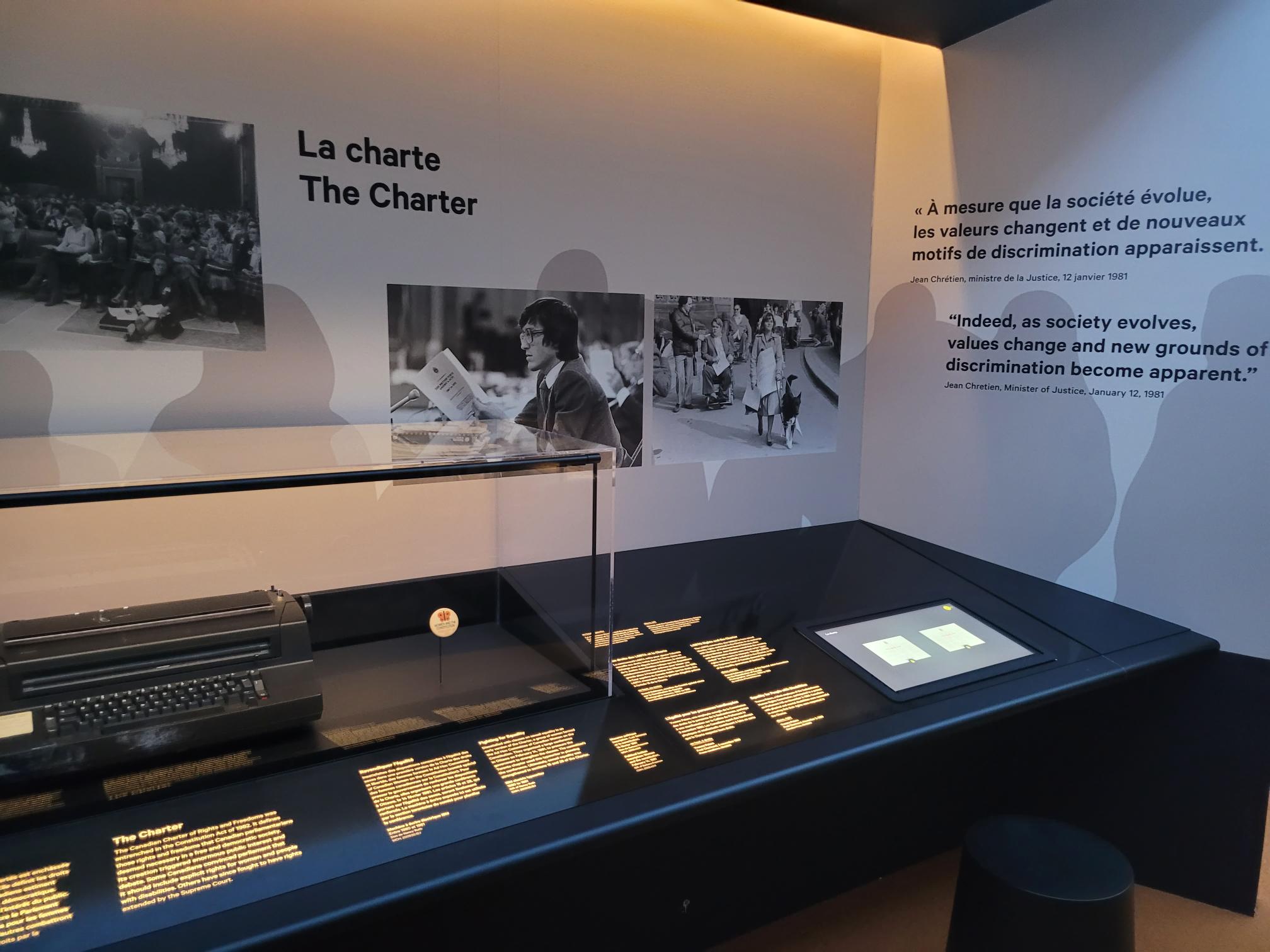
The Canadian Charter of Rights and Freedoms is a bill of rights entrenched within the Constitution.
Race and religion have long been difficult subjects, evolving over time.
This installation is by artist Leila Binbrek, with each side of these two tables reflecting her western and Yemeni influenced backgrounds.
Viola Desmond was a civil rights trailblazer. Owner of a beauty school in Nova Scotia, she challenged the segregation policies of a movie theatre, a decade before Rosa Parks. Today her portrait is on the Canadian ten dollar bill.
I leave off here with where we'll pick up tomorrow, with a panel about the disabled- particularly disabled athletes.
Tuesday, October 15, 2024
The Crisis
Picking up where I left off yesterday. The actions of the FLQ culminated in the October Crisis in 1970, with the kidnapping of a British diplomat and provincial cabinet minister. The federal government invoked the War Measures Act. By the end of the crisis, the diplomat was released, but the minister was murdered.
The province continued to question its future- as a province within country or as a country on its own. By 1976, a separatist party would win power in the province.
License plates reflect the change in leadership. The editorial cartoon at top shows the two rivals- the Quebec premier Rene Levesque (perpetually seen with a cigarette dangling from his lips) and the Canadian prime minister, Pierre Trudeau.
It came to a referendum over separation in 1980. Trudeau was one of the leaders of the No movement, to keep Quebec as part of Canada. Here video clips of both leaders play against each other in turn, this one being Trudeau making a speech at a rally on the subject.
The other features Levesque in the provincial legislature, with his own remarks on the subject.
The 1980 referendum did not get the result Levesque wanted. In 1995, separatists were back in power, and had another go at another referendum.
Jacques Parizeau, the premier of Quebec, was one of the leaders of the Yes side. He is represented here by a puppet.
Another puppet, but this being a leader of the No side- the prime minister at the time, Jean Chretien.
Tuesday, September 17, 2024
Canada
Continuing where I left off yesterday, here we see the Caribou Monument in Bowring Park, memorializing the war dead of Newfoundland and Labrador.
This is the Ukrainian Labour Temple in Manitoba.
The British Columbia provincial Parliament Buildings are found in Victoria, B.C.
This is the Old Arts Building in New Brunswick.
Grain elevators are a common sight in Saskatchewan.
Pier 21 is home to the Canadian Museum of Immigration in Nova Scotia- one of two national museums outside the national capital area.
This is the CCGS Amundsen, a Coast Guard icebreaker.
Dawson City is found in the Yukon Territory.
This scene is Pangnirtung in Nunavut.
And this is Point Prim Lighthouse on Prince Edward Island.
Inside the main hub of the Canadian History Hall is a viewscreen of various moments in our history. William Lyon Mackenzie King can be seen at top right, for instance, while at lower left is the dark chapter of the October Crisis.
The view screen changes, and so at lower left is a picture of Prime Minister Jean Chretien and Nelson Mandela, who was made an honorary citizen of the country right here at the museum.
Subscribe to:
Posts (Atom)