Showing posts with label woodworking. Show all posts

Saturday, August 15, 2026

Bytown

In the 1840s, Sister Elisabeth Bruyere and fellow Grey Nuns from Montreal came to Bytown, establishing a hospital, orphanage, school, and other social services. Sister Elisabeth's legacy remains today, with two hospitals in the city under the umbrella of the Bruyere organization, and a convent still active beside one of them.


After the Canal was built, timber was the dominant industry in the Ottawa Valley, and with both sides of the river being involved, the growing urban centers were keys to that industry. This is a remarkable artifact, a table carved by an employee of one of the lumber companies, done in three dimensions, showing the areas of the timber companies around the islands in the river.


The portrait on the wall is that of J.R. Booth, a lumber tycoon and railroad baron who established himself in what was Bytown and later became Ottawa. At one point, his lumber company was the largest in the world.


The actual work of the lumber men was a hard one, for months out of the year, out in the bush. 


This display case features some of their artifacts. 


Joseph Montferrand was one of the lumberjacks, a French-Canadian giant of a man who became a legend in the Ottawa Valley, today still remembered in folklore. It was said he once beat 150 men on the Chaudiere Bridge, members of an Irish street gang looking to make trouble.


Caulk boots, with nails or cleats on the soles, were used by the river drivers to pass over slippery logs. The bible box beside it was carved by Robert Spallin during time off in the camps.


This belt is an example of those worn by French-Canadian lumbermen.


Tools of the trade.


For a time, Bytown had a reputation as the most violent town in British North America, with riots, old-world biases spilling over into fights, and access to alcohol leading to troubles, all with minimal law enforcement in those early years.

Monday, March 10, 2025

Winter Playground

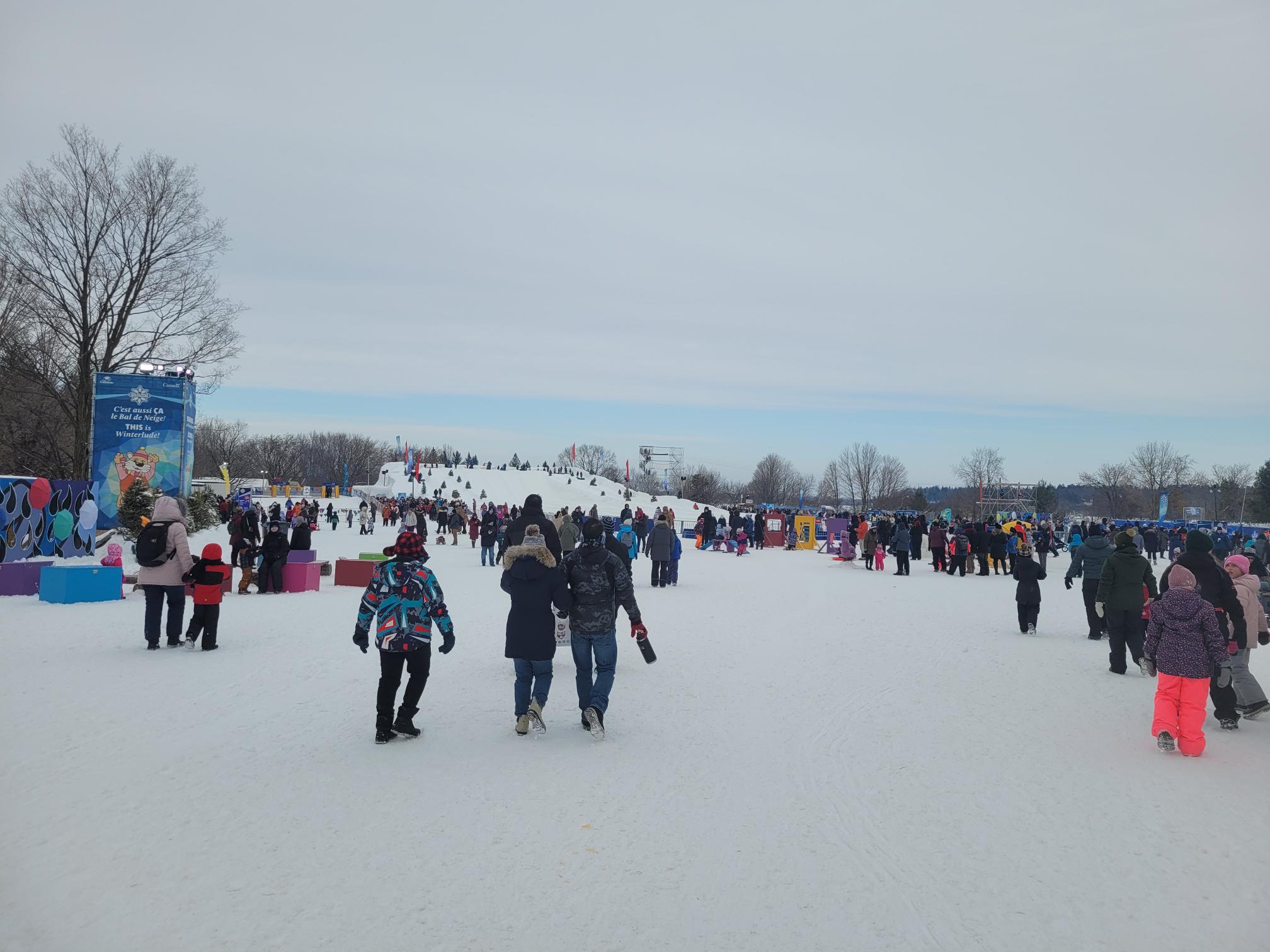
 Jacques Cartier Park is over in Gatineau, on the shores of the Ottawa River. Each year during Winterlude, it is transformed into a winter playground, and particularly busy on the weekends.


A staging area for buskers. One was setting up as I was departing. I took note of the woodworking here.


There are a couple of oversized Muskoka chairs here in the park.


The main draw is a huge slope of snow, with multiple lanes for snow tubing.


Another activity- zip lines.

Saturday, March 9, 2024

Snow Slides And The Ice Hogs

 This trio of wood sculptures caught my eye.


More of the snow slides.


This is another of the oversized Muskoka chairs in Jacques Cartier Park.


The Ice Hogs are the mascots of Winterlude, seen often at the various sites. A family of oversized groundhogs, they're a long tradition of the festival, and kids love them. I'll be back on the Ottawa side of the river tomorrow to continue this series.

Friday, January 19, 2024

Legacies

 I left off yesterday mentioning the seigneurial system of New France, which can still be seen today when you fly over: long strips of land with waterfront access. The old system is still echoed in the Canadian legal system- old French measurements of the time remain legal when describing lands under the old system.


This map of the era shows it in vivid detail.


This beautiful clock always catches my eye.


Household items of New France are seen here.


This contemporary sculpture is a family tree of Catherine Moitie, one of the filles du roi. Each line represents a branch of her family. In five generations, she had six hundred descendants. Millions of Canadians count a fille du roi among their ancestors.


New France was also highly religious, and if you were a woman who didn't want to raise a family, perhaps becoming a nun was the way to go, and they did provide a great number of services, including medical and educational services. Marie de l'Incarnation was one of them.


This cabinet is an example of a flourishing tradition of craftsmanship in New France.


I close off today with this reminder as to how religious New France was.