Wednesday, December 5, 2018

The Library Fit For The Queen

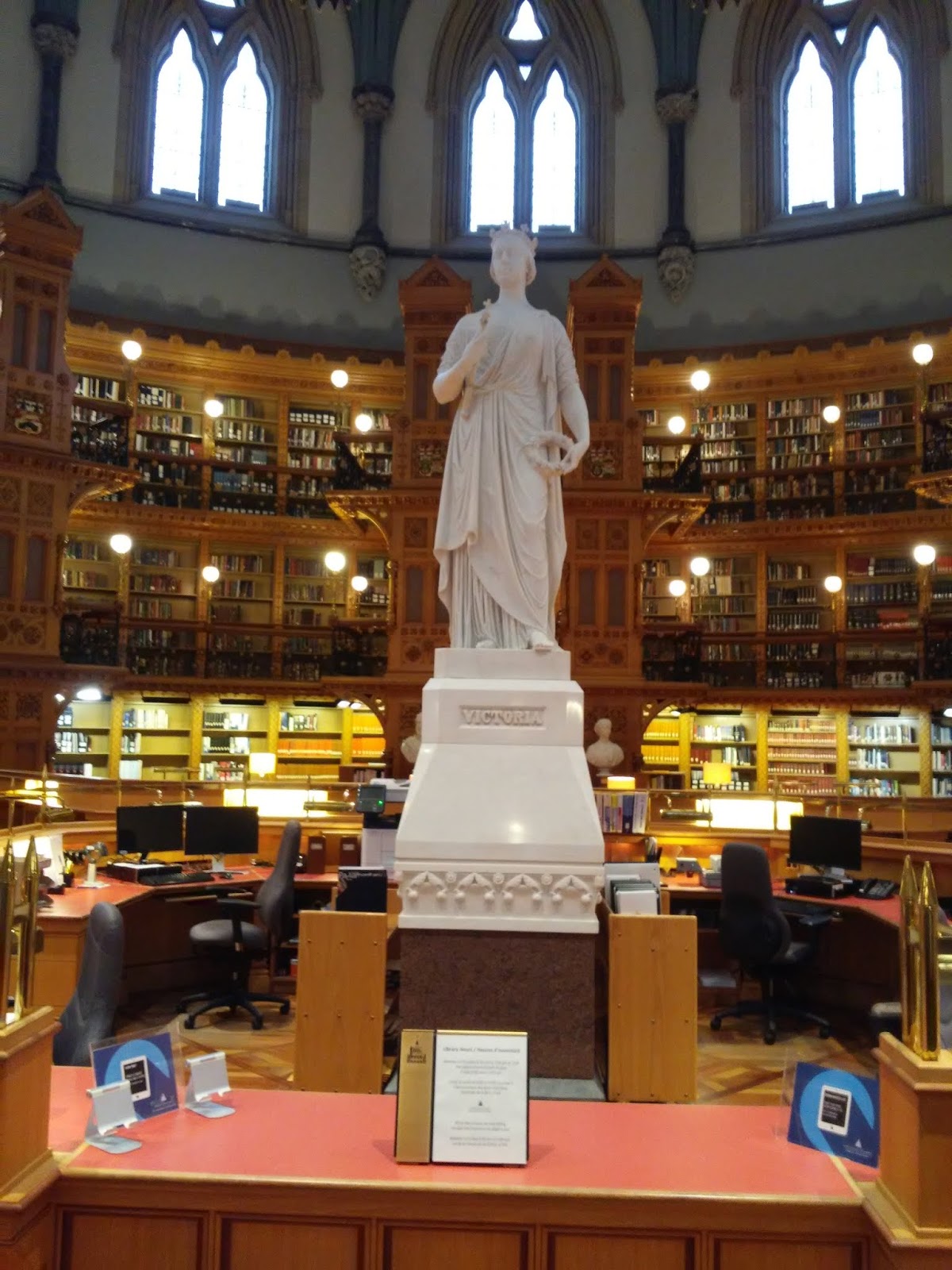
The Library Of Parliament is the only surviving part of the original Centre Block, situated behind the building on the north side of the property. During the 1916 fire, a fast acting clerk quickly sealed the heavy iron doors to the library, thus saving this structure from the blaze that destroyed the rest of the building. It is adorned with wood, filled with bookshelves, and is a glorious sight to behold. The Library and its satellite locations around the National Capital Region are available for parliamentarians and their staff in research work, with a highly trained staff at their disposal. Restoration work has been done here in recent years, though the Library will be inaccessible due to the Centre Block work, and so books are presently being moved to those satellite locations.


A statue of Queen Victoria stands at its heart. Crests of provinces as they would have been organized at the dawn of the 20th century can be glimpsed amid the woodwork.


A series of display panels are found here. They include this one that refers to the work of Parliament and speeches made by foreign leaders. Winston Churchill, for instance, spoke to the House of Commons in December 1941, when he gave his Some Chicken, Some Neck speech to assembled Canadian parliamentarians.


Here we have a view of the ceiling.


I could be quite happy in here, oh... for the rest of my days. I have more inside here tomorrow.

Tuesday, December 4, 2018

An Empty House Of Commons

This is the ceiling of the House of Commons lobby, adorned with Canadian symbols like the maple leaf or the fleur-de-lys, and symbols that represented cabinet ministeries at the time of the reconstruction of Centre Block.


Another view looks up at some of the sculptures.


This is the carved inscription past the left doors into the House of Commons area.


There is a lobby area between the foyer outside and the Commons itself. As there's not really enough room in the Commons for a tour group to stand, tours stay out here, but the glass wall is more than adequate to get good views inside. The governing party sits over on the left, the opposition parties here on the right, and the Speaker presides over things at the far end. Public galleries for viewing proceedings are up above. Taking its lead from the British example, the colour scheme in the Commons is green, while over in the Senate it is in red, a nod to the House of Lords at Westminster.


I photographed some of the stonework and glass at the top of this space looking in.


The tour led on, towards the Library of Parliament. Along the way I took the chance to photograph a couple of portraits of prime ministers that are down here. They are done after a prime minister has left office. This one is Lester Pearson, prime minister from 1963-68.


Kim Campbell was our first female prime minister, though spent considerably less time in the role, serving as Conservative PM from late June 1993 to early November. To be fair, she took on the job when her predecessor, Brian Mulroney, no doubt sensing electoral disaster, left the post in the final year of his second term. The fall election she called proved him right, as the Conservative party was nearly wiped out that time.


The path to the Library of Parliament goes down the length of the Hall of Honour. Sculptures can be found adorning the walls, and the arches of the ceiling are quite a sight. We'll pick up inside tomorrow.

Monday, December 3, 2018

A Foggy Visit To Parliament Hill

On the last Sunday in November, a week ago yesterday, I went up to Parliament Hill. There was a thick fog over the city that morning, as you can see in this view of Centre Block. This building is in the Gothic Revival style, which fits in with the other Parliamentary Blocks.


Parliament is in its last weeks of sessions before the Christmas break. After the break, Centre Block will be shut down for several years as part of the ongoing rehabiliation project going on here on the Hill. I wanted to take one of the tours of Centre Block before the closing, and will be coming back here sometime this month as I want to get some shots from the observation deck of the Peace Tower on a clear day (later in this series I'll show you the view, or lack of view, I got on this visit). 

Tours are offered in English or French with a guide escorting a group through each space. Ideally it's best to do this when Parliament is not in session. After going through security screening, one waits in a lounge area for their guide. Panels about the Parliamentary procedures are in this area. Included is this ballot box. Members of the House of Commons elect their Speaker at the beginning of a new Parliament by secret ballot, inserted into this.


A party whip is a member of the party who ensures discipline among members of their party. Occasionally they're presented ceremonial whips by their colleagues. This one belonged to James Gladstone, and resembles dance whips used by the Kainai people of the Blackfoot in Alberta- entirely appropriate as Gladstone was First Nations, the first Indigenous Senator.


A panel shows the two Houses of Parliament- the Commons and the Senate. The Commons will be meeting for the next few years in a temporary quarters placed into the West Block. The Senate is going to be meeting in the Government Conference Centre.


This pair of panels is nearby. The current Speaker of the Senate, George Furey (who I've seen in the Senate during a tour I made last December) is with the current Speaker of the Commons, Geoff Regan. Both men flank the poet laureate of Parliament, George Elliot Clarke. The second panel has Prime Minister Trudeau looking on as Speaker Furey presides over the speech from the throne, a tradition done by the Governor General in the Senate as each session begins.


Starting in the lounge area, then moving into a corridor, panels adorn the walls. When each term of Parliament ends, the members of the Commons and the Senate in turn are inscribed on these panels, placed in alphabetical order. The last panels are in a corridor beyond this one, where the tour led next.


The guide took us to our next destination, with portraits of Prime Ministers along the way. The House of Commons foyer is a large space outside the Commons. Canadians will know this area quite well, even if they've never been here, because it's here that politicians come out and face questions from the media. This portrait of Alexander Mackenzie, our second Prime Minister, is on one of the walls.


A Christmas tree is placed here at the moment. Centre Block is the second such building erected in this spot, as the original was destroyed by fire in 1916. The architects deliberately left blank areas in the interior for future sculptures and stained glass to be installed as time went on. The sculpting you see on the walls in this area, for instance, are more recent, and the guide noted that in the years this was done, the sculptor worked at night so as to not disturb Parliamentarians, or for that matter to be disturbed by them.


The staircase you see here will be quite familiar for Canadians- cabinet ministers are often seen in news footage descending here to go into the Commons.


This gives us a glimpse of a new addition. The stained glass window you see here was installed several years ago. It is the Reconciliation window called Giniigaaniimenaaning (Looking Ahead), part of the ongoing efforts to make amends for the treatment of First Nations peoples. The Canadian Museum of History has a copy of it, which you can see at this post.


I took more shots of the surroundings. We continue from here tomorrow.

Sunday, December 2, 2018

Late Autumn Within The Garden

Each season, I like to photograph the Landscapes Of Canada Gardens at the Canadian Museum of Nature to show things from that seasonal point of view. I was passing through the area one sunny day early last month and decided to take advantage of the clear skies. The Gardens consist of plants from four distinctive ecosystems in Canada. The first is Boreal Forest, with the trees, bushes, and shrubs one finds in the vast belt of woodland.


The golden tree you see above and below in this shot is a tamarack. It looks like a coniferous tree, but is in fact a deciduous tree- its leaves have the shape of needles and turn a deep golden yellow late in the fall before falling, usually after the bulk of the regular leaves are down.


Prairie Grassland follows, with the grasses and flowers one finds in the west planted here and growing well over the course of the summer.


This work of art spans the pathway, an iceberg in steel by the late artist Bill Lishman.


Over at one entrance, a number of bricks can be found with the names of people who have donated for  this, mostly families or those doing so in memory of another. I like how autumn leaves look against the bricks.


This view of the Museum and the iceberg is from the sidewalk. The third ecosystem, Arctic Tundra, is represented in the plants and shrubs planted amid the rocks on this side of the path. They're residents of the far north, and yet do quite well in an Ottawa growing season as well.


The path carries on, with Prairie Grassland at the right. On the left are plants that were present in North America thousands of years ago and remain present today. Mammoth Steppe is the last of the ecosystems making up the Gardens. A statue set of a family of three mammoths, life sized, are by the path. They were moved here from their original position, close to the iceberg, when the Gardens were devised. They're surrounded by the plants that the real mammoths would have been consuming around the time of the last ice age.

Saturday, December 1, 2018

City Daily Photo Theme Day: Joy

The first day of each month is a theme day for members of City Daily Photo. For December, that theme is Joy, and you can see how others are interpreting this theme here.

For this theme, I felt that Miwate fit the requirements of the theme, as it was joyful to watch. That was the name of a music and light show done by the production company Moment Factory in collaboration with the Anishinaabe First Nation, held in the fall of 2017 as part of the Canada 150 celebrations. It involved illuminating the Chaudiere Falls, which stand in the heart of the Ottawa River between Ottawa and Gatineau, in a ten minute show that carried on through the evenings and was quite popular. The lights, mounted upon the dam behind the falls and other spots, brought the waterfalls to vivid life. Miwate captured the imagination of visitors, and I visited on numerous occasions. These shots were from one of those evenings, and I left them aside for future use. I also filmed videos; if you'd like to see one, click here, though you might want to turn the volume down somewhat- the audio on that camera was a bit harsh.