Sunday, July 24, 2016

People And The Land

Moving into the Canadian collection at the National Gallery, I'm starting with Josepth Ourne, a portrait of a young Aboriginal woman by the Quebec artist Joseph Legare, painted circa 1840.


There are several paintings in the Gallery's collection by the artist Cornelius Krieghoff, a Dutch born artist who spent years living in Canada. This is an oil painting entitled White Horse Inn By Moonlight, painted in 1851.


Another Krieghoff is this oil painting, The Chaudiere, which depicts the Chaudiere Falls on the Ottawa River as they would have appeared at the time he painted this in 1858.


Winter Landscape, Laval is the title of this Krieghoff oil painting from 1862. 


These two paintings are both Krieghoffs as well. They are both takes on the same subject, a waterfall in Quebec. The top one is from 1854, titled The Saint Anne Falls Near Quebec from Above And Looking Upward. The lower painting, from 1855, is The Saint Anne Falls. 


This painting is by an artist named John Bell-Smith. The oil portrait is titled Miss Amelia Boddy. It dates back to 1845.


I peeked in at the enclosed courtyard garden while I was passing through this part of the Gallery.


And today I'll finish up with this pair, by the artist Paul Kane. The top one is Chinook Indians In Front Of Mount Hood, an oil painting dating circa 1851-56. Its companion also dates to those years, and is titled Interior Of A Clallam Winter Lodge, Vancouver Island.

Saturday, July 23, 2016

Within The Gallery

Another stop on Canada Day was at the National Gallery of Canada, where a visitor first comes up the long ramp to the glass tower that gives views of Major's Hill Park, the Chateau Laurier, and Parliament Hill.


This view from the second level, late in my visit, showed a downpour outside.


This painting is from the permanent exhibits; it's a Picasso, titled The Small Table, dating back to 1919. I make note of this here because there was also a special exhibit going on that I stopped in to see. 'Picasso: Man And Beast' is a collection called the Vollard Suite, a series of etchings and drawings the artist did over several years, drawn out of Greek mythology. You can get a taste of the exhibit here. There are few complete sets of the Vollard Suite- many of the sets were broken down into smaller segments for collectors- but major galleries like this one do have them. This exhibition is the first time since the Gallery acquired them that they've been on display. Some of the prints have more of a conventional look, while others definitely look like Pablo's style. Obviously photography in the exhibit hall was out of the question.


There was another exhibit going on that I have to go back to see. Elizabeth Louise Vigee Le Brun was an 18th century portrait artist in the court at Versailles, a favourite of Marie-Antoinette and this exhibit features her life's work. Have a peek at the exhibit website.

Friday, July 22, 2016

Symbolic Birds

Within the Bird Gallery, there is a series covering the provincial and territorial birds of Canada, each in turn. At present, there is no national bird, though there have been some initiatives in the last couple of years to designate one.


These final pictures are from a couple of the display cases at the beginning of the exhibit- though they were my final shots of the Bird Gallery.

Thursday, July 21, 2016

Bird Life

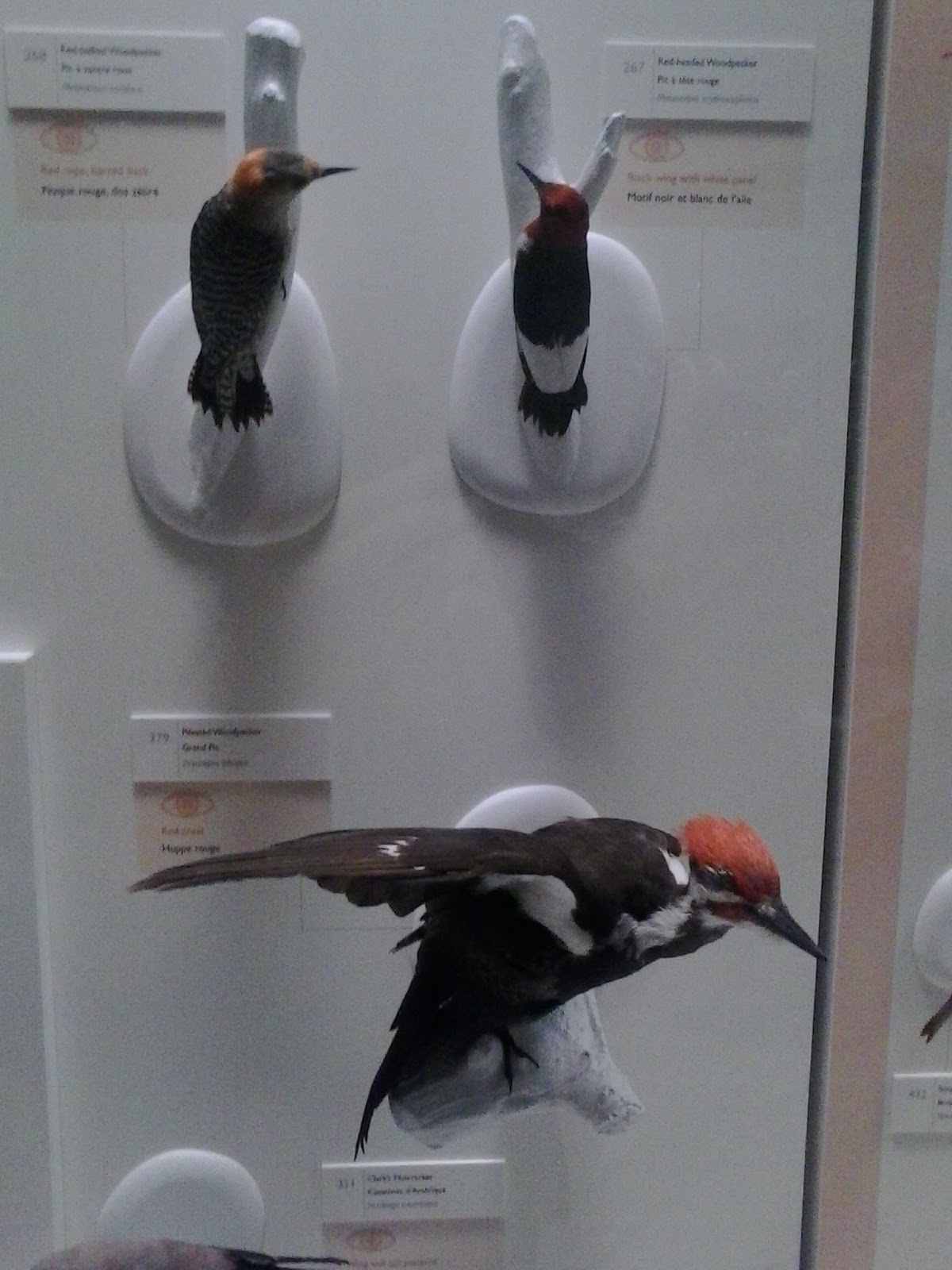
Here are some more of the displays from the Bird Gallery at the Museum of Nature.

Wednesday, July 20, 2016

In Flight

The last time I visited the Museum of Nature for a tour I showed back in April, the Bird Gallery had been closed, as it was in the process of being moved down one level. It was open again when I visited on Canada Day. There are displays of birds through the Gallery, with a concentration on Canadian birds. Some of these are displayed by themes such as size, feathers, or common characteristics. There are also interactive exhibits- how much you might weigh in hummingbirds, for instance, or how a bird's vision works. I have more from here over the next two days.

Tuesday, July 19, 2016

Terrain

I visited the Museum of Nature on Canada Day, which as you can imagine was insanely busy. Before going in, I walked along the west side of the property. When I last took you on a tour of the museum, I mentioned that there was a landscaping project underway on the west side. Last fall most of the work was done, and the area was fenced off, with some last details handled this spring before the area was opened. It's called the Landscapes Of Canada Gardens, and it presents around sixty species of plants and trees as you pass through.

The idea is to present various terrains of Canada with their plant life along the path. It starts with boreal forest- evergreens have been planted here, as you can see in the background, along with ground shrubs and bushes, all of which are marked. On a subsequent visit I even noticed different species of lichen on the dead tree in the center have been marked.


The path then leads into prairie grassland. In collaboration with a museum in the West, the Museum has planted a considerable amount of prairie grasses and flowers, a hint of what once covered a massive part of North America. At different times of the year, and even different times of the day, this section in particular will look quite different for the photographer.


The path next leads to tundra landscape, including small flowers and scrub bush that usually grow in the most inhospitable parts of the country, perhaps for a few weeks a year. I did not record the name of this particular flower among the rocky terrain.


There is also a large work of art here. This iceberg sculpture is visually fascinating, allowing the visitor to walk right through it. It is the work of the Canadian artist Bill Lishman. You might not know the name at first- he's the same fellow who built an ultra-light aircraft to teach geese and other birds to fly south, and his story was retold in the film Fly Away Home.


There is also a section here where the woolly mammoth sculptures have been moved from their original location, which was close to where the iceberg sculpture has been placed. Behind them have been planted shrubs and flowers that are still around today, but were also present in the era when the real mammoths walked the earth at the close of the last ice age. This area is referred to as the Mammoth Steppe.

Monday, July 18, 2016

Air War

When I stopped in at the War Museum for Canada Day, I went through the permanent exhibits, which I've featured before, but also stopped in at the temporary exhibit currently being displayed. It covers the air war during the First World War, with models, artifacts, art, and panels on personalities done in what's basically a graphic novel format. The exhibit also includes a rebuilt Sopwith Pup plane of the era. The battle in the air during that war constituted a completely new form of warfare, where young pilots were inventing tactics literally at the spur of the moment.

One of the panels, which I didn't photograph, featured Manfred von Richthofen, remembered by history as the Red Baron. It was a Canadian pilot, Roy Brown, involved in the Baron's final duel; there is controversy to this day as to who actually downed the Baron- was it Brown or Australian infantry firing from the ground? Another panel mentioned the Baron landing to see if a downed Canadian pilot he'd just bested was all right. However his death, it was probably for the best- had von Richthofen survived the war, he surely would have been a propaganda tool for the Nazis in the Second World War. This way his legacy, honour, and reputation were never tarnished- and his long feud with Snoopy The World War I Flying Ace could proceed unhindered.