Showing posts with label Arthur Currie. Show all posts

Tuesday, December 30, 2025

A Finale For Ottawa Christmas Lights

 The National War Memorial occupies the heart of Confederation Square, and is surrounded by landmarks like Parliament Hill, the Chateau Laurier, the Government Conference Centre, the National Arts Centre, and the Chambers. Christmas lights are strung up in the trees around it. I started walking around the perimeter, taking shots as I went.


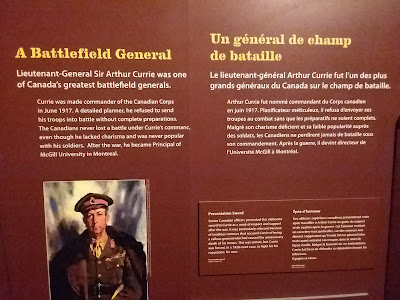
On the northeast side of the perimeter, a series of statues and busts are gathered around a staircase that comes up from the Rideau Canal. They are collectively called The Valiants, consisting of figures from across Canadian military history. General Arthur Currie commanded Canadian forces during the last part of World War One, and by all accounts did very well with them.


I carried on.


My last stop was Parliament Hill, where the Peace Tower was illuminated in blue and purple, with snowflakes falling down the length of the tower.

Friday, November 28, 2025

Battles Of A Hundred Days

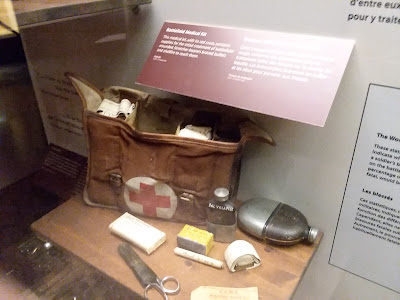
 Here we see a battlefield medical kit of the World War One era.


Blood transfusion sets were being brought to the field of battle, saving lives.


Men from across Canada and all sorts of backgrounds fought in the First World War. Women served as nurses and in other capacities, as well as doing work at home.


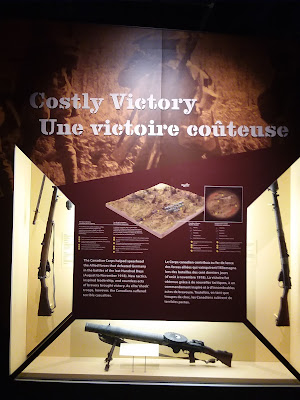
The Hundred Days is the final stage of that war, in which the stalemate of four years of trench warfare was finally broken, and victory was achieved at a high cost, a series of battles along the western front in which Germany was pushed back again and again.


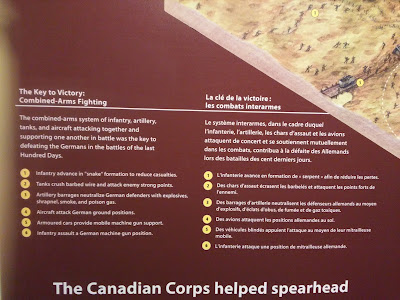
What broke the stalemate? The concept of combined-arms fighting, simply the coordinated work of infantry, artillery, tanks, and aircraft in fighting together and supporting each other in battle. After four years of futility and throwing masses of men at heavily defended positions for nothing, someone finally got it right. 


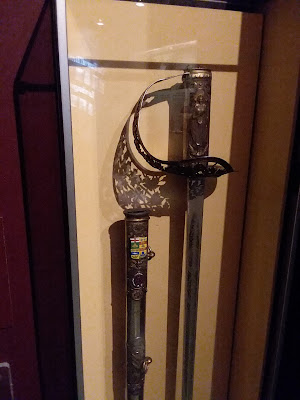
Arthur Currie commanded the Canadians from June 1917. While not a popular commander among his men, he was nonetheless a very effective general, and a believer in being prepared. His ceremonial sword is displayed here.


Newfoundland was a separate dominion at the time, not part of Canada, and sent troops to fight in the war, and yet also sent some of them to fight alongside their Canadian counterparts. Robert Pilot was one of them. In the years afterwards he would be known for his vivid art.


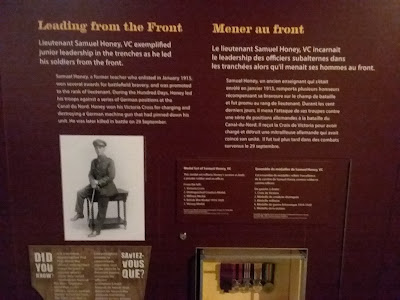
Lieutenant Samuel Honey won the Victoria Cross for his bravery and leadership at the Canal du Nord, part of the Hundred Days. Like so many others, he did what seemed impossible, but did it anyway.


This is a model of a tank making its way across terrain, with supporting infantry.


The tank was brand new to warfare; while slow, they provided a reason for the enemy to worry.


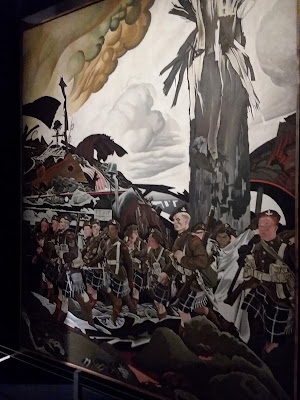
The Conquerors is a work by Eric Kennington, painted after the war. It depicts Canadian soldiers during the Hundred Days on the march. Among them, characterized by pale faces and black rimmed eyes, are the ghosts of their fallen comrades.


The Hundred Days saw Canadians doing the extraordinary, pushing back the Germans time and again in a series of fierce battles, but at an enormous cost in casualties.

Sunday, December 3, 2023

The Hundred Days To End The Great War

While Canada mostly sent white males to war in the First World War, that wasn't exclusively the case, as indigenous, black, and other minorities joined the fight, and women made their own presence known. This mosaic of photographs reflects the variety of people who went to war.


The Hundred Days is the final stage of the Great War. After four years of stalemates and death on a scale never seen before, all because of generals using outdated tactics against modern technology, the breakthrough came about in Allied officers coming to understand the value of combined arms fighting- the system of attacking together in tandem- infantry, artillery, tanks, planes- all working in support of each other as a team. It broke the stalemate, and the Germans gave way. Over the Hundred Days, Canadian soldiers fought a series of battles at great cost, but with great gains, pushing their German adversaries back each time.

If only the generals had figured out combined arms fighting so much sooner.


Arthur Currie was a Canadian general who was forward thinking in tactics and strategy, not one given to the outdated techniques, and an effective commander. His ceremonial sword is here.


Alongside their allies, the Canadians surged forward during the Hundred Days through battle after battle.


This painting, The Conquerors, depicts the ghosts of the fallen marching alongside their surviving comrades. It is by Eric Kennington.


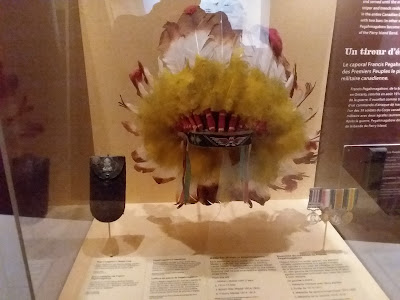
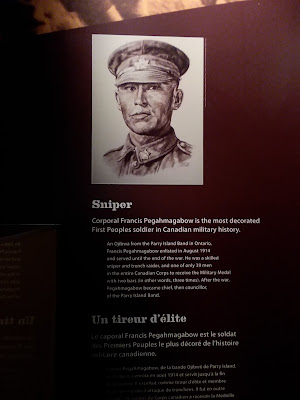
This is the ceremonial headdress of Francis Pegahmagabow, one of the country's most decorated indigenous soldiers, a formidable sniper throughout that war. He would later go on to represent his people as a chief and leader for decades.


Perhaps the last man to die in the war, and certainly the last Canadian soldier, Private George Price, who died in the minutes before the armistice broke out.


Canadians ended the war by liberating the town of Mons, Belgium, where the people came out to meet them in celebration.


But the war had a huge cost on the country. One in ten who served died. This was typical of casualty rates. Families were forever marked by it.

Thursday, January 6, 2022

The Hundred Days: A Path To Victory

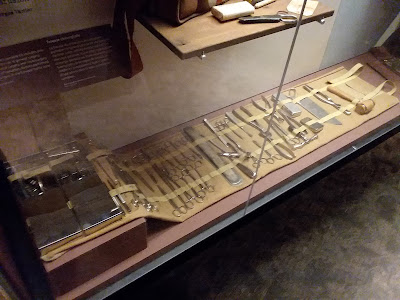
Battlefield medical supplies are seen here going back to the time of the First World War. 


After four years of generals sending masses of men against opposing positions and modern technology and getting them slaughtered, finally in the last months of the war things changed. The Hundred Days marks the concluding battles of the war, with Allied forces adapting to use combined arms fighting to turn the tide and win the war. Simply put: coordinate all of your military assets on the field and work together- infantry, tanks, artillery, and air. This is what won the war. If only it had been learned earlier.


The senior Canadian general, Arthur Currie, would likely have ascended to command to all British empire forces had the war gone on. As it was, he was one of the best generals in Canadian history, a methodical commander whose efforts helped in bringing his men victories.


This ceremonial sword was presented to him by senior officers after the war out of respect to him.


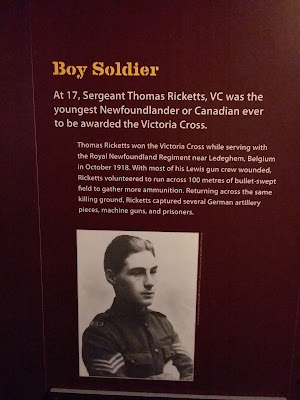
Thomas Ricketts won the Victoria Cross for extraordinary bravery in battle late in the war.


Lieutenant Samuel Honey won it too for his own courage in battle, though he would not live to see the end of the war.


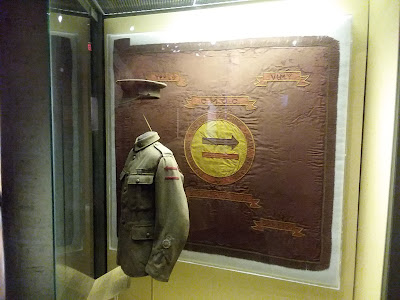
A uniform jacket and cap, along with regimental colours, is displayed here.


This unusual painting always catches my eye. The living march with their ghostly comrades in this painting titled The Conquerors.


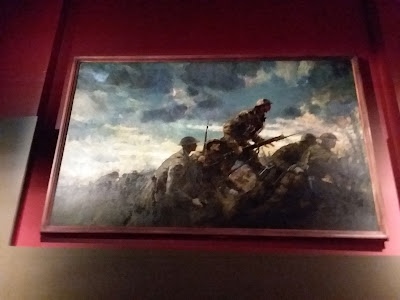
Another painting, one of the most dramatic in the Museum's collection, depicting a moment during the Hundred Days. Over the Top, Neuville-Vitasse shows men of the 22nd Battalion at a village at the front in late August 1918 pushing the attack against the Germans. Georges Vanier, who decades later would be the governor-general of the country, said that he was the officer seen in the painting holding his pistol.


This is the ceremonial headdress of Corporal Francis Pegahmagabow, a sniper who is the most highly decorated Indigenous soldier in Canadian history. After the war he would be a chief of the Ojibwa.