Showing posts with label Nelson Mandela. Show all posts

Monday, February 9, 2026

Human Rights

 Women's rights, particularly gender discrimination and violence, are explored. The Ecole Polytechnique massacre of December 1989, in which fourteen women were murdered, had a huge effect on the country.


The Roseland Theatre in Nova Scotia became the focal point of a human rights complaint back in the 40s. There was no law in the province for racial equality, and so private businesses could practice segregation if they wanted. In 1946, Viola Desmond, who owned a beauty parlour in Halifax, was in town and attended a movie- getting arrested for sitting in the whites only section. These days her portrait is on the Canadian ten dollar bill.


Disability rights and accomodation have evolved over time. From everyday AODA needs to those who shine on the international stage, Canadians have responded and adapted. Paralympic hockey sticks are seen here, along with a glove that has a story in and of itself. It is a glove that was used by Rick Hansen, who showed the world what a man in a wheelchair can really do.


Hansen went around the world on his wheelchair to raise money for spinal injury research, leaving a big impact on the world as a whole.


Disability adaptation includes a model for a full scale playground equipment seen here.


Human rights applies as well to around the world.


Lotta Hitschmanova was a refugee who came to Canada, where she founded the Canadian chapter of the Unitarian Service Branch and dedicated her life to working with refugees affected by war.


This is one of her uniforms.


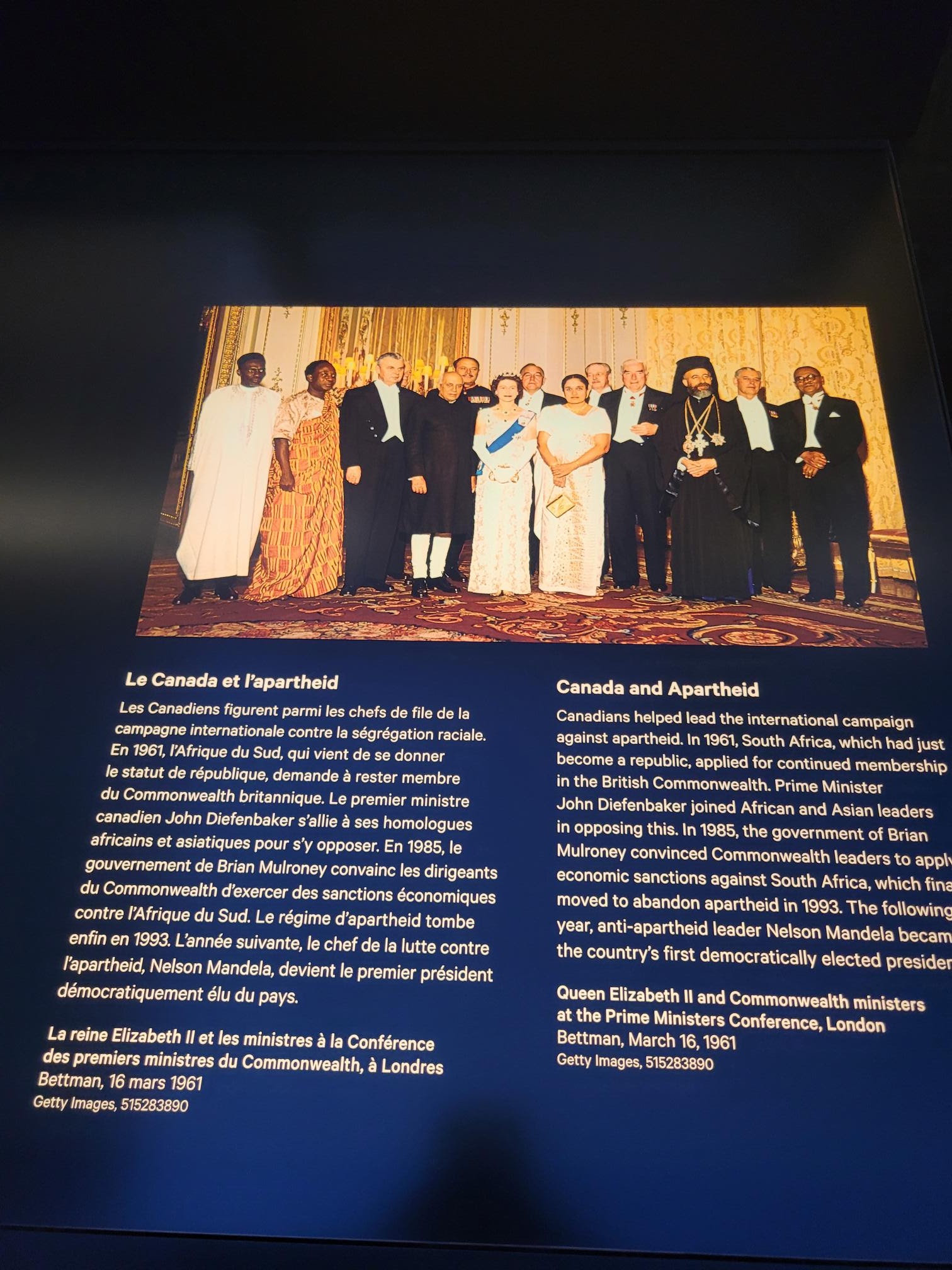
Canadians also got involved in the fight against apartheid over successive governments- with the government of Brian Mulroney becoming even more assertive to convince the world to bring economic sanctions upon South Africa as a tool. Whatever else he was as a prime minister, it's something about him that I respect. It meant disagreeing with his allies, Margaret Thatcher and Ronald Reagan, both of whom wanted to go slower.


Nelson Mandela was made an honorary citizen of the country right here at the Museum. With Canadians so vocal in the fight to end apartheid, he had a warm relationship with the country as a result.

Friday, October 18, 2024

Justice

 Continuing where I left off yesterday. Nelson Mandela was made an honourary citizen of Canada here in the Museum while on a state visit. Canada's strong stance against apartheid resulted in a warm relationship between Mandela and the country as a whole.


Canadians have often gone out in disaster response around the world. This display case looks at some of that.


Canadians have also been active within the United Nations from the start. John Peters Humphrey, seen at lower right with Eleanor Roosevelt, drafted the UN Universal Declaration of Human Rights. Stephen Lewis has spent a good part of his career doing work for Canada within the UN.


This is the robe of a prosecutor for the war crimes tribunal that looked into the aftermath of the collapse of the former Yugoslavia.


Louise Arbour was the Canadian judge who became chief international prosecutor in those tribunals, seeing the darkest humanity had to offer in the search for justice.


Canada today has a fine reputation abroad, with its citizens welcome around the world.

Tuesday, September 17, 2024

Canada

 Continuing where I left off yesterday, here we see the Caribou Monument in Bowring Park, memorializing the war dead of Newfoundland and Labrador.


This is the Ukrainian Labour Temple in Manitoba.


The British Columbia provincial Parliament Buildings are found in Victoria, B.C. 


This is the Old Arts Building in New Brunswick.


Grain elevators are a common sight in Saskatchewan.


Pier 21 is home to the Canadian Museum of Immigration in Nova Scotia- one of two national museums outside the national capital area.


This is the CCGS Amundsen, a Coast Guard icebreaker.


Dawson City is found in the Yukon Territory.


This scene is Pangnirtung in Nunavut.


And this is Point Prim Lighthouse on Prince Edward Island.


Inside the main hub of the Canadian History Hall is a viewscreen of various moments in our history. William Lyon Mackenzie King can be seen at top right, for instance, while at lower left is the dark chapter of the October Crisis.


The view screen changes, and so at lower left is a picture of Prime Minister Jean Chretien and Nelson Mandela, who was made an honorary citizen of the country right here at the museum.

Thursday, February 8, 2024

Canadians Out In The World

This is the service uniform of Lotta Hitschmanova. 


She came to Canada as a refugee during the Second World War, and at war's end founded the Canadian branch of the Unitarian Service Committee, which still carries on her work today. She spent her working life in service to those affected by war.


The apartheid question in South Africa was a thorny diplomatic issue for decades. Canadian governments in turn opposed it.


In the 1980s, the movement globally against apartheid resonated with society. The Canadian government under Brian Mulroney pushed for economic sanctions against South Africa- while his allies Ronald Reagan and Margaret Thatcher would have preferred less overt steps. Despite the many flaws of the man (as many a Canadian would attest to), this stance on principle is worth respecting.


Nelson Mandela never forgot that Canadians were outspoken in opposition to apartheid, having a warm relationship with the country and the people, and he was made an honorary citizen of Canada right here at the Museum.


This quote speaks volumes, and rings true.


Christina Briand was one of a number of Mounties posted in Haiti on a UN detail in 2010 when a massive earthquake struck the country. She worked on rebuilding an orphanage.


People in her hometown raised money in support of the reconstruction.


Both Canadian government and non-governmental agencies actively get involved in emergency response around the world.