Tuesday, April 24, 2018

Final Views

Today I conclude this visit to the Canada Agriculture and Food Museum with some final perspectives. I am also adding this post into Tom's Barn Collective theme for this week. This looks at the Learning Centre. As you can see, by the time I was departing, the skies were considerably more clear than when I had arrived that day.


This view looking south takes in some of the buildings that are part of the Experimental Farm's day to day operations, beyond the bounds of the Museum area.


Here we have views of the Small Animal Barn.


Earlier in the series I showed you an old wagon. That one's in the background of this shot, while another wagon takes centre stage. These are near the Cereal Barn, which is in the following shot.


I stopped by the enclosure again where the horses were, near the Horse and Cattle Barn.


And I close off with two final views of the Dairy Barn. The first includes the annex section with the Soil Lab. The second, from the south, includes the picnic area. I hope you have enjoyed this tour.

Monday, April 23, 2018

Dairy Barn

I focused on the patterns on a couple of the backs of cows here in the Dairy Barn. This first one was a cow named Eden.


I didn't get the name of this one, but she had a pattern that looked rather like a country.


Here we have more panels- the difference between hay and straw starts.


Milk tanks follow, along with a look through windows at some of the building's milk tanks.


Frequently asked questions are answered here, and information on the dairy industry is addressed by another panel.


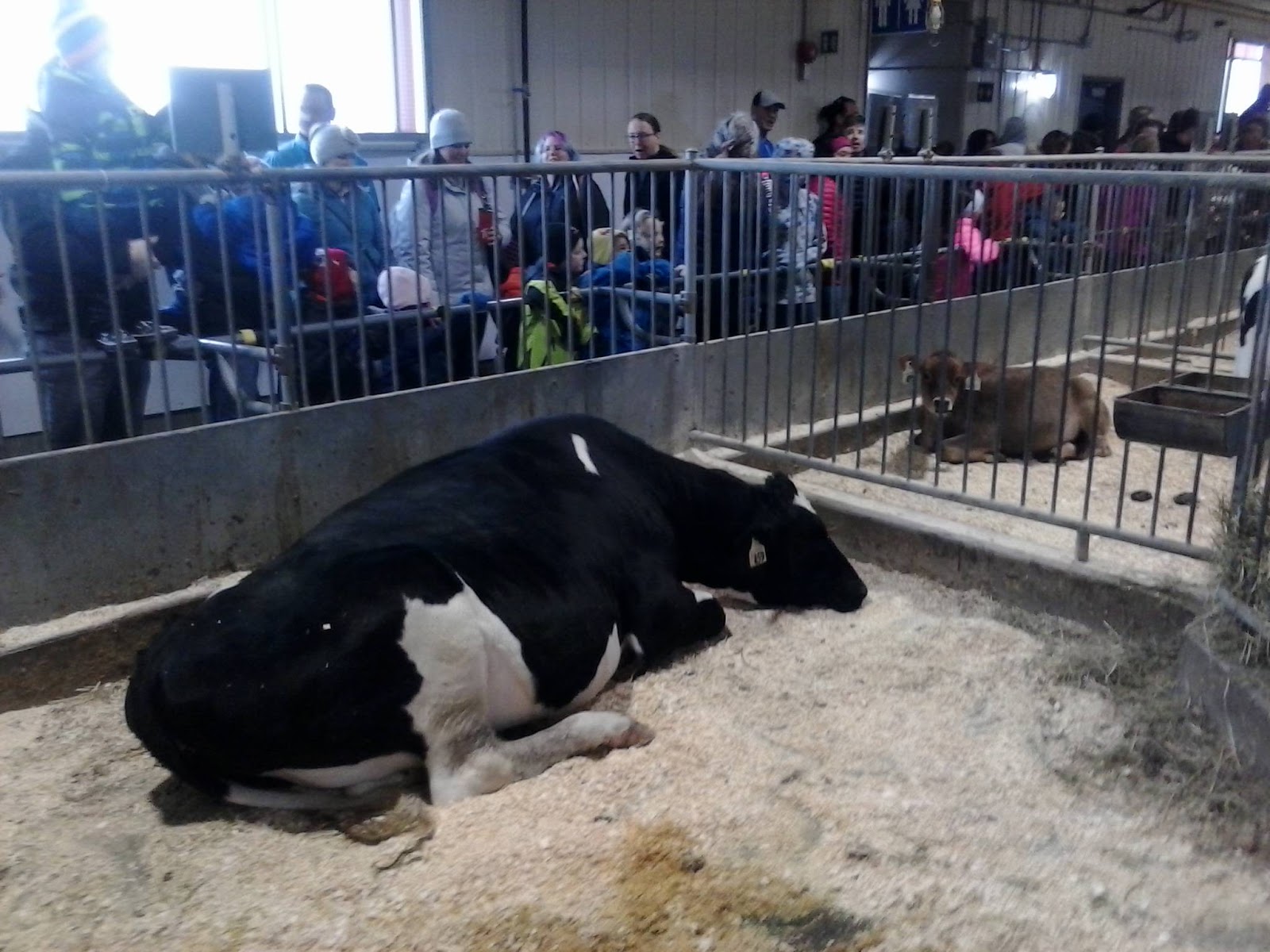
I liked the way the light played over this resting cow.


The calves are kept (at least until the weather warms up and the herd gets out to pasture) in a nursery area. Their diet is a mix of hay, regular feed, and mother's milk, presumably bottle fed. Most of them were resting when I first came in, though this first one was up on her feet and lapping up attention from visitors when I came through afterwards.


This pair, side by side, had the names Tinkerbell and Velvet. Tomorrow I bring this series to a close.

Sunday, April 22, 2018

Dairy Barn

Here we have another view of the Dairy Barn, before heading indoors to see the herd. I am adding this to Tom's Barn Collective. Looking at the map of the property given to me upon entry, I realized after the fact that I had missed a couple of exhibition spaces in this building, in areas away from the cows. Oh well, there's always next time.


The herd consists of several different breeds. When they're all in here, they're in tie stalls. When the weather's warm enough, they spend their time out in pastures, only coming in for milking in the afternoons. The calves get first dibs on the milk from their mothers, and the rest of the milk is sold as part of the national supply. Calves are off in another section I'll show you tomorrow. Female calves end up joining the herd, while male calves will be sold to other farms after a certain age. On the odd winter day when it's mild enough, they get time outside while their stalls are cleaned and fresh straw is put down for them. And there's a technology involving a low electrical current that prompts them to step back to relieve themselves away from the straw. Workers come through replenishing their hay as needed, and water pipes feed into bowls between the stalls. There is even the sound of birds chattering away, and one sees them amid the pipes- though how they get inside the barn is another matter.


Panels on the walls and over the stalls detail milking, cow biology, breed types in this herd, how much they eat, and their summer pastures. One also makes note of the fact that a previous barn at this site went up in a fire. Each of the cows have names, marked above their stalls with their breed type.


A section of stalls nearby is set aside as a maternity ward. This is a Canadienne breed cow named Adele. She was lying quietly the first time I came by, and then having some hay when I came by afterwards. Her time for giving birth was coming up, and so she was placed down here and checked in on regularly by farm staffers. 

Saturday, April 21, 2018

Critters

A pair of alpacas are among the animals here in the Horse and Cattle Barn. They looked impatient for spring.


Two calves share a stall here. They're born in the last couple of months. They are siblings, of the Simmental breed of cow. One was up on their feet, the other having a rest. In this first shot, you can see the walkway used by workers to access the stalls.


Emma, also a Simmental, was born last year, and is in the neighbouring stall. She is in fact their sister, as the signage indicates all three had the same father and mother. The Farm handles breeding through artificial insemination.


A mother and calf were sharing a stall. Cleo is a three year old cow of the Blonde D'Aquitaine breed. Fernando was born this year. The signage cautioned that Cleo is a protective mother.


Another pair, calves by the look of them, were here with their mother.


And one more cow for today (with more tomorrow as we head over to the Dairy Barn).


This display dealt with the horse shoe process.


Back outside the barn, the horses were having lunch.


Late in my visit, with the skies clearing, I took additional perspective shots of this barn.

Friday, April 20, 2018

Critters

Several of the horses were out in one enclosure here at the Canada Agriculture and Food Museum during my visit, while a couple of cattle were in another enclosure nearby, the weather being warm enough to let them out for awhile during my visit. This big horse looms before the background of the Horse and Cattle Barn. Horses, various breeds of cattle, and some other animals can be found inside during the winter, and would get some time here or in other pastures in warmer weather, as the dairy herd does.


Here we have another view of the barn. The animals spend colder weather indoors, and the building is equipped to keep temperatures suitable for them through the year, as well as with fans to circulate air throughout. Public paths circle around the edges of the building, while central passageways allow for workers to access the stalls for cleaning and feeding.


This formidable fellow is a Hereford bull named Hercules, born in 2011.


Most of the cattle in here are females. They would be raised for meat on other farms. Here they get names.


This one, for instance, bears the name Everest, and is a Charolais breed.


While this one is an Angus named Lady, caught at two different points in my visit.


It's not all cattle and horses in here though. This pair were busy preening themselves.


This is one of the display panels here in the barn, having a look at the famous horses used by the Mounties during their Musical Ride.