Monday, October 26, 2020

Fathers Of Confederation

This is a bust of Lord Elgin, the Governor-General at the time of the push towards responsible government.


Tensions south of the border had their influence on those who would lead the country into Confederation. The Civil War served as a lesson to colonial politicians looking for further self government that they needed a strong union among the Canadian colonies.


The Fathers of Confederation came into their own in the 1850s and early 1860s. Not all of them were politicians, but most were. They didn't all get along, but understood the need to work together. During meetings and negotiations in the 1860s, they would eventually bring about the terms that led to Confederation in 1867.

 Three of them are gathered in photographic portraits here: John A. Macdonald, George Brown, and George-Etienne Cartier.


The most eloquent of the Fathers was one of their most unusual: Thomas D'Arcy McGee. He had in younger days been a radical in his native Ireland, had fled to the New World, and here had underwent a complete change in his perspective, seeing the value of a Parliamentary system based on British influences where minorities could have a chance to prosper.


McGee would pay dearly for his change of heart. Irish radicals despised him for it, and in 1868 he was assassinated while coming home from Parliament to the boarding house he was staying in near the Hill. The gun used in the assassination is here.


Artifacts of the time, with a photo of Queen Victoria behind. Cartier would take this trunk with him to London for the conferences that would formalize Confederation.


This large banner on a wall shows the reading of the proclamation of Confederation at Market Square in Kingston on July 1st, 1867.

Sunday, October 25, 2020

Making A Country

This area includes more of the everyday objects and tools being used by settlers in the first part of the 19th century throughout what is today eastern Canada.


Rebellions in the 1830s would ultimately rise to the idea of responsible government and Confederation.


Among the artifacts here is the crest of the old Molsons Bank and the Cabriolet Sleigh, which was featured in the Canadian Pavilion at the Great Exhibition in London in 1851. 


Recreation could be found in the colonies at the time, particularly in urban centres. Cricket, curling, and lacrosse are represented here. The last of those three was a game that had a long history here before the arrival of white people; First Nations peoples had been playing it long before then.


The drive towards responsible government that came out of the rebellions found its strongest voices in a partnership of English and French speaking leaders, Robert Baldwin and Louis Hippolyte LaFontaine, who would share leadership of the united Upper and Lower Canadas.

Saturday, October 24, 2020

New Dynamics

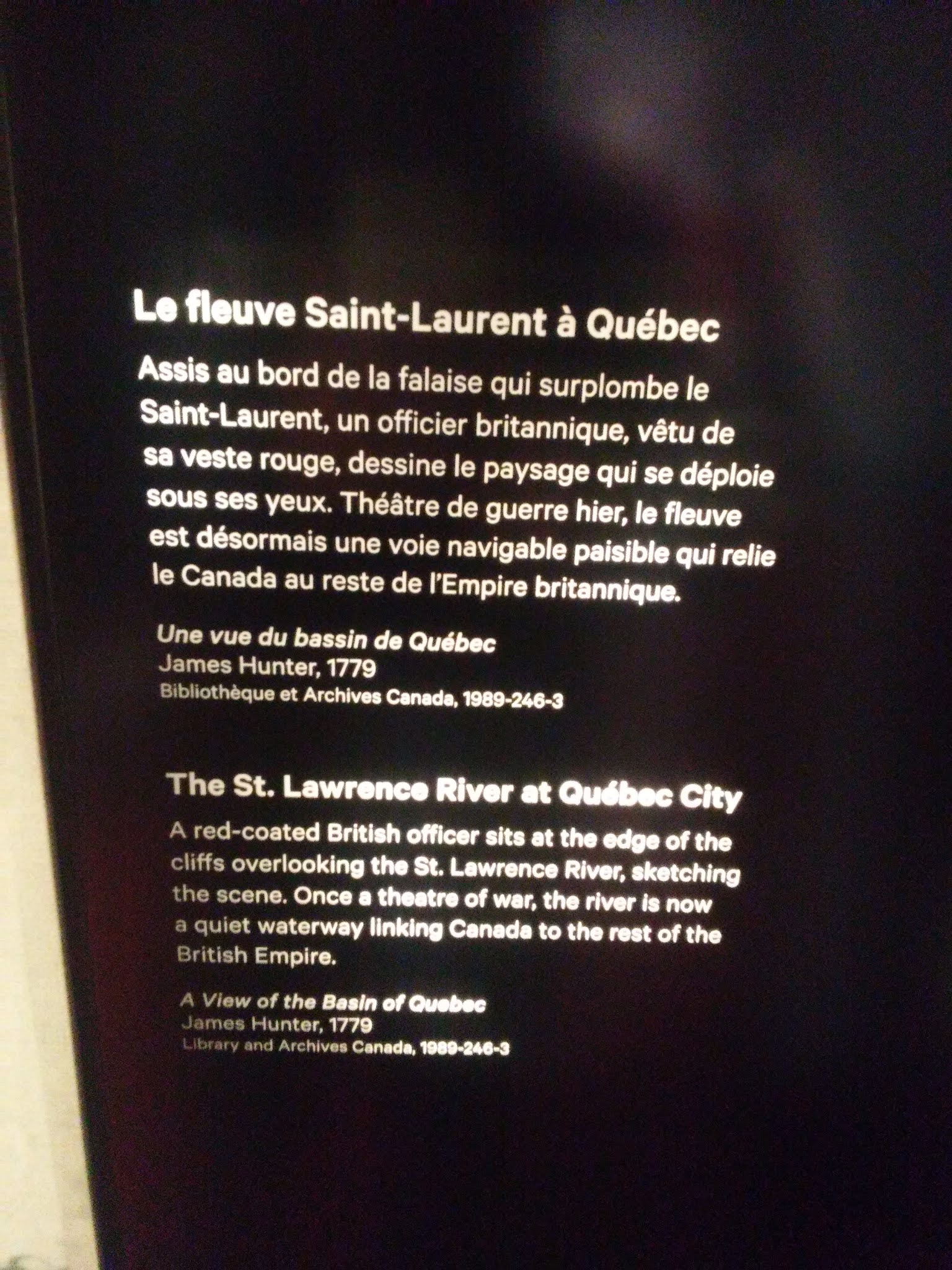
 The Museum narrative continues along, with this large banner reproducing an original work of art depicting the St. Lawrence River at Quebec.


Our relationship with our southern neighbours is a theme that comes back through our history. The American Revolution would send Loyalists north in its aftermath, and the War of 1812 would bring outright conflict. Effectively for the first century of the existence of the United States, there was a perpetual state of tension, even while trade goods flowed back and forth.


This is a hooded overcoat also called a capot or canadienne worn by French Canadians already in the days of New France. This one was made after 1852.


The influx of English speakers and others during the end of the 18th century and first half of the 19th century would have a big effect. New colonies were created, and language dynamics would change.


A set of dishware is among the artifacts of the time.


For today I leave off with this.

Friday, October 23, 2020

Adversaries

Portrait Of James Wolfe at Quebec is by J.C.S. Schaak, done around 1766, portraying the British general whose forces won at the decisive Battle Of The Plains Of Abraham, but who lost his life at that place during the French and Indian War.


His French counterpart also died of his wounds at that battle. This is Portrait Of Louis-Joseph de Montcalm, by an unknown artist, dating to the early 1800s.


Here we have two views from Quebec City at that time, by the same artist, Dominic Serres, done in 1760. A View Of The Treasury And Jesuits College, Quebec City is at top, and A View Of The Church Of Notre-Dame-de-la-Victoire is below.


More art of the period: four portraits of First Nations chiefs who traveled to Britain to meet with Queen Anne. Artist John Verelst painted them.


New France fell, and power in North America came to Britain (whilst setting the stage for a dust-up south of the border with those colonials of the Thirteen Colonies just a few years later). How to manage a place with various First Nations tribes, a lot of French Canadiens, and new challenges? Pragmatism and compromise.


Here we have two portraits: Gabriel-Elzear Teachereau had fought against the British but ended up making a success of himself in the British administration. At right is Sir Guy Carleton, who governed here from 1766-1778.


A panel and portrait here is where I'll leave off for today, featuring Frances Brooke, a writer of the period.

Thursday, October 22, 2020

Ambitions

While New France was establishing itself, the British had their own designs on North America, establishing colonies along the eastern seaboard and pursuing trade networks deep in the interior. Conflict would inevitably break out.


This hood is of Anishinaabe origins.


Here we have a painting, Annapolis Royal, Nova Scotia, from the circle of Samuel Scott, done around 1751.


The dynamics of tribes interacting with the two colonizing nations from Europe could be complicated. Among the artifacts here is a wampum belt.


The Seven Years War is also known as the French and Indian War. The fall of New France is examined with displays and artifacts.