Showing posts with label King George VI. Show all posts

Tuesday, August 12, 2025

The Supreme Court

 A few days back, I decided to pay a visit to the Supreme Court of Canada. My last visit inside was, I believe, before Covid.


The Court is an Art Deco masterpiece, its current headquarters started in 1939 and opened in 1946.


On its grounds is this statue. Louis St. Laurent was a lawyer who went into politics late into his middle age- had he not, he had all the makings of a Supreme Court Justice, so his presence is fitting here. He succeeded William Lyon Mackenzie King as leader of the Liberal Party, and Prime Minister of Canada.


Flanking the main entrance are two larger than life statues by the artist Walter Allward, whose masterpiece was the Vimy Memorial in France. This one is Truth. Its counterpart we'll look closer at before we end this series.


Guided tours are offered hourly, in English and in French, especially this time of year when court is not in session. While waiting, I photographed a series of displays.


Ernest Cormier was the architect, based out of Montreal, designing the current headquarters of the Court, as well as its emblem. 


The Court itself is in its 150th year, with its local roots nearby on Parliament Hill before its current headquarters was opened. Queen Elizabeth dedicated the cornerstone in the presence of her husband King George VI and the prime minister, Mackenzie King.


There are nine justices today, hearing appeals and references from the government. Of the cases submitted to the Court, perhaps a tenth of them actually get a hearing.


Allward's two statues Truth and Justice were originally meant for a memorial to King Edward VII that was never made, and the statues were forgotten, rediscovered half a century later, and installed outside the building.


Next year, the Court will move across the street while the building undergoes renewal work for a number of years. One of the key points- and the most time consuming- is measures to protect against earthquakes.


Here we have a scale model of the building.

Wednesday, August 6, 2025

The Supreme Court Of Canada

A note to those in the area: Ottawa Buskerfest is this weekend, from Friday to Sunday. 

Each year, the federal government puts on a display series on Plaza Bridge, here at Confederation Square, with a different historical subject. This year it is the 150th anniversary of the establishment of the Supreme Court of Canada. This view from the west takes in the former main train station, turned Government Conference Center, which these days is temporary home to the Senate.


The Supreme Court itself is to the west of Parliament Hill, with its current building an Art Deco masterpiece that was started in 1939. 


It originally was housed in committee rooms in Centre Block, and then stood east of its current location, roughly where the Confederation Block would be today, in the old Supreme Court Building, seen here.


The court has evolved over time, from six judges to nine. With the mix of English and French influences, and the bilingual nature of the country, three judges are from Quebec, three are from Ontario, two from the west and the north, and one from Atlantic Canada.


It was Queen Elizabeth, mother of the late Queen Elizabeth II, who laid the cornerstone for the current building during a state trip with her husband King George VI in 1939, mere months before World War Two. Here they are both seen at the ceremony, with the Canadian Prime Minister of the time, William Lyon Mackenzie King.


By the 1940s, the Supreme Court was the final avenue of appeal for Canada. It had been possible beforehand to appeal to the Privy Council in the United Kingdom.


Here we see the main courtroom during a case. The Court decides which cases to hear, or to decline. They are not required to give a reason as to why a case might be declined.


The Court even has its own institutional flag.


Judicial influence is a key factor in the Supreme Court. While justices are appointed through the government, it is a rigorous process that does not favour partisanship in potential justices. The current Chief Justice is Richard Wagner.


The nine justices take part in attending the Throne Speech at Parliament.


A wider view, including the presence of the Rideau Canal, which flows beneath Plaza Bridge.


The Canadian Charter of Rights and Freedoms is an integral part of the Canadian constitution, and a core issue for the Court in determining if rights have been violated in legal proceedings.

Friday, November 26, 2021

Fearlessness

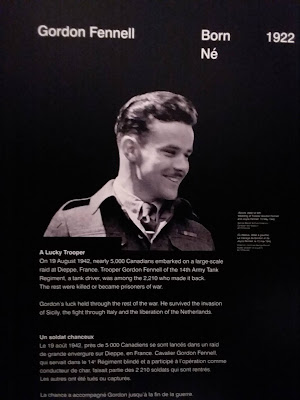
Gordon Fennell was one of the lucky ones, surviving the war after serving throughout.


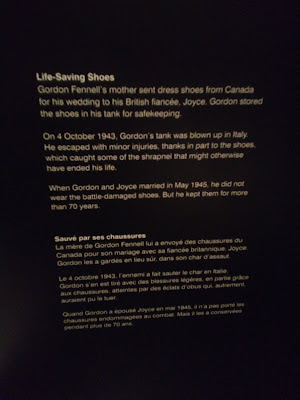
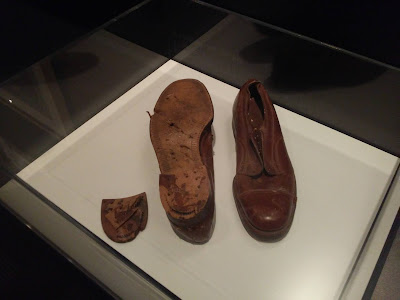
His luck extended to a particular pair of dress shoes, displayed here in the exhibit, and kept for years after the war. They were kept in his tank where they probably saved his life.


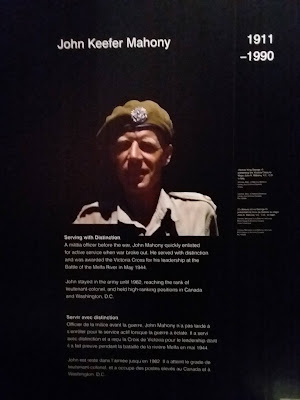
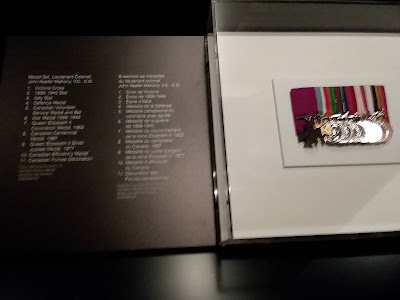
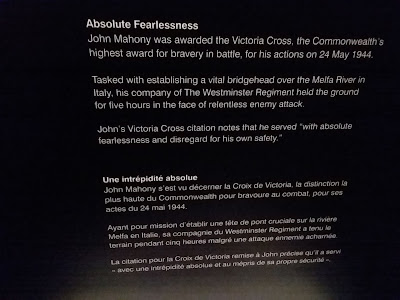
Officers were, by and large, sharing the risks with the men they commanded in each branch of the services. Such was the case with John Mahony, who would be decorated by a king and end up a lieutenant-colonel.


This is his medal set.


Among those medals, the Victoria Cross, for his actions over five hours on May 24, 1944.


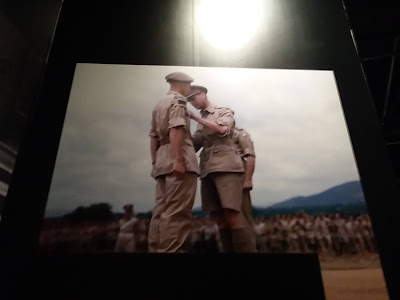
And here's him getting it, from King George VI.


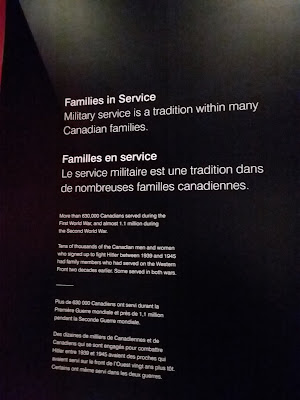
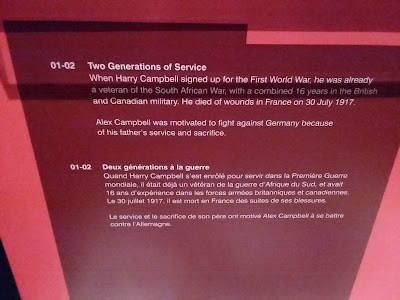
As was the case elsewhere, generations of Canadians served. Fathers who had served in the First World War saw sons do the same in the Second World War.


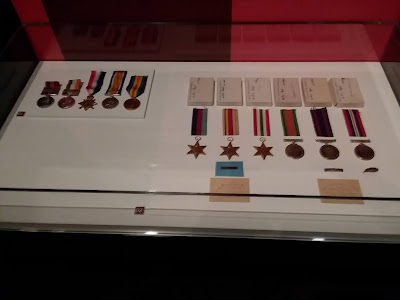
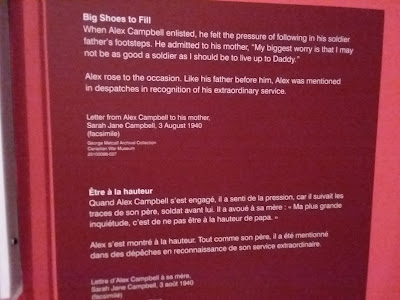
Included below are the medal sets of father and son: Harry Campbell, who served in the South African and First World Wars and died in the second of those conflicts, and those of his son Alex Campbell, mentioned yesterday, who was driven by the death of his father.


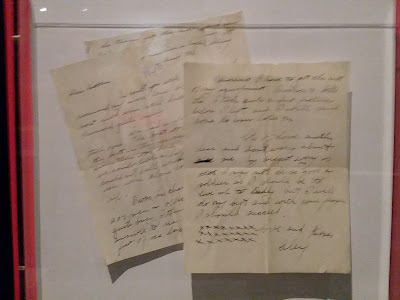
Letters by Alex to his mother are included here.

Friday, July 6, 2018

A Prime Ministerial Residence

Yesterday I featured the neighbour to this building, and today I feature Laurier House, a prominent fixture and National Historic Site here in the Sandy Hill area. The residence of two prime ministers, it is administered by Parks Canada and open to visitors through the summer. It regularly participates in Doors Open. The equipment on the front lawn was only there temporarily- new glass panes were being installed.


This Second Empire manor dates to the 19th century, and starting in 1897 was the residence for Prime Minister Wilfred Laurier and his wife Zoe. She outlived him by a couple of years, and willed it to the new leader of the Liberal Party, William Lyon Mackenzie King, who used it as his in-town residence and pretty much ran the country from his study. Artifacts of the Lauriers and King can be found within. This is the Morning Room on the ground floor.


A small office off this room was used in King's day by the Mounties as a security post. A uniform remains today, while a photograph of King George VI with Queen Elizabeth share the wall with one of Mackenzie King and Winston Churchill. The latter stayed here in Laurier House during wartime visits.


This room is the formal dining room, used by both the Lauriers and King for entertaining.


Laurier House is hosting an exhibit this summer on Josh Silburt, a Canadian editorial cartoonist and artist whose work in the first dates to the 1930s and 1940s, ranging from national to international subjects, with a sly sense of humour to them. Some of his paintings, from after that period, are also included, and I'll show you them in tomorrow's post.