Monday, December 8, 2014
Sunday, December 7, 2014
Jogging My Memory
Looking at this picture, I'm reminded of Long Way Round, the documentary series following Ewan McGregor and Charley Boorman on a motorbike trip around the world. On more than one occasion the two remark on how they don't know this or that about the place they're in. Such is the case with this, taken in the Bytown Museum on Colonel By Day. Usually with a digital camera I'd photograph the display tag as a reminder of what it is for reference in a post, something that'll come in handy, for instance, in an art gallery. Instead I find myself looking at this picture and wondering, "so what was this about again?"
Anyway, the display has something to do with weights and measures, I think (fingers crossed), about blocks in the building of the Canal by Colonel By and his work crew.
Saturday, December 6, 2014
A Haunted Museum?
Stepping into the Bytown Museum today for the first of several posts, we find ourselves looking first into the stone vault, built into the structure a few years after it was erected. The walls in here are thick, and it might remind you of a cell, particularly with that gate.
The building was originally a storehouse and treasury for John By's work on the Canal, and then used as a storehouse for the government for many years after until the 1950s, when the museum took over the structure to house its collection of local history artifacts. The building is as solid as ever, a testament to the skill of the masons who built it. It might be a pleasant place in the day... but night is another matter. The Museum has become a regular stop on the Haunted Walks held here in the downtown core.
There are a few ghost stories here. Lights go on and off by themselves. Footsteps and whispers are heard where there is no one present. Electronic devices behave in odd ways when no one is near them. Dolls in a cabinet are said to have eyes that blink and follow visitors. And some visitors have felt being pushed. Is Colonel By still here? One of his aides? Perhaps some of the thousand odd workmen who died during the building of the Rideau Canal?
Friday, December 5, 2014
Pleasure Boats In The Ottawa Locks
We have another look at boats in the Ottawa Locks from the area around the Museum. Major's Hill Park is at the top of that tree lined bluff, tucked away behind the Chateau Laurier. If you look to the left, you'll see Nepean Point. That figure you can just make out on top of the promontory is the statue of Samuel de Champlain, which I showed you a few days ago.
The park still has the foundations of the home where John By and his family stayed during the Canal's construction. It burned after their return to Europe, but traces of it are still there. Take a look at this post for a look at the site.
Thursday, December 4, 2014
The Rideau Canal And The Chateau Laurier
Alongside the Bytown Museum and the walkway down to the Ottawa River, there are plenty of chances to take in the Rideau Canal here at the Ottawa Locks. Depending on the size of the boats, six of them can fit into a lock at any one time. These boats are heading up from the River onto the Canal, and they have a total of eight locks to travel, ascending a height of 24.1 metres (79 feet) from the river to the passage of the Canal through the city; from here the next set of locks are up at Carleton University. It can take an hour and a half to ascend or descend the locks. Having the Chateau in the background certainly makes for a pleasing image.
I had to look twice at the pic when I first saw it. The person on the forward right side of the nearest boat looked naked.
Wednesday, December 3, 2014
Taking In Two Views Of The Bytown Museum
These two were engaged in colouring a mural that had been hung up on the wall below the Museum as part of the day's festivities. The Museum is the oldest stone building in the city, having had been John By's headquarters during the construction of the Canal. Today it serves as a local history museum, but since Ottawa is the capital of the country, the local history blends together with the national history.
Stepping further back, we get a wider view of the Chateau, the Canal, and the Museum.
Tuesday, December 2, 2014
Above The Ottawa Locks For The Rideau Canal Festival
This shot is taken from Plaza Bridge on Colonel By Day. The Ottawa Locks, as the last (or first) set of locks on the Rideau Canal are called, descend down towards the Ottawa River, nestled between Parliament Hill and the Chateau. The building at the left along the Canal is the lockmaster station, dating back to the 1880s. Down the hill is the Bytown Museum, which was John By's Commissariat when he was overseeing the building of the Canal from 1826-1832. I've shown you the outside before, and we'll see more of it, both inside and outside, to come.
The Canal is a UNESCO World Heritage Site, and Colonel By Day intersects with the final day of the Rideau Canal Festival, marked along the length of the waterway in communities. Here at the Ottawa Locks, as you go along the path down to the river, the day features demonstrations by re-enactors such as blacksmiths and weavers, musical performances on a stage by the Museum, and local history and cultural societies setting up tables with information and items of interest. It's a good way to spend an afternoon getting to know the city's history and heritage, complete with a visit inside the museum.
Compare and contrast the view with one I took from Plaza Bridge in the late summer of 2013, on a quiet day.
Monday, December 1, 2014
City Daily Photo Theme Day: People In Their Workplace
The first day of each month is a theme day for photobloggers from around the world belonging to the City Daily Photo community. For the first of December, the theme is People In Their Workplace. You can find other interpretations of the theme right here.
I was out and about on the Civic Holiday weekend in August. Here in Ottawa we call it Colonel By Day, after John By, the founder of the city and the man who led the construction of the Rideau Canal. It's a busy day at the Ottawa Locks, here where the Canal meets the Ottawa River. I've chosen two people in period clothing as my people in their workplace subjects. They were two of several people in period clothing from the early 19th century, engaging with the public down along the Canal. These re-enactors would be members of local historical societies, but being in those clothes on a hot day certainly rates as a working day. The building in the background is the Chateau Laurier.
I have more shots from Colonel By Day to come in the days ahead.
Sunday, November 30, 2014
Razem Frazem! (Farewell To Old Film)
I could have also titled this post Doctor Strangefilm: How I Learned To Stop Worrying And Love The Red Glow.
I still had a disposable camera lying about with shots I took from the Civic Holiday weekend in August, and had it developed this week. I hadn't had a camera on hand on Canada Day, so I ended up buying a double pack of one time use cameras. Some of the shots came out nicely, and I'll go through them in the next few days (some nice warm weather shots for those of you in the cold). Others? Well, let's just say they looked really weird....
I wasn't sure about posting this one. Though realistically, the problems with the image are merely at the sides. Namely that black edge on the left and the hint of a red glow on the right. The rest of the shot is fine. These two soldiers were standing guard at the War Memorial that weekend. The Memorial has had some additions on it since then, unveiled on Remembrance Day: below the dates of the First World War is a new inscription in metal, in both English and French: in service of Canada. Dates for the Afghan War and the South African War have also been added elsewhere on the Memorial's stone.
Sufficed to say, lesson learned: always have a proper camera close at hand.
Saturday, November 29, 2014
Paper, Politics, Money, And The River
Since I've been spending the last two days speaking about Yousuf Karsh, his brother Malak Karsh was mentioned. Malak became a landscape photographer, travelling across Canada and in other places, photographing the land and the people in astonishing detail in both black and white as well as in colour. Like his brother, he worked late into life, and his skill with the camera was just as good. Wisely in choosing landscape photography, he forged his own path, professionally going by his first name. Between the two of them, they were the best photographers the country has produced.
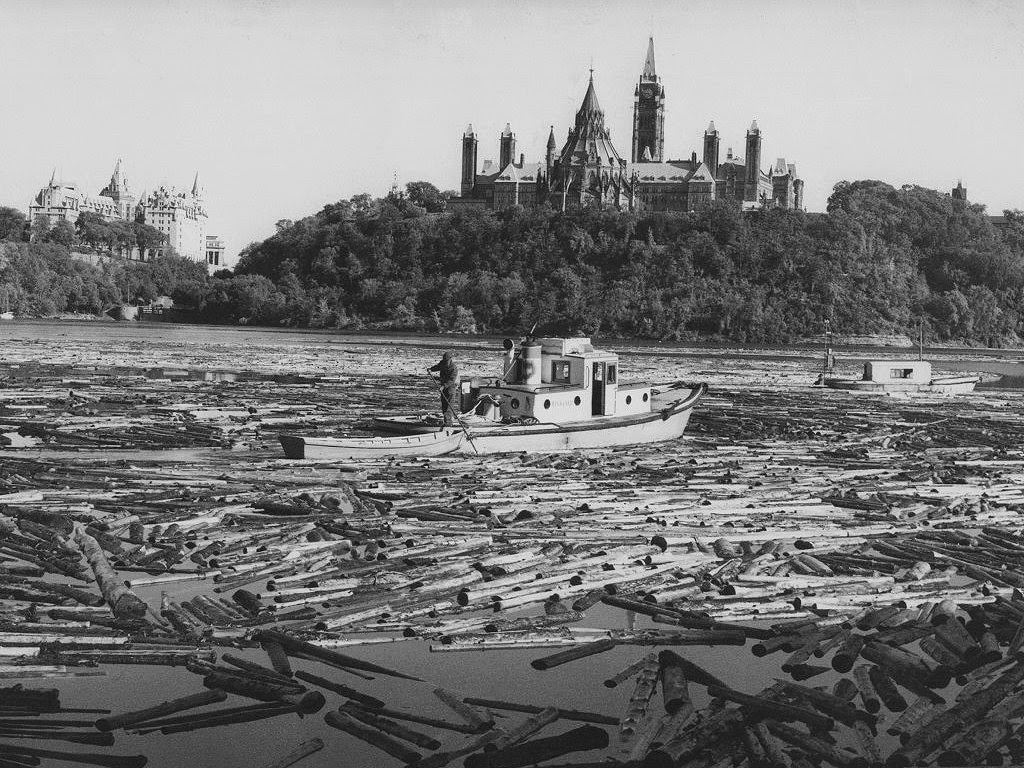
Malak took this photograph, entitled Paper & Politics, in 1963, on the Quebec side of the Ottawa River, looking out at Parliament Hill and the Chateau Laurier. The tugboats were involved in dealing with the breakup of a log boom upstream. This was back in the day when fleets of timber were still floated down the river.
![]() |
| Paper & Politics, by Malak, 1963 |
The two brothers had their work together on the Canadian one dollar bill for many years until it was replaced by the dollar coin in the Eighties. Many Canadians will remember it. One of Yousuf's portraits of the Queen was on the one side. Malak's image above was adapted and engraved onto the other, as you see below.
This is the view today from the same spot; I took it this past May during the Tulip Festival. A bed of tulips has been planted here where Malak took that shot of the Hill and has been named in his honour. It is a fitting tribute to a man who was instrumental in the creation of the festival, and part of the lifeblood of the city and the country.
A reminder to City Daily Photo bloggers: the theme for December 1st is Workers.
Subscribe to:
Posts (Atom)


