Thursday, November 5, 2020

Challenging The Old Order

 The Quebec Referendum of 1995 is as close as the country ever came to breaking up.


There are French speaking communities beyond Quebec, especially the Acadians of New Brunswick. This is the Acadian flag.


The next thematic area is about multiculturalism and diversity. One of the installations here is by a Yemeni-Canadian artist, Laila Binbrek, titled Mirror, Mirror. Two makeup counters back to back feature both sides of her cultural background, Middle Eastern and of the West.


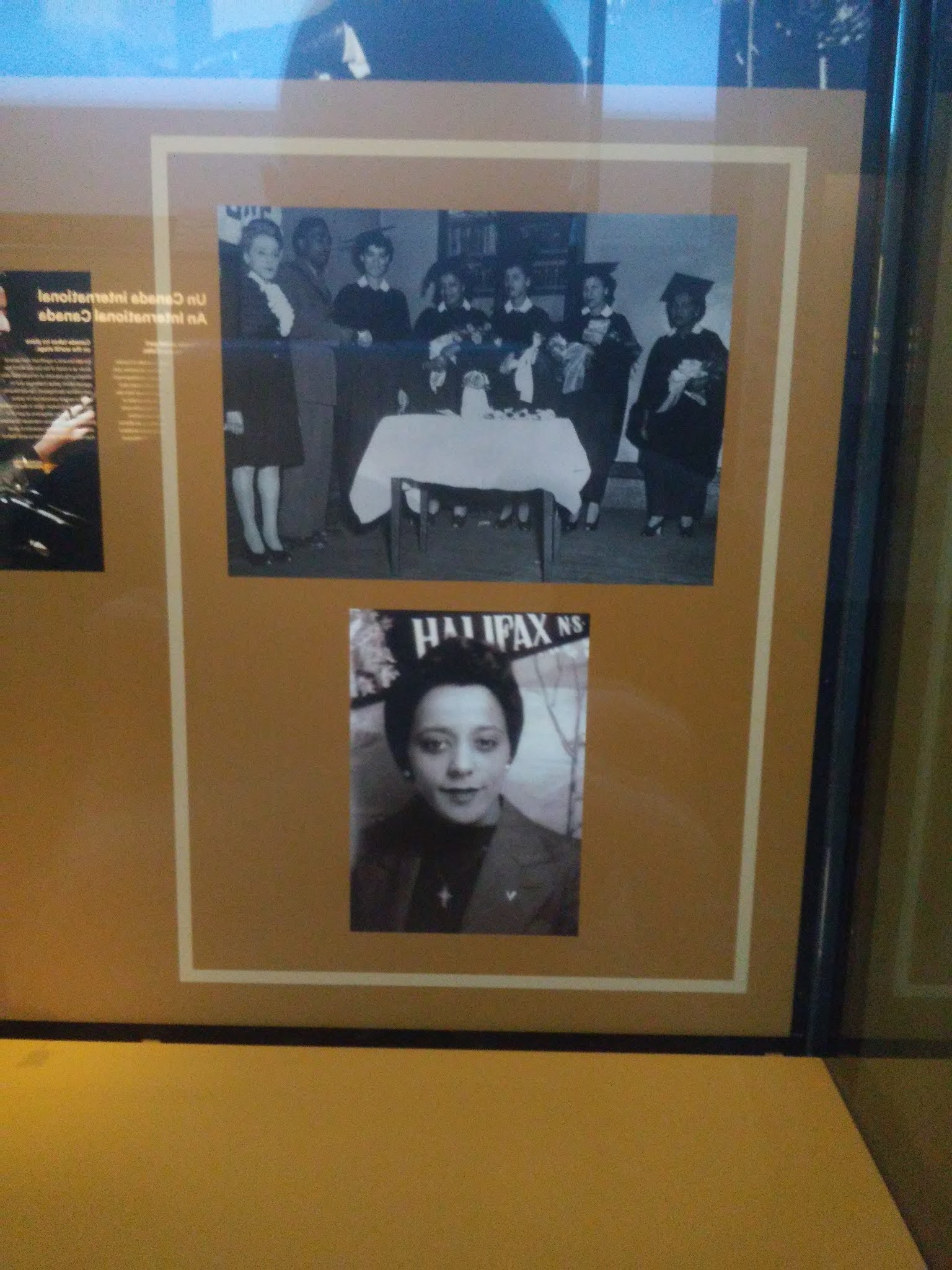
Viola Desmond, a black businesswoman in Nova Scotia, confronted the segregation policy of a movie theatre in 1946. Today she's on the Canadian ten dollar bill.


Accessibility for the disabled is explored here as well, with artifacts that include sledge hockey sticks for paralympian sports, and a model of an accessible playground. We'll pick up here tomorrow.

Wednesday, November 4, 2020

The Question Of A Province

Here we have more art from First Nations artists. There is a rich, vibrant energy to these works.


Quebec and its place in Canada is the next thematic area. In 1967, Charles de Gaulle, the self proclaimed liberator of France, general, president, and narcissistic arrogant egotistical blowhard came to Canada, made a speech and proclaimed, "Vive le Quebec libre" to a crowd outside. It contributed to a nationalist sentiment growing in the province. A real asshole sort of thing to do, frankly, but that term pretty much defined de Gaulle. 

In my personal opinion, Charlie didn't do anything during the Second World War that no one else in the Free French could have managed, and it might have been better for history had some German sniper taken him out in 1940.


The sovereignty movement in Quebec has ebbed and flowed over the years. There have been two separation referendums, both of which were narrowly contested, in 1980 and in 1995.


Prime Minister Pierre Trudeau led the No side in 1980. Books by Trudeau are here, below a screen. A speech given at the time is here, paused at times for remarks from the leader of the Yes side.


His opponent was the premier of Quebec and leader of the Parti Quebecois, Rene Levesque, seen here giving remarks in the legislature. The effect of the two video recordings going back and forth has the feel of a debate between two leaders, in two different places.


In 1995, the Parti Quebecois was back in power, led by Jacques Parizeau, with allies in Ottawa under Lucien Bouchard, the leader of the sovereignist Bloq Quebecois. Another referendum was called for.


The No side was led by Quebec Liberal leader Daniel Johnson, bolstered by the federal government of Jean Chretien.


Two marionettes are here. This is Parizeau.


And this is Chretien.


More tomorrow. If you don't hear from me, assume I've been strangled to death by the vengeful ghost of Charles de Gaulle.

Tuesday, November 3, 2020

Hope, Truth, And Reconciliation

Before starting off today, I'd like to address my neighbours south of the border. I try not to get political here, but on behalf of the majority of the planet, would you please vote that narcissistic, incompetent, dementia ridden con artist out of office today? A return to sanity would be much appreciated.

Carrying on. In April 1980, Terry Fox started what was called the Marathon of Hope, dipping his foot in the Atlantic at St. John's, Newfoundland, and intending to make a run across the country to the west coast to raise money for cancer research. He had lost a leg to the disease, and his quest caught the attention of the country as whole.


He was forced to stop his run near Thunder Bay, and cancer would take his life the following year, but he left a huge legacy behind. Runs in his name continue to raise money each year for the battle against cancer.


One of his shirts is here.


How we relate to our American neighbours is examined as well. The quote accompanying this photograph is from Pierre Trudeau, the father of the current Prime Minister.


The signing of the North American Free Trade Agreement is seen here.


The Museum's concluding area is thematic in nature, with several different themes examined. First we deal with the state of First Nations peoples, through history to the current time. This map shows how many residential schools there were in the country, into the 1990s. Children were taken from their homes, in the attempt to integrate them, regardless of the damage done to them or their families. It is a stain on our history we're still grappling with.


The Truth And Reconciliation Commission was formed to come to terms with the fallout of residential schools. This quotation from its chair is on one of the walls here.


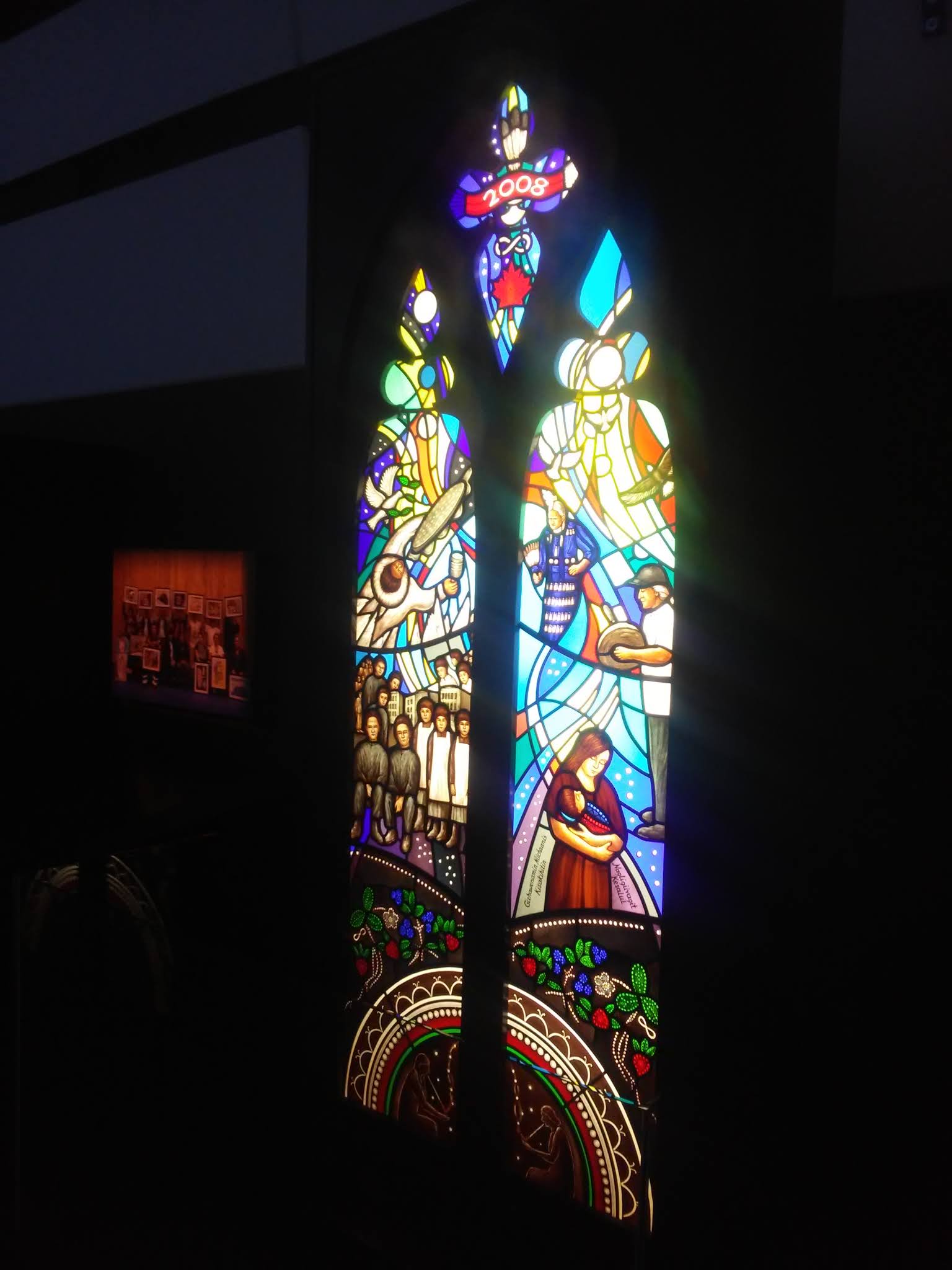
Giniigaaniimenaaning (Looking Ahead) is the title of this stained glass window. It's one of a duplicate pair, with the other placed inside Centre Block on Parliament Hill. It was commissioned to recognize the impact of residential schools on survivors and their families. The artist is Christi Belcourt, done in 2013.


Among the items here is this powow attire I've shown you before. Amanda Larocque is a Mi'kmaq performer of fancy dance, a specific powow style. This is one she's used.

Monday, November 2, 2020

A Country Finding Its Own Course

The panels and displays on World War Two continue here. 


Following the War, in 1949, Confederation expanded when Newfoundland joined the nation. This tapestry shows the island dominion.


It was an initiative spearheaded by Joey Smallwood, the politician who became the premier of the province, and thus considered the final Father of Confederation.


As was the case elsewhere, the post-War years saw much change in society. Display cases here include artifacts reflecting that change. This electric guitar was given to the Museum by Randy Bachman, guitarist for the Canadian rock band The Guess Who.
 

A photograph of Joan O'Malley is included here. She played a pivotal role in part of the country's direction in the 1960s.


There was at the time a debate about a change to the national flag. O'Malley sewed the three prototypes of the flag for the Prime Minister's consideration.


And this is the machine she sewed them on.


Here is one of the other variants.


This is not one of hers, but a flag sewn by a young Canadian at the time.


This gown, with its red leaves on white, was the work of a diplomat's daughter. Marjorie Gehl wore it to several functions during the centennial year of 1967.

Sunday, November 1, 2020

City Daily Photo Theme Day: Kindness

The City Daily Photo theme for the beginning of November is Kindness, and you can see how others are interpreting this theme right here.

I am choosing three locations today. Campbell House lies in Centretown, and dates to 1883. It was the residence of Sir Alexander Campbell, a lawyer, politician, and Father of Confederation. Today it houses offices.


As you'd expect, there's a historical plaque commemorating Campbell.


But there's another historical plaque here, commemorating another resident decades later, Colonel Elizabeth Smellie, a military nurse who resided here. The very profession of nursing involves acts of kindness, and felt appropriate to the theme.


Moving on a few blocks north, a statue stands at one of the entrances to Parliament Hill. Henry Harper's final act in life was one of kindness, sacrifice, and bravery, trying to save the life of a young woman who fell through the ice on the Ottawa River. His life is commemorated with this statue, done in the Galahad style, with plaques in English and French. 


An inscription in the stone quotes Tennyson's The Holy Grail: "Galahad... cried, 'if I lose myself, I save myself.'"


A short walk away along the Sparks Street pedestrian mall is this entrance, with a bas relief plaque to the left. 56 Sparks Street was the address for the Unitarian Service Committee of Canada, still operating today and founded in 1945.


Its founder was Lotta Hitschmanova, seen here on the bas relief. She was a refugee from Europe who came to Canada during the Second World War and who would dedicate the rest of her life to humanitarian service. I'll have more about her as I continue my series from the Canadian Museum of History.