Tuesday, November 10, 2020

Museum Finale

 The Hartland Covered Bridge is found in New Brunswick.


The L'Anse aux Meadows site is featured here, with a reconstruction of the Viking settlement in Newfoundland built alongside the site of the original, proof that Norsemen were in North America centuries before Columbus sailed across the ocean.


And the last of these is something to be found in many parts of Canada: a First Nations ceremonial dancer.


Coming out of the corridor brings us to this plaster cast of Chief Of The Undersea World, by Haida artist Bill Reid, a stylized depiction of the killer whale and a worthy companion to his Spirit Of Haida Gwaii, down in the Grand Hall.


Here we have a final view of the Grand Hall from above.


When I started this series I mentioned that I'd made two visits to the Museum. These were taken on my arrival outside during the second visit, a brighter day than the first one.


Between the two wings of the Museum, the Ottawa skyline beckons, with the Chateau Laurier and Parliament Hill dominating the horizon.


And this is the last shot for this tour, taken at the end of my second visit, as twilight was starting to show, looking back at the exhibit wing's main entrance. I hope you've enjoyed this extended tour of the Canadian Museum of History. I hope to be back here again in the not so distant future.

Monday, November 9, 2020

Canadian Images

Here we have another view of St. Onuphrius from above as we start departing the Museum's Canada Hall. 


Along with more of the large scale photographs of scenes across Canada.


The ramp leads down to the central hub, with another view of Canada in map form on the floor below.


The corridor leading out features more of the scenes of Canada that I showed coming in, a combination of mirrored surface and white overlay to show a scene. This is the Carleton Martello Tower in New Brunswick.


And this is Cape Spear in Newfoundland and Labrador, the easternmost point in North America, excluding Greenland. I conclude this visit to the Museum of History tomorrow.
 

Sunday, November 8, 2020

Justice And Hope

 One of the darkest chapters of the world during the 1990s was that of the Yugoslavian wars. Canadian soldiers were there as peacekeepers throughout, and a Canadian judge, Louise Arbour, was the chief prosecutor of war crimes committed there. Among her other accomplishments would be time spent as a member of the Supreme Court of Canada.


This is a standard gown used for members of that tribunal.


The way out leads us past a rooftop view of St. Onuphrius Church.


Along the path are large photographs of Canada and Canadians.


This one, with a Canadian soldier interacting with Afghan children, particularly catches my eye.

Saturday, November 7, 2020

Service In The World

Reconciliation: The Peacekeeping Monument is located in Ottawa, and it's been awhile since I last featured it. I did photograph it recently with fall colours.


9/11 was a day that shocked the world, and it meant Canadians went to war in Afghanistan.


Humanitarian work is another kind of service, and this is well exemplified by Lotta Hitschmanova, who came to Canada as a refugee in 1942 and founded the Canadian branch of the Unitarian Service Committee, still active today. This is her uniform.


Disaster response is another humanitarian work, and the response by many Canadians to the Haiti quake of 2010 is examined here. Displays include items connected to Canadians on the ground during the aftermath of the quake.

Friday, November 6, 2020

Resilience And Activism

Rick Hansen is one of our most extraordinary stories. A track and field athlete who became a paraplegic after a spinal cord industry, he became an activist and philanthropist, capturing the imagination of the country and the world in his Man In Motion wheelchair journey around the world from 1985-87. 


The place of Canada in the world is the last thematic area, explored in a multitude of ways. One of the measures successive Canadian governments took was a stand of principle against the South African apartheid system, going back to the Diefenbaker government.


The poster here was for a solidarity workshop in Bolton, Ontario. Prime Minister Brian Mulroney maintained the stand against apartheid through his time in office, even if it meant taking a different approach than allies like Margaret Thatcher or Ronald Reagan.


Nelson Mandela never forgot the support from Canadians in general and Canadian governments in particular. He was designated an honourary Canadian right here at the Museum in 2001.


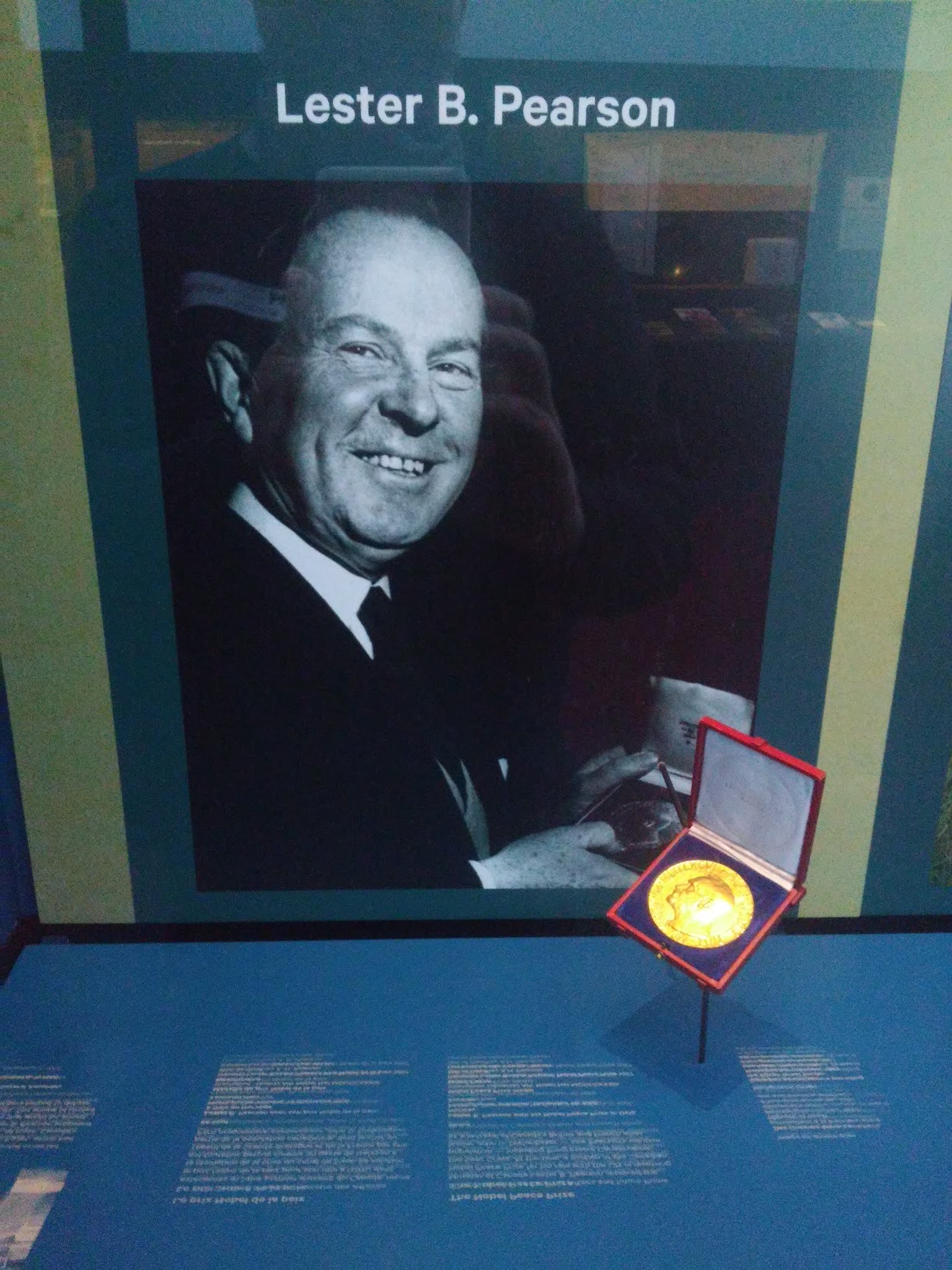
Lester Pearson, our foreign minister at the time and later one of our best Prime Ministers, was integral in the creation of the concept of peacekeeping during the Suez Crisis. He would win the Nobel Peace Prize for his efforts.


One of the displays here details the contributions of Mark Isfeld, a Canadian soldier, peacekeeper, and combat engineer killed by a landmine in Croatia. Items here include a knitted doll, something made by his mother and handed out to children in places he was working in.


The Ottawa Treaty, a measure meant to eliminate landmines, has been ratified by many countries, but not all- the United States, Russia, and China are among the holdouts.