Sunday, June 22, 2014

Churches On Cathedral Hill

I have shown you St. Peter's Lutheran Church during my series on the Tulip Festival. It is one of two churches here on Cathedral Hill, on the west side of the downtown core. This present incarnation of the church dates back to 1952, but there was a previous location elsewhere downtown. It's designed in the English Gothic style, and features a Casavant organ inside.


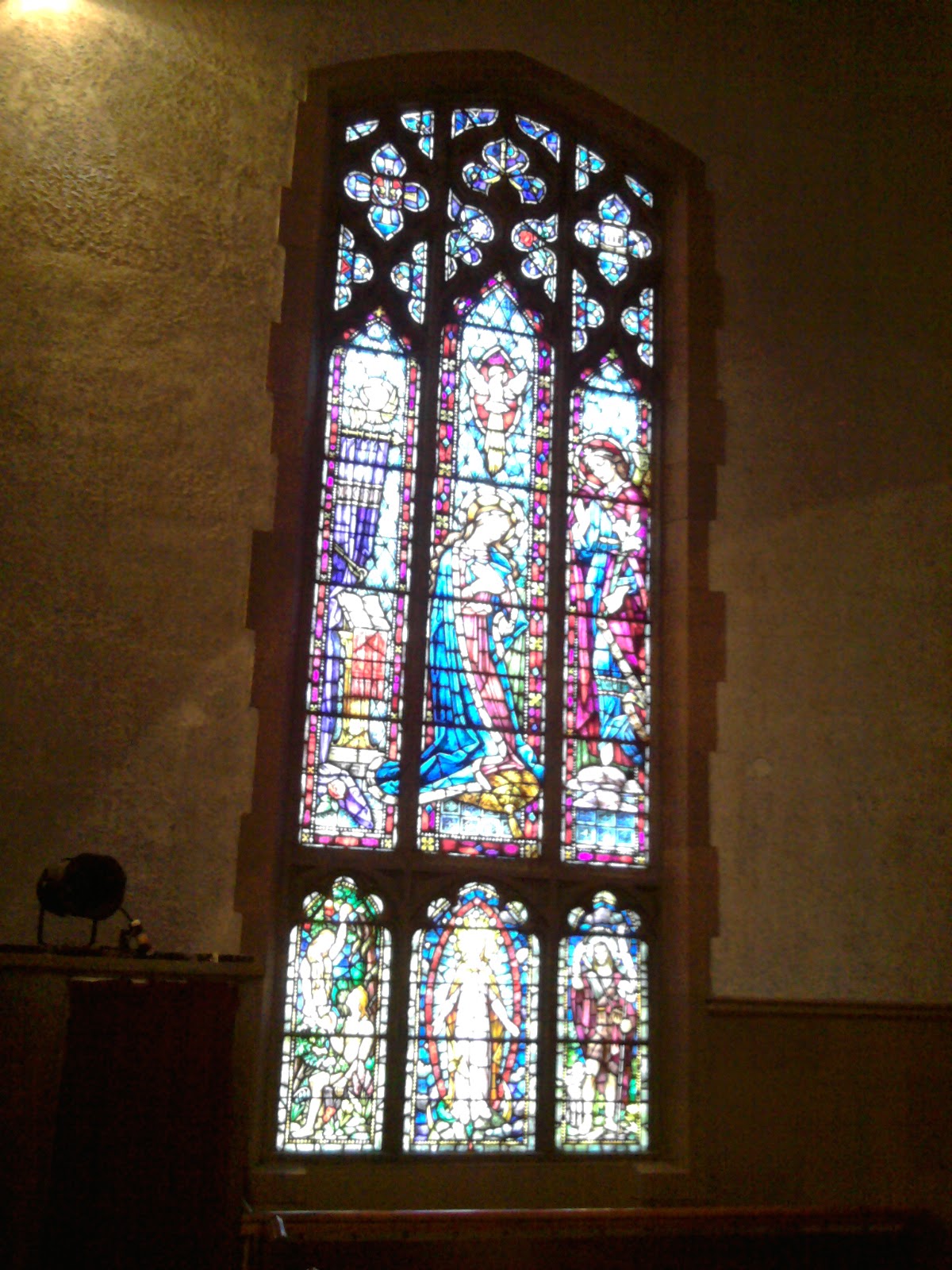
For whatever reason, shots of the sanctuary itself didn't come out properly, but these stained glass windows worked. The first is one of several inside, depicting Biblical scenes.


The second features historical figures from the Lutheran church in Canada, as well as landmarks and references to Lutheran work done here.


And this last window is dedicated to music; Martin Luther is flanked by the composers George Handel and Johann Sebastian Bach, both of whom composed extensive sacred music. Luther is surrounded by key aspects of his own history, while Bach and Handel have elements of music incorporated into the glass around them.


The neighbouring church on the hill is Christ Church Cathedral, an Anglican congregation. The current church dates back to the 1870s, though the congregation's roots stretch back to 1832. 


It's also in the English Gothic style.


The high altar inside the sanctuary is impressive.


More from inside Christ Church tomorrow. I'm linking this today to Inspired Sunday. Click on that link for other blogs posting places of religious significance.


Saturday, June 21, 2014

The First Day Of Summer?

To quote that immortal philosopher Bugs Bunny, ain't I a stinker? 


I took these shots during a couple of stormy days back in March. These first two are in Old Ottawa South.


This quiet path is in Little Italy, looking quite snowbound.


St. Anthony's Church looks quite chilly, doesn't it? Compare it to when I last showed it to you.


Laurier Avenue downtown also looks windswept. Lovely, lovely, lovely cold white snow...


These flags were flowing in the wind at Carleton University.


The view out the windows in the library gave me quite a pleasant view too towards the Rideau Canal. Now if you'll excuse me, I'm sure there are more than a few people thinking right now of having me drawn and quartered. I'll be back into Doors Open related material tomorrow. 


Friday, June 20, 2014

A Garden On High Ground

The C.D. Howe Building is a modern office complex a block south of Parliament Hill, home to government offices. It's named after a Liberal cabinet minister who served continuously under two prime ministers from 1935-1957. The elevators took me up to the roof.


Across the street below, there's another glass building, but there's something else inside it- an old building entirely encased in the new building. I'm not sure if it's accessible, but I'll have to find out. If I'm right, the Currency Museum is in there- one place I haven't been to yet.


The roof of the C.D. Howe Building is something different. Thirty percent of it is green roof technology. Another thirty percent is landscaped with indigenous shrubs, flowers, and grasses. 


It's a nice, serene spot to come up to relax... at least for the government workers. Doors Open is the only weekend the public can get up here.


And it has nice views. The Alexandria Bridge, Gatineau, the Ottawa River, and Parliament Hill can be seen from here. The Parliamentary block on the right is the West Block, undergoing restoration and construction work. The block on the left is one part of Parliament Hill that I haven't shown you yet. It's called the Confederation Building.


Thursday, June 19, 2014

Contrasting Sanctuaries

Today we have two very different sanctuaries, both participating in Doors Open again this year. The Christian Science sect has this church downtown. It dates back to 1913, and was designed in a Classic Italian style.


The organ is down at front, sunken into the floor at the base of the pulpit.


A few blocks west stands the Church of St. Barnabas, of the Anglican denomination. It combines Byzantine and Romanesque influences, and dates back to 1931.


The baptismal chapel is just off the sanctuary.


The church is a mix of styles, with iconography that you might expect in an Orthodox church set against a more austere backdrop. Here we have the high altar.


This icon definitely reminds me of Orthodox work.


A Nativity painting can also be found here. I rather liked the look of it.


Wednesday, June 18, 2014

St. Matthew's Anglican

Across the street from the High Commission for Trinity And Tobago is St. Matthew's Anglican Church. It's a magnificent building of stained glass windows, a soaring sanctuary, and a side chapel. The church was built during 1929 and 1930, and is an example of English ecclesiastical architecture. While I was inside, recorded choir music was playing in the sanctuary.


Tuesday, June 17, 2014

Diplomatic Relations

The High Commission for Trinidad and Tobago is here in the Glebe, housed in a century old building that was once occupied by Bell as a telephone exchange. A High Commission is the same as an embassy- it's just the term used if you're a member of the Commonwealth having a diplomatic mission in another Commonwealth country.


It's brightly decorated inside, a combination of office space and reception space featuring cultural items of the two Caribbean islands. I imagine this fashion statement might only be taken out for special occasions.


This reception hall no doubt gets used often. The High Commission regularly participates in Doors Open each year, but this was my first year stopping in.


A short walk away is Vietnam House. It's the home of the Vietnamese ambassador, a Spanish Colonial design on a quiet street in the Glebe. This is also one of the homes designed by architect W.E. Noffke.


This was its first year participating in Doors Open. 


Monday, June 16, 2014

The Avalon Studio

Blessed Sacrament is a Catholic church in the Glebe. It was participating in Doors Open again this year. I haven't been inside before. The church dates back to 1932, and incorporates elements of Roman design, with an altar featuring Greek monograms.


A short walk away was another destination. The Avalon Studio opened last year. There was a full scale theatre called the Avalon in this part of the Glebe for decades, until it was gutted and turned largely into retail. The bones of the building are still there, though, and for some reason, the fly gallery of the old performance space was left untouched.


The guys who run the place were looking for studio space for acting lessons, and this place suited them. They're the two up above in this second photograph. They told me that the purpose of a learning center here has met their expectations, and that they completely underestimated the demand for a small performance space. The Avalon Studio is well booked for months to come.


The space is quite versatile for performances; depending on what's going on, music or theatre, they can fit between sixty to eighty audience members in here. It's a marvelously preserved old space, and for so long went unnoticed.